


Editor’s Note: We asked authors of Original Investigations to provide short plain-language summaries that would briefly summarize what inspired their study, the basic approach taken, what was learned, and why it matters. We hope our readers will find this valuable in helping them keep up with the latest research in the field of nephrology.
Highlights from the July 2026 issue:
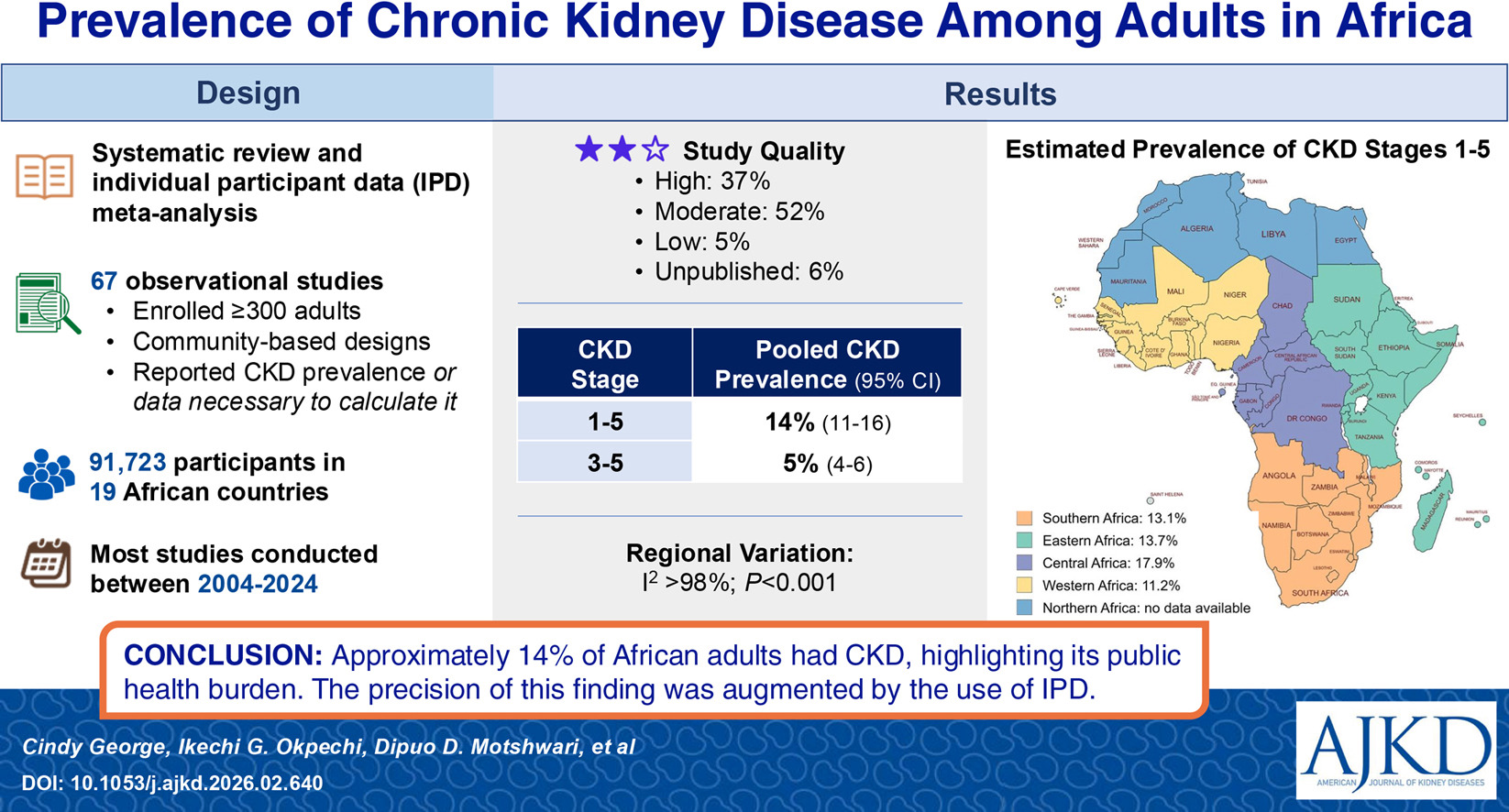
Prevalence of CKD Among Adults in Africa: A Systematic Review and Meta-Analysis
by Cindy George et al. [OPEN ACCESS]
DOI: 10.1053/j.ajkd.2026.02.640
EDITORIAL: CKD in Africa: A Call to Urgent, Coordinated Action by Robert Kalyesubula et al. [FREE]
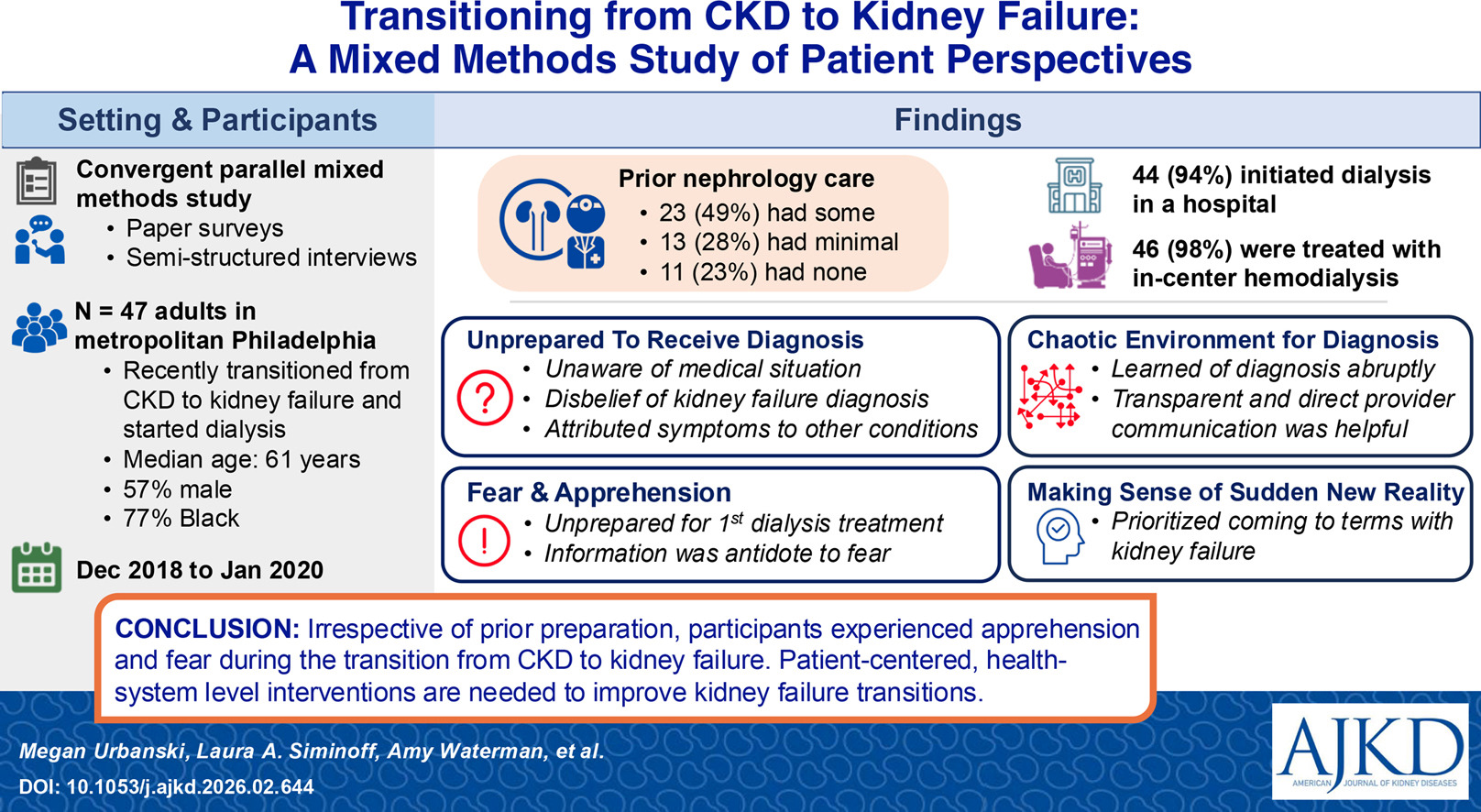
Transitioning From CKD to Kidney Failure: A Mixed-Methods Study of Patient Perspectives by Megan Urbanski et al. [OPEN ACCESS]
From the authors: The progression from chronic kidney disease to kidney failure and dialysis is a challenging time for patients. We sought to understand the experiences of patients—those who had received prior kidney disease care and those who had not—during this transition to kidney failure and dialysis treatment. We interviewed and surveyed 47 patients in metropolitan Philadelphia within 5 months of their dialysis initiation to understand and compare their experiences. Nearly all participants described this transition as traumatic and chaotic, even those who had received prior kidney disease care. This study underscores the need for patient-centered, health system–level programs that equip patients with the knowledge, resources, and support necessary to cope with this major life change and ultimately improve patient outcomes.
DOI: 10.1053/j.ajkd.2026.02.644
EDITORIAL: The Need to Stress Patient Distress in Transitioning to Dialysis by Tamara Glavinovic and Deborah Zimmerman [FREE]
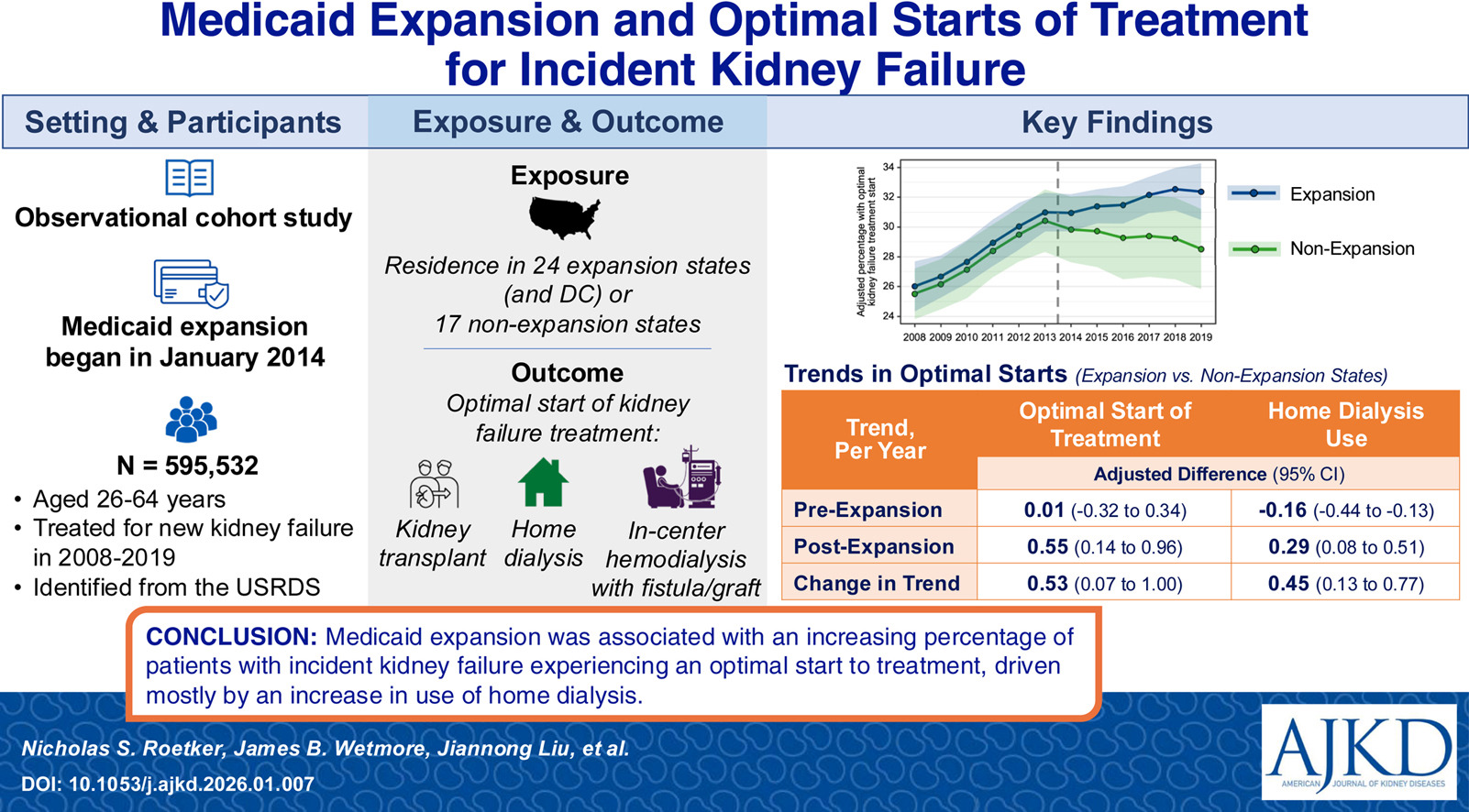
Medicaid Expansion and Optimal Starts of Treatment for Incident Kidney Failure
by Nicholas S. Roetker et al. [OPEN ACCESS]
From the Authors: This study examined whether the expansion of Medicaid eligibility in 2014 led to improvements in the percentage of patients receiving an optimal start to treatment for new-onset kidney failure (ie, kidney transplant before the need to start dialysis, initiation of home dialysis, or initiation of in-center hemodialysis using an arteriovenous access). We compared trends from 2008 to 2019 across US states that expanded Medicaid and those that did not. Before 2014, both groups showed a similar upward trend in optimal starts. However, after Medicaid expansion, states that expanded Medicaid continued to experience an increase in optimal starts whereas states that did not expand showed a decrease over time. Much of the difference was explained by a larger increase in the use of home dialysis in states that expanded access to Medicaid. Our findings suggest that expanding Medicaid may lead to better initial treatment for kidney failure.
DOI: 10.1053/j.ajkd.2026.01.007
Risks of Hypocalcemia and Other Bone Mineral Disorders for Denosumab Versus Zoledronate Across the Spectrum of Kidney Function: A Target Trial Emulation by Ruowei Xiao et al. [OPEN ACCESS]
From the Authors: Denosumab is a drug used to prevent fractures, but it can affect calcium, phosphate, and parathyroid hormone levels in the blood. We studied adults aged 50 years or older in Stockholm, Sweden, to examine whether these risks differ by kidney function. Compared with zoledronate, denosumab was associated with higher risks of low calcium, low phosphate, and high parathyroid hormone levels. These adverse events occurred mainly within the first 2 weeks after starting treatment and were largely limited to people with moderate to advanced chronic kidney disease. Our findings suggest that patients with chronic kidney disease treated with denosumab should receive careful monitoring of mineral and hormone levels, especially at treatment initiation.
DOI: 10.1053/j.ajkd.2026.02.642

Cystatin C and Creatinine–Based Estimated GFR and Disease Activity Biomarkers in Rheumatoid Arthritis by Sho Fukui et al. [OPEN ACCESS]
From the authors: Rheumatoid arthritis (RA) is a chronic inflammatory joint disease that can also affect the kidneys. Doctors often check kidney function using blood tests for creatinine or cystatin C, but inflammation and RA medications may influence these tests differently. We studied patients with RA who began either a conventional drug combination (triple therapy) or a tumor necrosis factor (TNF) inhibitor. We measured kidney function and inflammation markers over a 6-month period after the treatment. We found that both cystatin C-based and creatinine-based estimates of kidney function were unchanged overall. An analysis of trial participants who received triple therapy showed an increase in cystatin C-based kidney function, along with a decrease in 1 inflammatory biomarker, TNF receptor 1 (TNFR1); however, the creatinine-based estimates remained unchanged. Understanding how RA treatment and inflammation affect kidney function tests may help develop better ways to monitor kidney function in people with inflammatory diseases.
DOI: 10.1053/j.ajkd.2026.01.014

Core Curriculum in Nephrology in the July 2026 issue:
Obesity in CKD: Core Curriculum 2026 by Holly J. Kramer et al.
DOI: 10.1053/j.ajkd.2026.02.641
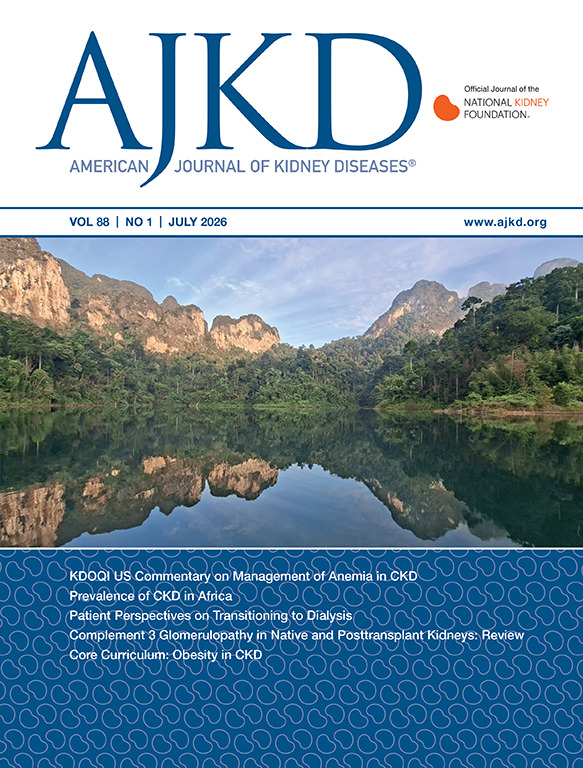
Like a reflection on still water revealing more than meets the eye, target trial emulation brings real-world clinical experience into clearer focus by aligning observational data with clinical decision-making. While it does not replace randomized controlled trials, it offers a pragmatic complement, capturing treatment effects in broader and more representative populations where trials are often limited or infeasible. In this issue, Xiao et al show that denosumab, compared with zoledronate, is associated with higher risks of hypocalcemia, secondary hyperparathyroidism, and hypophosphatemia—particularly among patients with reduced kidney function. These findings underscore the need for careful monitoring when using denosumab in patients with CKD.
Special thanks to Editorial Intern Elias Elenjickal for curating the cover image and drafting the cover blurb for this issue. The photo “Sunrise Reflection at Khao Sok” © 2026 is by Harold Feldman. Reproduced with permission.
Special Collection: Kidney Transplantation
The editors present this special collection of articles focused on the kidney transplantation.