
World Kidney Day 2026: Caring for People, Protecting the Planet
Ana Flavia Moura, MD, PhD, FASN, is a nephrologist based in Salvador, Bahia, Brazil. She is a Professor at the Bahiana School of Medicine and Public Health. She currently serves her second term as President of the Bahia Regional Chapter of the Brazilian Society of Nephrology and is Vice-Director of the Hypertension Department of the Brazilian Society of Nephrology. She is also a member of the Scientific Council of the Brazilian Society of Hypertension and of the ISN Young Nephrologists Committee. She is part of the Visual Abstract Editorial Board of the ASN journals (JASN, CJASN, and Kidney360).
José A. Moura-Neto, MD, PhD, FASN, FACP, FRCP (Lon), is a nephrologist based in Salvador, Bahia, Brazil. He is President of the Brazilian Society of Nephrology (2023–2024; 2025–2026) and Professor at the Bahiana School of Medicine and Public Health. He holds a PhD in Medicine, a Master’s degree in Management (FGV), and an MBA in Health Management (FGV). Dr. Moura-Neto has edited eight books in nephrology, including Nephrology Worldwide (2021), and serves on the editorial boards of Blood Purification, CJASN, JASN, and Kidney360.

Chronic kidney disease (CKD) affects approximately 13% of the global population and is among the fastest-growing causes of disease and death worldwide. Despite its high prevalence and substantial impact, CKD remains underdiagnosed and poorly recognized by the general population. This is largely due to its silent nature. In most cases, patients do not experience symptoms until they reach more advanced stages of the disease, when valuable opportunities for prevention and slowing disease progression have already been lost. As a result, millions of people worldwide receive a late diagnosis, leading to avoidable suffering, increased cardiovascular risk, premature mortality, and rising costs for healthcare systems. In this context, addressing kidney health, prevention, early diagnosis, and equitable access to care is essential. This has been the guiding mission of the World Kidney Day (WKD) campaign since its inception.
 Established in 2006 by the International Society of Nephrology (ISN) and the International Federation of Kidney Foundations (IFKF), WKD is celebrated annually on the second Thursday of March. In 2026, the campaign marks its 20th anniversary. To commemorate this symbolic milestone, the chosen theme is “Kidney health for all: Caring for people, protecting the planet,” reflecting contemporary challenges in nephrology. The 2026 theme acknowledges that kidney health cannot be dissociated from social, economic, and environmental dimensions. It proposes an integrated vision that values person-centered care while also drawing attention to the environmental impact of CKD, particularly that associated with kidney replacement therapy (KRT).
CKD disproportionately affects vulnerable populations, especially in low- and middle-income countries, where access to screening strategies, early diagnosis, and specialized care is limited. Despite the availability of simple and low-cost tests, such as serum creatinine measurement and routine urinalysis, CKD often remains undetected at early stages, even in high-income countries.
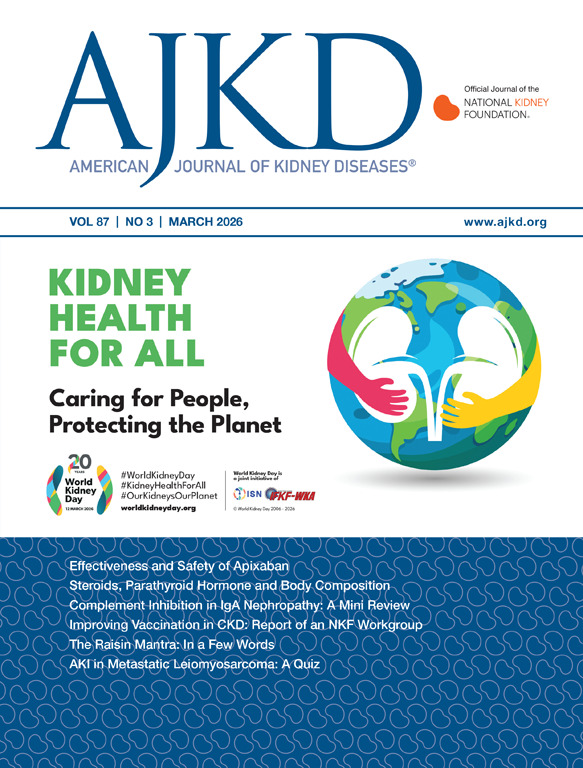
AJKD March 2026 cover celebrating World Kidney Day
Failure to diagnose CKD in its early phases has profound consequences. Late diagnosis is associated with poorer quality of life, higher cardiovascular risk, increased mortality, and a growing number of patients requiring KRT. From a public health perspective, this translates into increased pressure on already overstretched healthcare systems, widening health inequities, and rising costs. From a human perspective, it means lives affected by disease progression that, in many cases, could have been prevented or delayed.
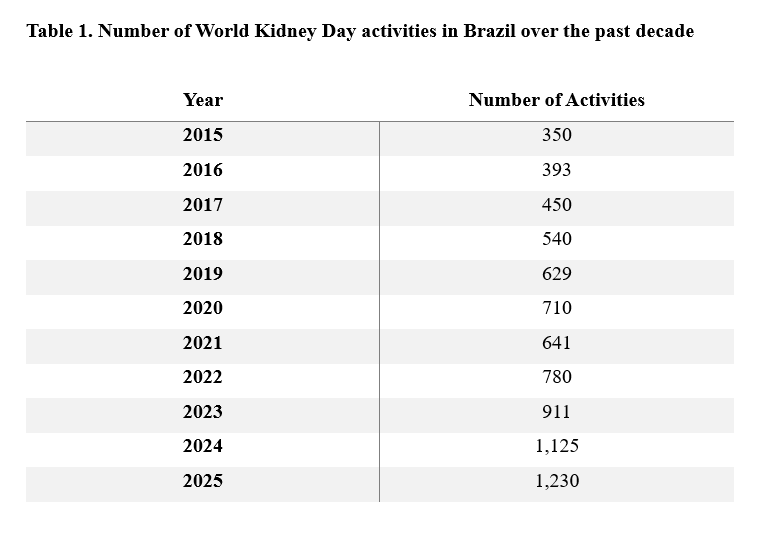
In Brazil, the Brazilian Society of Nephrology currently coordinates the largest WKD campaign in the world. The number of activities has increased steadily over recent years (Table 1), and since 2024, more than 1,000 initiatives have been carried out annually across the country. These activities include community walks, educational events, illumination of public landmarks in the campaign’s colors, distribution of informational materials, blood pressure measurements, and serum creatinine testing among at-risk populations.
In 2025, 8,374 individuals with risk factors for CKD had their point-of-care serum creatinine measured during WKD activities conducted in 40 major Brazilian cities. More than 3,370 participants – representing nearly 40% of those tested – presented abnormal creatinine values and were referred for medical follow-up and diagnostic confirmation of CKD. For 2026, it is estimated that more than 1,400 activities will be held in multiple Brazilian cities in March for the WKD campaign. Point-of-care serum creatinine testing will again be performed, this time accompanied by a confirmatory 3-months later serum creatinine testing and urinary albumin-to-creatinine ratio (uACR) assessment, allowing more accurate monitoring and confirmation of newly diagnosed CKD cases.
Beyond these impressive numbers, the Brazilian experience highlights two central outcomes of WKD: a population that is progressively more informed about kidney health and healthcare professionals who are increasingly engaged in CKD prevention and early diagnosis. Together, these elements form a critical foundation for sustainable kidney care strategies, particularly in countries marked by significant regional inequalities and constrained healthcare resources.
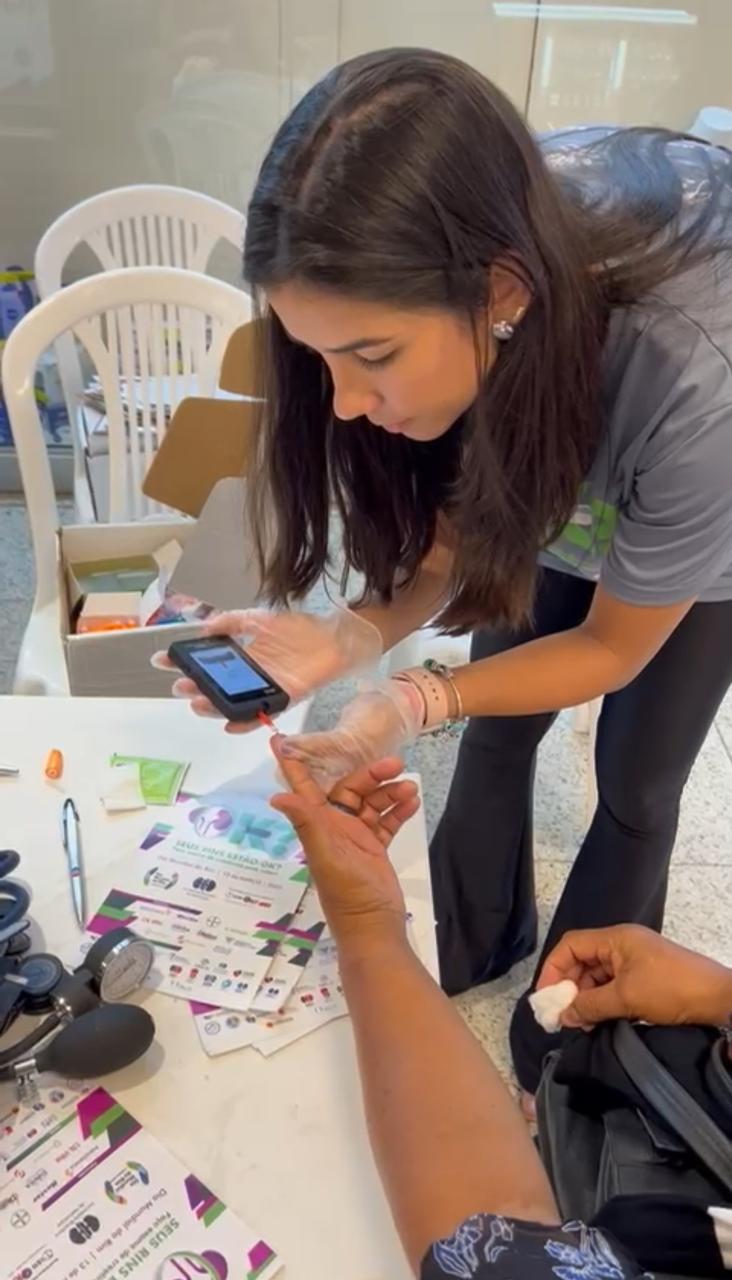
Dr. Moura participating in the Brazilian Society of Nephrology’s screening campaign for at-risk patients.
As the global prevalence of CKD increases, so does the demand for KRT, particularly dialysis. Although dialysis is a life-saving treatment, hemodialysis in particular requires substantial amounts of water and energy and generates significant volumes of plastic and biomedical waste. Recent studies have shown that dialysis is among the healthcare sectors with the greatest environmental impact, contributing substantially to greenhouse gas emissions, potable water consumption, and waste generation. A single hemodialysis session may consume hundreds of liters of water, much of which is discarded during water treatment processes. When multiplied by millions of sessions performed annually worldwide, this impact becomes considerable.
The theme of WKD 2026 invites a necessary reflection: investing in CKD prevention and early diagnosis is an effective clinical, social, and environmental strategy. Preventing or delaying progression to kidney failure reduces the need for dialysis, lowers healthcare costs, and mitigates the environmental impact associated with KRT. At the same time, it is essential to incorporate sustainability as a core principle of innovation in nephrology. This includes optimizing dialysis processes, reducing waste, rethinking supply chains, promoting the use of renewable energy sources, and valuing home-based care modalities whenever possible. These strategies must be implemented equitably, ensuring that the pursuit of sustainability does not create new barriers to access to treatment.
Healthcare professionals, medical societies, policymakers, industry, and patient organizations share this responsibility. WKD offers a unique platform to align strategies, expand dialogue, and transform awareness into concrete action. Two decades after its creation, the 2026 campaign reinforces that promoting kidney health means caring for people throughout the life course while simultaneously protecting the planet that sustains healthcare systems. Investing in prevention, early diagnosis, equitable access, and sustainable practices is essential to improve outcomes today and secure a healthier future for the next generations.
WKD 2026 is not only a celebration of achievements. Above all, it is a call for collective responsibility, innovation, and action.
– Post prepared by Ana Flavia Moura and José A. Moura-Neto
During the preparation of this work, the authors used ChatGPT (version 5.2), accessed via https://chatgpt.com/c/697a4e36-1b70-832b-84c2-0acb6ecd95b2, to improve language and readability. After using this tool, the authors reviewed and edited the content as needed and take full responsibility for the content of the blog post.

Leave a Reply