
#NephMadness 2026: Animal House – Cats, Kidneys, and the Art of Surviving on Almost No Water
Submit your picks! | @NephMadness | @nephmadness.bsky.social | NephMadness 2026
Autumn Harris
At NC State University, Dr. Autumn Harris investigates how kidneys regulate acid-base balance and what drives kidney disease progression. Her clinical trials seek earlier diagnosis and better treatments for chronic kidney disease in dogs and cats—advancing both veterinary care and comparative nephrology.

Competitors for the Animal House Region
Team 1: Dogs
vs
Team 2: Cats
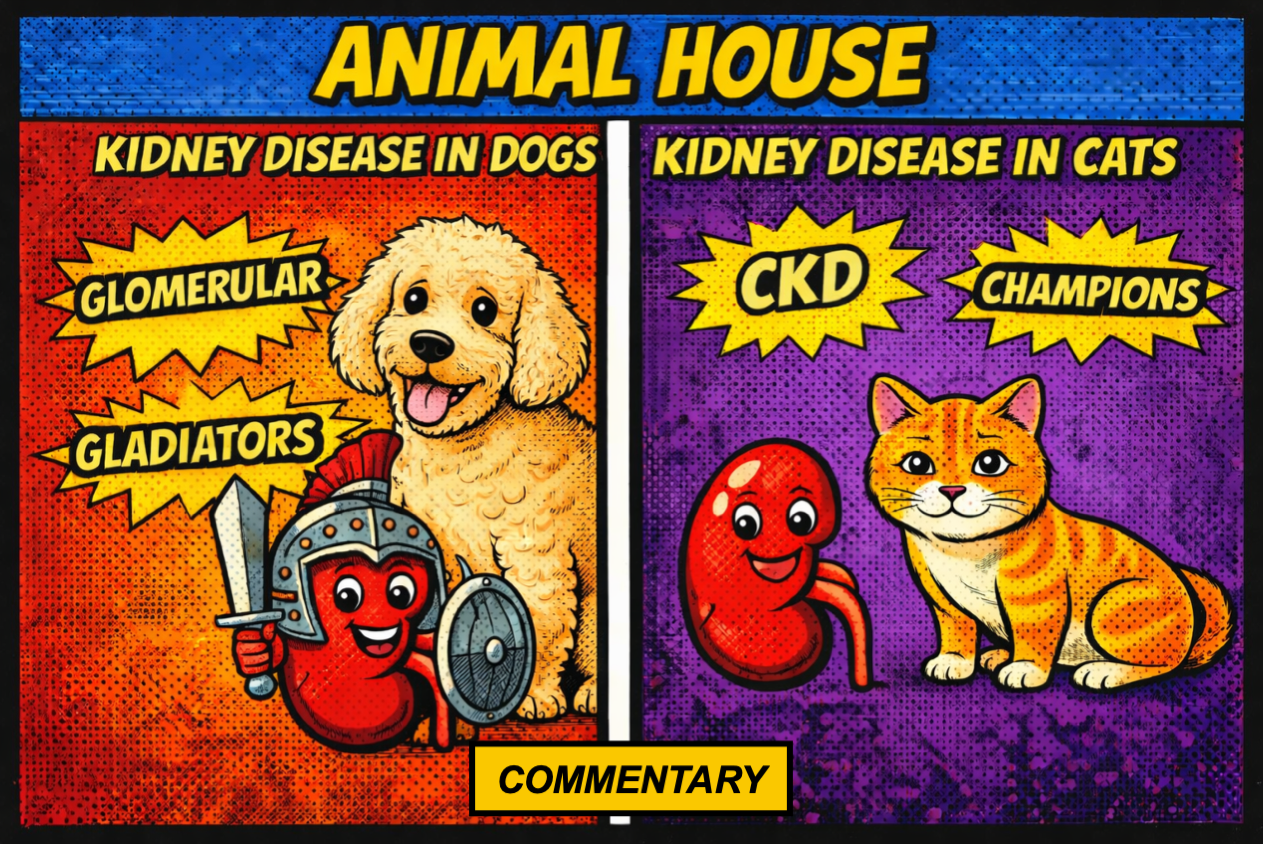
Image generated by Matthew Sparks using ChatGPT at http://chat.openai.com, February 2026. After using the tool to generate the image, Sparks and the NephMadness Executive Team reviewed and take full responsibility for the final graphic image.
The Animal House Region returns once again to one of nephrology’s most enduring themes: how organisms adapt their kidneys to survive in environments that relentlessly challenge water and electrolyte balance. Across species, kidneys tell evolutionary stories — stories written in loops of Henle, medullary gradients, and the quiet math of osmolality.
As August Krogh famously noted, “for every biological problem, there is an organism best suited to solve it.” Few problems are as fundamental as conserving water while maintaining internal homeostasis, and few organisms solve it as elegantly as the domestic cat.
Cats are desert carnivores, descended from ancestors that evolved in arid landscapes where free water was scarce, and survival depended on extracting the maximum value from every meal. Long before cats became household companions, their kidneys were already masterpieces of efficiency. A high proportion of long-loop nephrons, an expanded renal medulla, and powerful urea recycling allow cats to generate urine with osmolalities that routinely exceed those of humans and most other domesticated animals. From a nephrologist’s perspective, this is not merely adaptation; it is specialization.
But specialization comes with consequences.
The same physiological traits that allow cats to conserve water so effectively may also predispose them to kidney disease later in life. Chronic kidney disease is extraordinarily common in cats, particularly with aging, affecting the majority of geriatric felines. Unlike dogs, whose kidney diseases often center on glomerular pathology and proteinuria, feline CKD is typically a disease of the tubulointerstitium. Nephrons are lost quietly through fibrosis, vascular rarefaction, and gradual nephron dropout. The glomerulus often remains structurally unremarkable until late in the disease course.
This slow, silent progression is precisely what makes cats such powerful models for contemporary nephrology.
Feline CKD mirrors the dominant form of kidney disease seen in humans today: non-glomerular, progressive, age-associated, and deeply intertwined with overall health and quality of life. Appetite loss, dehydration, anemia, constipation, and hypertension often shape outcomes more than any single laboratory value. Management strategies emphasize nutrition, hydration, and symptom control, underscoring that nephrology is as much about preserving function and well-being as it is about extending survival.
Cats also highlight the downstream effects of renal dysfunction on mineral metabolism. Their predisposition to calcium oxalate urolithiasis, phosphate imbalance, and hypertension underscores the kidney’s central role in maintaining systemic equilibrium. These features resonate strongly with human CKD, where disturbances in mineral metabolism and vascular health drive both morbidity and progression. It is no coincidence that emerging therapies in feline CKD, including gut-directed approaches aimed at reducing uremic toxin generation, parallel growing interest in the gut–kidney axis in human disease.
Dogs have played, and continue to play, an essential role in nephrology. They have taught us invaluable lessons about glomerular disease, immune-mediated injury, and inherited renal disorders. But cats occupy a different, increasingly relevant niche. They embody the long arc of kidney disease, one defined by efficiency, endurance, and the cumulative cost of adaptation over time.
So in this Animal House matchup, my vote goes to Team Cat.
Not because cats are friendlier or more cooperative, they are famously independent but because their kidneys tell a story that feels strikingly familiar. A story of organs optimized for survival in harsh conditions, operating at the edge of physiological possibility. A story of aging, tradeoffs, and resilience.
Cats may walk by themselves, but their kidneys walk a path nephrologists know all too well.
– Guest Post written by Autumn N. Harris, DVIM, DACVIM (SAIM), DACVNU
As with all content on the AJKD Blog, the opinions expressed are those of the author of each post and are not necessarily shared or endorsed by the AJKD Blog, AJKD, the National Kidney Foundation, Elsevier, or any other entity unless explicitly stated.
Click to read the Animal House Region
Submit your picks! | @NephMadness | @nephmadness.bsky.social | NephMadness 2026

Leave a Reply