
#NephMadness 2026: IgA Nephropathy – The Bench is Loaded, but is There a Clear Star?
Submit your picks! | @NephMadness | @nephmadness.bsky.social | NephMadness 2026
Jonathan Barratt
Jonathan Barratt is a Professor of Renal Medicine at the University of Leicester in the UK. His research is focussed on a bench to bedside approach to improving our understanding of the pathogenesis of IgA nephropathy. He is the IgA nephropathy Rare Disease Group lead for the UK National Registry of Rare Kidney Diseases (RaDaR), Convener of the International IgA Nephropathy Network and lead for the KDIGO IgA Nephropathy Guideline.

Competitors for the IgA Nephropathy Region
Team 1: B-Cell Modulators
vs
Team 2: Complement Inhibitors
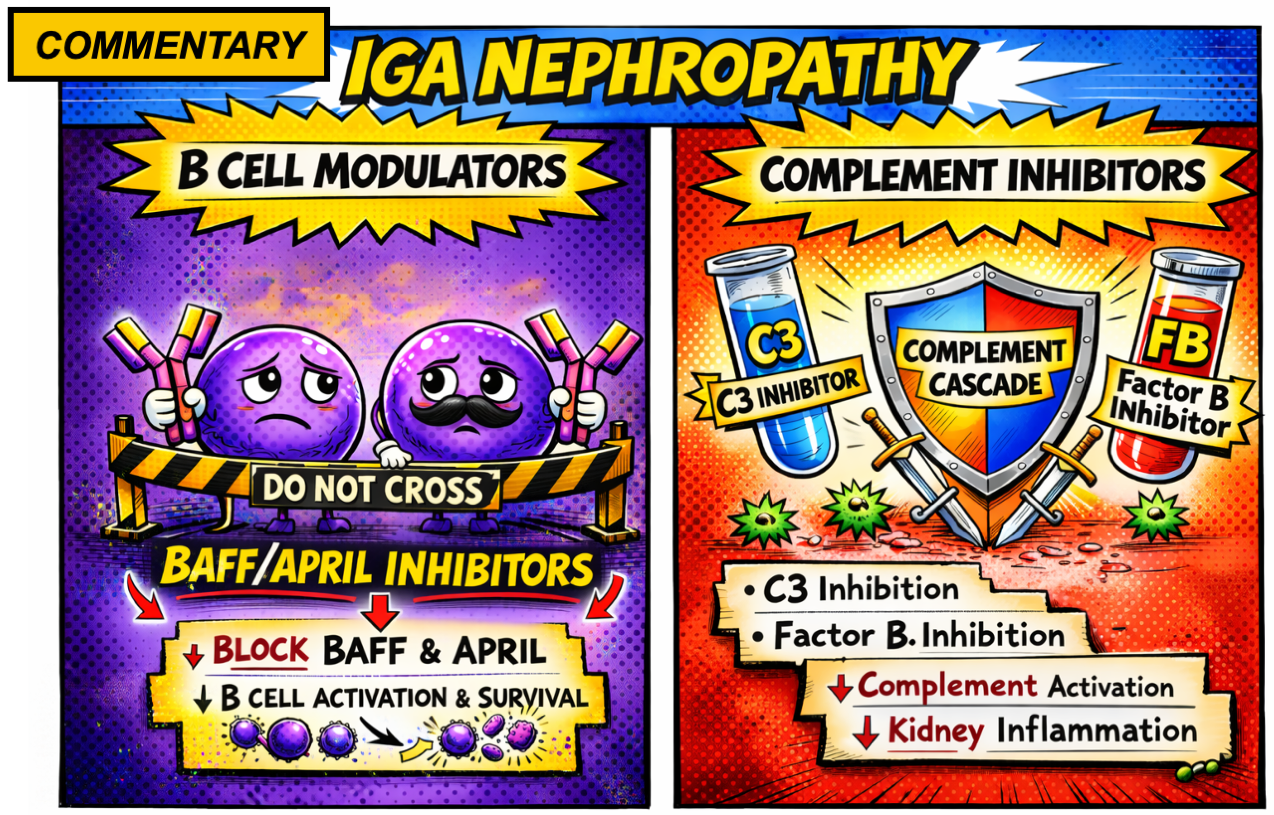
Image generated by Matthew Sparks using ChatGPT at http://chat.openai.com, February 2026. After using the tool to generate the image, Sparks and the NephMadness Executive Team reviewed and take full responsibility for the final graphic image.
IgA Nephropathy is back at it in NephMadness–but did it ever leave? Anyone attending any kidney disease conference on the planet knows that IgA nephropathy will have had at least one podium spot and likely many more at every meeting (where was this for the first 25 years of my career!). As we see more phase 3 trials reporting their interim and 2 year data the question being asked most commonly is – “Is there a winner?”. Competition is hotting up, I can’t imagine there isn’t a week goes by without you being asked to discuss these new therapies or attend a seminar on the newest agent out there. In 2026 the US is likely to get at least another 2 approved drugs for IgAN to add to the 5 approved therapies they already have and access to these drugs will undoubtedly spread out to the rest of world slowly but surely. So the question for this NephMadness is: B cell directed treatment or complement blockade for IgAN……..?
IgA nephropathy is at it’s heart an immune complex mediated glomerular disease and fundamental to it’s pathogenesis is the production of pathogenic IgA molecules, so targeting antibody production makes perfect sense-right? Failure of rituximab in IgAN did make us think hard about this approach, but evolving data from the new drugs targeting BAFF and/or APRIL, the two key B cell cytokines, are getting us more confident that a B cell directed approach is the right approach. Consistently across this drug class we have seen clinically relevant reductions in proteinuria, haematuria and the pathogenic form of IgA1, Gd-IgA1 in phase 2 and phase 3 studies. Currently, however we do not have 2-year eGFR data from any of the phase 3 trials to be confident that these early efficacy signals do indeed translate to meaningful protection of kidney function. We also have limited safety data for this new class of drugs and it is unclear how long term suppression of B cell and plasma cell function will impact on infection risk. This is important as every study has shown that this drug class does not “cure” IgAN and once this treatment is stopped the disease returns quickly and behaves in exactly the same way as it did before treatment. Is this an approach we want to commit our 30 year old IgAN patients to for the rest of their lives?
Anyone who has ever attended a kidney biopsy meeting will know that almost universally for every bit of IgA deposited within the glomerulus there is accompanying C3, indicative of IgA immune complex mediated complement activation. Across all the complement mediated kidney diseases we know that complement activation is bad news for the glomerulus, and likely the tubulointerstitium as well. Complement inhibition has revolutionized the treatment of atypical haemolytic uraemic syndrome and we have recently seen transformative data supporting complement inhibition in C3G, another contender in NephMadness 2026. So how about IgAN? There are early data showing that inhibition of both the alternative and terminal complement pathways is efficacious in IgAN. Inhibiting complement activation leads to clinically significant reductions in proteinuria, haematuria and urine biomarkers of complement activation. Again, however, we do not have 2 year eGFR data from any of the phase 3 trials to be confident that these early efficacy signals do indeed translate to meaningful protection of kidney function. Unlike BAFF and/or APRIL inhibitors we do have longer term safety data, with complement inhibition now having being used for >15 years both as a monotherapy and in combination with other immunosuppressants. The initial fears of life-threatening infections with encapsulated bacteria have almost entirely been mitigated by stringent vaccination and prophylactic antibiotic policies. Intriguingly complement proteins have been identified as key components of circulating IgA immune complexes and there are early data suggesting that the complement composition of IgA immune complexes could influence the propensity for mesangial IgA deposition and the nephritogenicity of IgA immune complexes. So could complement inhibition actually slow down mesangial IgA accumulation?
Until we have mature eGFR data with these agents the jury is out in my opinion. I want to return the rate of loss of kidney function in my IgAN patients to that seen in a healthy person- that may be possible with either approach but my guess is for the majority of patients we are going to need combination therapy- both disease modifying drugs and “CKD” drugs to get close to this target and many patients we will need to combine disease modifying therapies- the question then becomes is the combination safe and is it affordable!
– Guest Post written by Professor Jonathan Barratt, PhD, FRCP
As with all content on the AJKD Blog, the opinions expressed are those of the author of each post and are not necessarily shared or endorsed by the AJKD Blog, AJKD, the National Kidney Foundation, Elsevier, or any other entity unless explicitly stated.
Click to read the IgA Nephropathy Region
Submit your picks! | @NephMadness | @nephmadness.bsky.social | NephMadness 2026

Leave a Reply