
Highlights from the March 2025 Issue
Editor’s Note: We asked authors of Original Investigations to provide short plain-language summaries that would briefly summarize what inspired their study, the basic approach taken, what was learned, and why it matters. We hope our readers will find this valuable in helping them keep up with the latest research in the field of nephrology.
Highlights from the March 2025 issue:
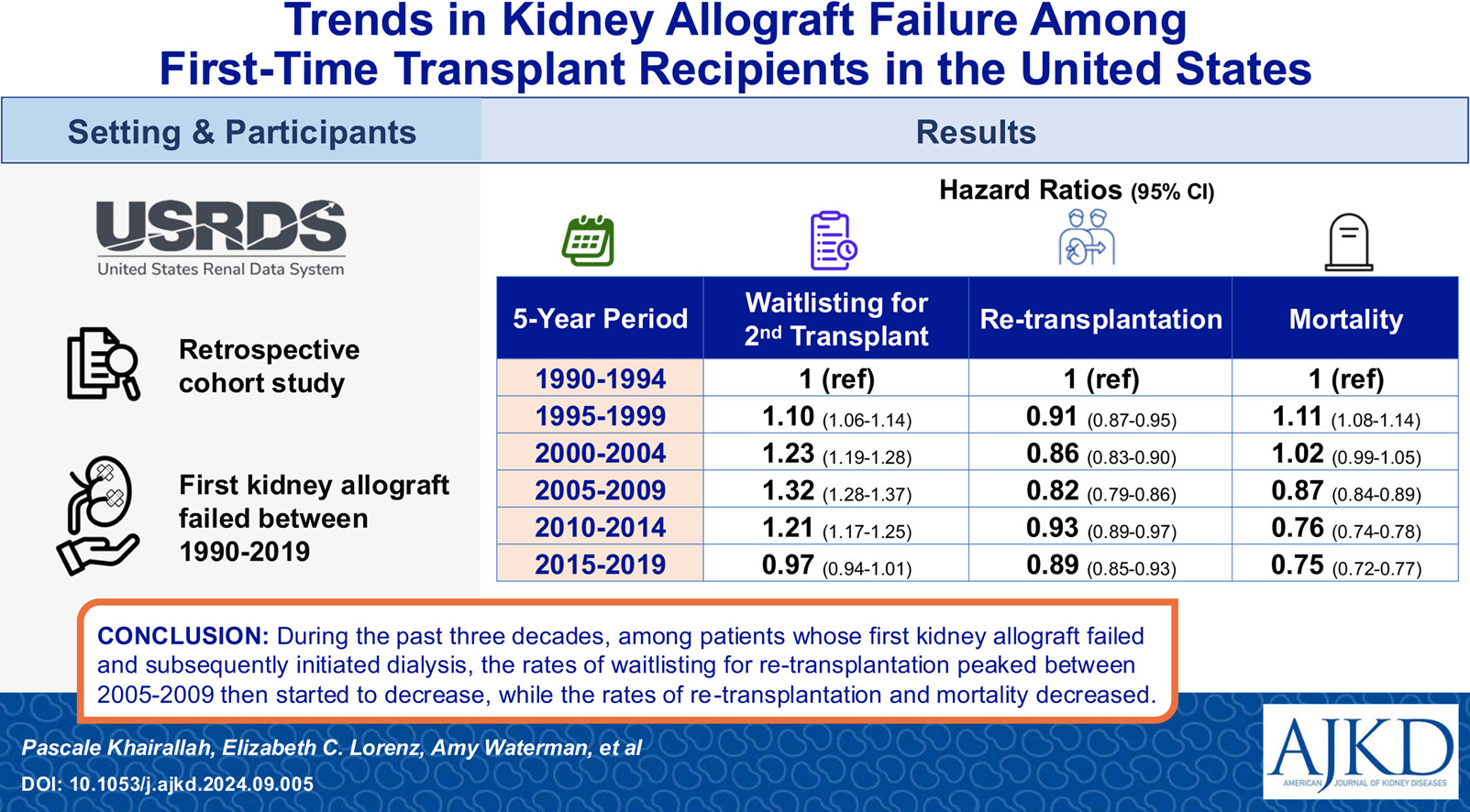
Trends in Kidney Allograft Failure Among First-Time Transplant Recipients in the United States by Pascale Khairallah et al. [OPEN ACCESS]
From the authors: Kidney allograft failure constitutes the fourth most common cause of dialysis initiation in the United States, and it accounts for 4% to 10% of yearly new dialysis starts globally. Little is known about the trends in the outcomes of patients whose kidney allograft failed. We studied US patients whose first kidney allograft failed between 1990 and 2019 to understand trends in waitlisting for retransplantation, retransplantation, and all-cause mortality after kidney allograft failure. Among patients whose first kidney allograft failed and started dialysis, rates of waitlisting increased and rates of retransplantation and mortality decreased over the past 3 decades. We found racial, ethnic, and sex-based disparities in outcomes. Compared with White patients, African American and Hispanic patients had significantly lower rates of waitlisting, retransplantation, and mortality. Women also had lower rates of waitlisting and retransplantation compared with men.
DOI: 10.1053/j.ajkd.2024.09.005
EDITORIAL: Does the Transplant System Fail Patients Following Kidney Allograft Loss? by Anne M. Huml et al. [FREE]
Patient Education for CKD and Decision Support in Primary Care: Findings From the EPIK Pilot Study by Julie Wright Nunes et al.
From the authors: Most patients who have chronic kidney disease (CKD) are not aware of their illness. Few studies have explored whether patient education can increase patients’ knowledge about CKD or influence patients’ satisfaction with the care or communication they receive from their physicians. This study tested whether a short CKD education intervention implemented by the patient’s physician was associated with patients’ greater awareness of their CKD as well as their satisfaction with care and communication. This pilot study found that a decision aid for patients with CKD was implementable in a primary care setting. Patients who received CKD education felt more satisfied with their care and communication with their physicians compared with patients who did not receive the education.
DOI: 10.1053/j.ajkd.2024.10.005
EDITORIAL: Decision Aids in Kidney Care: The Need for Interventions Addressing Kidney Disease in Marginalized Populations by Delphine S. Tuot et al. [FREE]
Intensive Home Blood Pressure Lowering in Patients With Advanced CKD by Elaine Ku et al.
We conducted a pilot trial to test the feasibility of lowering blood pressure (BP) intensively through the use of home BP monitoring in patients with low kidney function. We found that home BP monitoring used to guide antihypertensive medication dosing permitted better BP control for patients with chronic kidney disease and did not appear to be associated with major adverse events.
DOI: 10.1053/j.ajkd.2024.08.010
AJKDBlog COMMENTARY Exploring the Optimal Blood Pressure Target in Advanced CKD by Nozaina Mahmood and Efren Chavez Morales [FREE]
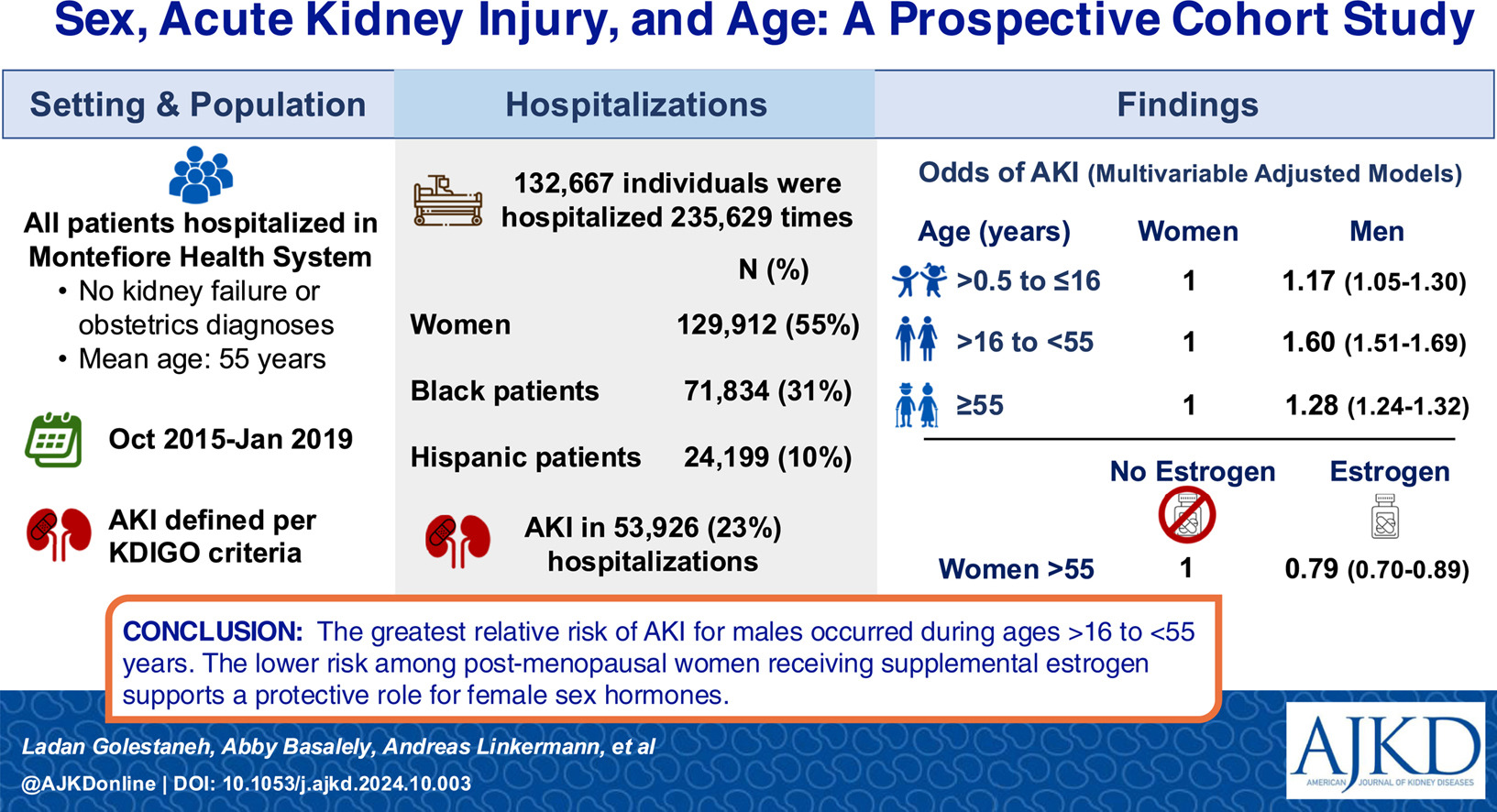
Sex, Acute Kidney Injury, and Age: A Prospective Cohort Study by Ladan Golestaneh et al.
From the authors: Male sex is a risk factor for acute kidney injury (AKI) in animals, but in human studies this association is not as robust. We studied hospitalizations at a single center to examine the association of hospital-acquired AKI and sex. After controlling for various sources of potential bias and stratifying by age categories through the life course, we observed that men have a higher risk of AKI throughout life. This risk was especially high compared with women of fertile age and older women prescribed estrogen. This pattern was consistent in prespecified subgroups of hospitalizations. These results support a protective role for female sex hormones in the occurrence of hospitalized AKI.
DOI: 10.1053/j.ajkd.2024.10.003
Glomerular Filtration of Creatinine: Validation of a Novel Index of Muscle Mass Among Older Adults by Tatsufumi Oka et al.
From the authors: Low muscle mass is common among older adults and is associated with poor clinical outcomes. Quantifying muscle mass is challenging in routine clinical practice. We evaluated whether glomerular filtration of creatinine (GFcr) could serve as an index of muscle mass. We performed a cross-sectional study including 794 older adults who underwent computed tomography for thigh muscle lean area as a directly measured indicator of total body muscle mass. Significant positive associations between thigh muscle lean area and both measured GFcr (serum creatinine [Scr] ×measured glomerular filtration rate [GFR]) and estimated GFcr (Scr ×estimated GFR based on serum cystatin C [Scys]), a more practical index, were shown. These findings suggest the value of using eGFcr, a simply obtained novel index in the clinical setting, to assess muscle mass among older adults.
DOI: 10.1053/j.ajkd.2024.09.013
Clinicopathologic, Proteomic and Outcome Characteristics of Renal Apolipoprotein C-II Amyloidosis: A Case Series by Samih H. Nasr et al.
From the authors: Amyloidosis derived from apolipoprotein C-II (AApoCII) is very rare, and data on clinicopathologic and outcome characteristics are scant. This study of 25 patients with AApoCII diagnosed by mass spectrometry at the Mayo Clinic Tissue Proteomics Laboratory revealed that most patients were elderly White females who presented with proteinuria and reduced kidney function, without involvement of other organs. A family history of kidney disease was often lacking. Pathologically, most cases exhibited nodular glomerular involvement. Proteomic analysis revealed abundant protein spectra for Apo C-II and amyloid signature proteins, and identified an Apo C-II variant in over half of cases (most commonly the p.Lys41Thr variant). The cumulative incidence of kidney failure was over 50% at 5 years follow-up. Only 4 deaths occurred over an average follow-up period of 76 months.
DOI: 10.1053/j.ajkd.2024.09.007

Review in the March 2025 issue:
Biomarkers of Rejection in Kidney Transplantation by Scott G. Westphal and Roslyn B. Mannon [FREE]
Alloimmune injury is a major cause of long-term kidney allograft failure whether due to functionally stable (subclinical) or overt clinical rejection. These episodes may be mediated by immune cells (cellular rejection) or alloantibody (antibody-mediated rejection). Early recognition of immune injury is needed for timely appropriate intervention to maintain graft functional viability. However, the conventional measure of kidney function (ie, serum creatinine) is insufficient for immune monitoring due to limited sensitivity and specificity for rejection. As a result, there is need for biomarkers that more sensitively detect the immune response to the kidney allograft. Recently, several biomarkers have been clinically implemented into the care of kidney transplant recipients. These biomarkers attempt to achieve multiple goals including (1) more sensitive detection of clinical and subclinical rejection, (2) predicting impending rejection, (3) monitoring for the adequacy of treatment response, and (4) facilitating personalized immunosuppression. In this review, the authors summarize the findings to date in commercially available biomarkers, along with biomarkers approaching clinical implementation. While they discuss the analytical and clinical validity of these biomarkers, they identify the challenges and limitations to widespread biomarker use, including the need for biomarker-guided prospective studies to establish evidence of clinical utility of these new assays.
DOI: 10.1053/j.ajkd.2024.07.018
 On the Cover:
On March 13, 2025, the 20th annual World Kidney Day (WKD) highlights the global burden of kidney disease. This year’s theme, “Are Your Kidneys OK? Detect early, protect kidney health,” calls attention to the urgent need for earlier identification and treatment of kidney diseases. Further information on the 2025 WKD campaign is available at http://www.WorldKidneyDay.org.
SPECIAL COLLECTION: World Kidney Day 
In celebration of World Kidney Day, this special collection highlights kidney disease research from around the world (all articles are freely available until April 20, 2025)
Leave a Reply