
#NephMadness 2025: Hemodialysis – The Future of Dialysis Personalization
Submit your picks! | @NephMadness | @nephmadness.bsky.social | NephMadness 2025
Mariana Murea @MarianaMurea
Mariana Murea is an Associate Professor, nephrologist, and clinician-scientist at Wake Forest University School of Medicine. Her research program focuses advancing patient-centered dialysis care, addressing fundamental questions such as the independent impact of arteriovenous access type on clinical and patient-reported outcomes and determining the optimal strategies for initiating hemodialysis.

Competitors for the Hemodialysis Region
Team 1: Hemodiafiltration
vs
Team 2: Incremental Dialysis
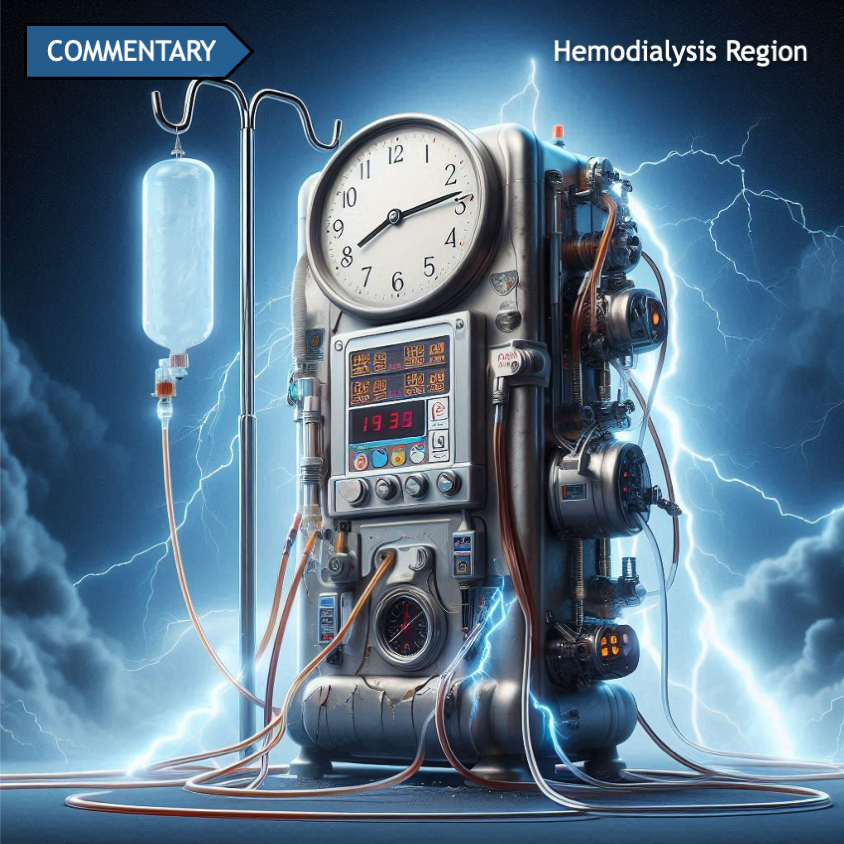
Image generated by Evan Zeitler using DALLE-E 3, accessed via ChatGPT at http://chat.openai.com, February 2025. After using the tool to generate the image, Zeitler and the NephMadness Executive Team reviewed and take full responsibility for the final graphic image.
Dialysis in 2025 is at a crossroads. On one side, we have hemodiafiltration (HDF)—the high-efficiency, high-convection therapy that promises superior middle-molecule clearance and potentially better patient outcomes. On the other, incremental hemodialysis (iHD)—a paradigm shift that challenges the “one-size-fits-all” approach by tailoring dialysis intensity to patient’s clinically manifestations, largely driven by their underlying levels of residual kidney function. At its core, this region was about cutting-edge technology vs. patient-centered philosophy.
Hemodiafiltration: The Ferrari of Dialysis—But Who Is in the Driver’s Seat?
First, let’s extend hearty congratulations to the investigators of the CONVINCE trial. Their study, the latest and largest randomized controlled trial (RCT) in the field, has been a major success, shedding new light on the potential benefits of HDF.
One could liken HDF with the Ferrari of dialysis modalities—sleek, powerful, mimicking glomerular physiology, and taking uremic toxin depuration and fluid removal to the next level by combining diffusion with convective transport. It promises better removal of large uremic toxins, reduced inflammation, and maybe even longer survival. But does it win all the races?
The CONVINCE trial reported a reduction in all-cause mortality for patients receiving high-volume HDF. Sounds great, right? But take a closer look: the mortality benefit was driven primarily by a reduction in infection-related deaths, not cardiovascular deaths. Some critics argue this weakens the case for HDF’s superiority. But let’s be honest—a death prevented is a death prevented. If fewer patients die from infection on HDF, isn’t that still a win?
Another issue? The intervention seemed to benefit “healthier” patients, raising concerns of selection bias—a classic statistical pitfall where the results may not generalize to sicker patients who need the most help. Yet, this brings us to a conundrum: what is HDF’s true niche? If it benefits mostly the healthier subset, how do we justify its broader application, especially given its resource-intensive nature?
Speaking of resources, HDF doesn’t come cheap. It requires new dialysis equipment and exponentially higher water consumption. Notably, in the CONVINCE trial, the dialysate flow rate was not reduced in the HDF group compared to the HD group, highlighting the substantial resource utilization associated with HDF. This underscores the need to identify which patients benefit most from HDF.
Incremental Hemodialysis: The Underrated Workhorse in a High-Speed Dialysis Race
While HDF commands attention with a robust body of RCTs, iHD is underutilized yet promising strategy. Why? That’s a loaded question—one that invites complex, and at times, polarized answers. Nephrology as a field has been conditioned to believe that more is always better—more depuration, more efficiency, more technology. But what about more individualization? iHD challenges the entrenched belief that all patients must start chronic HD at a uniform minimum intensity prescribed thrice-weekly. Instead, iHD recognizes the heterogeneity in ‘end-stage’ kidney disease severity at dialysis initiation, largely dictated by variations in residual kidney function (RKF). So why are these differences ignored when prescribing chronic HD? More provocatively, why does nephrology meticulously consider RKF in peritoneal dialysis but act largely indifferent to it in patients initiating HD?
Beginning chronic HD with a less intensive prescription in the form of fewer sessions per week offers clear advantages: improved quality of life, reduced vascular access complications, and a smoother transition to full dialysis dependence. A common benchmark for initiating iHD is a urine output of 500 mL/day or more, though the ideal threshold varies from patient to patient. RKF is dynamic, influenced by diet, hydration status, and intercurrent illnesses, among other factors. This variability is no different from the individualized decision-making process that determines when to initiate dialysis in a patient with advanced kidney disease. And yes, most patients will eventually require an increase in dialysis frequency over time—but that transition can be made incrementally rather than applying a rigid, one-size-fits-all approach from day one.
Meta-analyses of observational studies—where treatment intensity was guided by personalized care rather than resource constraints—and small clinical trials have consistently supported iHD as a safe and viable approach for patients with RKF. Around the world, dedicated nephrology groups have championed iHD for decades, embracing the philosophy of individualized dialysis care. Yet their data has been drowned out by the prevailing doctrine that more dialysis is always better.
Here’s the challenge: iHD is not the easy path. It demands greater effort, vigilance, and adaptability from every stakeholder:
- Nephrologists and care teams need to reassess dialysis adequacy during their routine monthly evaluations. Is the current regimen still sufficient? Should session duration, dialysate flow rates, or frequency be adjusted? Do medications—such as diuretics—need modification? iHD demands proactive management rather than passive adherence to a fixed schedule.
- Patients must be educated and engaged, actively monitoring their well-being, tracking urine output, and recognizing symptoms that might signal the need for changes in treatment.
- Dialysis units need to embrace flexibility—a challenge in a system built around rigid scheduling models.
This is not the path of least resistance, and humans’ natural inclination toward simplicity may partly explain why iHD hasn’t gained widespread traction—despite its logical appeal. Still, the lack of large RCTs fuels skepticism—and fair enough. Several RCTs comparing iHD to the conventional approach are now underway across multiple continents, bringing long-overdue attention to this approach. But let’s not forget: many of the protocols that define “standard” dialysis care today are based on non-randomized data.
The Verdict: Incremental Hemodialysis Moves Forward!
Let’s be clear—the brilliance of NephMadness lies in sparking discussion and capturing public perception, not declaring absolute winners and losers. Neither HDF nor incremental HD has truly “lost” here. In fact, from a purely scientific perspective, HDF could easily be deemed the frontrunner, given its extensive research portfolio.
The intervention that captured the spirit of this debate is the one that prioritizes personalized care, greater attention to the patient, and a mindful approach to the burden on both individuals and the healthcare system.
This type of victory—one rooted in patient-centered care—matters deeply for the future of dialysis and for the many investigators striving to advance incremental HD for a better tomorrow. While we wait for more trials, we already have enough knowledge to rethink how we initiate dialysis today—whether through HDF or incremental HD.
This NephMadness round belongs to incremental hemodialysis—because in dialysis, for some patients, temporarily doing less can ultimately mean doing more.
– Guest Post written by Mariana Murea
As with all content on the AJKD Blog, the opinions expressed are those of the author of each post and are not necessarily shared or endorsed by the AJKD Blog, AJKD, the National Kidney Foundation, Elsevier, or any other entity unless explicitly stated.
Click to read the Hemodialysis Region
Submit your picks! | @NephMadness | @nephmadness.bsky.social | NephMadness 2025

Leave a Reply