
Highlights from the September 2025 Issue
Editor’s Note: We asked authors of Original Investigations to provide short plain-language summaries that would briefly summarize what inspired their study, the basic approach taken, what was learned, and why it matters. We hope our readers will find this valuable in helping them keep up with the latest research in the field of nephrology.
Highlights from the September 2025 issue:
Comparative Effectiveness of Glucagon-Like Peptide-1 Receptor Agonists and Sodium/Glucose Cotransporter 2 Inhibitors in Preventing Chronic Kidney Failure and Mortality in Patients With Type 2 Diabetes and CKD by Yen-Chieh Lee et al.
DOI: 10.1053/j.ajkd.2025.03.016
EDITORIAL: Kidney Protective Effects of Glucagon-Like Peptide-1 Receptor Agonists Versus Sodium/Glucose Cotransporter 2 Inhibitors in Persons With Diabetes and CKD: Implications for Personalized Medicine by Maarten W. Taal [FREE]

AJKDBlog COMMENTARY: GLP1 Receptor Agonists vs SGLT2-I in Preventing CKD in T2DM: An Interview by Chia-Hsuin Chang [FREE]
Systemic Inflammation and the Risks of Adverse Kidney Outcomes in Adults With Atherosclerotic Cardiovascular Disease by Faizan Mazhar et al. [OPEN ACCESS]
From the authors: Inconsistent evidence exists regarding the association between the circulating blood marker of inflammation C-reactive protein (CRP) and kidney outcomes. We conducted an observational study in more than 83,000 adults with atherosclerotic cardiovascular disease undergoing routine care. The study showed that CRP levels were higher in participants with lower levels of kidney function and that CRP was associated with more rapid declines in kidney function over time as well as a greater risk of acute kidney injury.
DOI: 10.1053/j.ajkd.2025.04.011
EDITORIAL: Inflammation: A Key Driver in the Progression of CKD by Peter Stenvinkel et al. [FREE]

Association of Volume Overload With Kidney Function Outcomes Among Patients With Acute Decompensated Heart Failure by Amanda I. Moises et al.
Studies evaluating volume overload as a risk factor for kidney function decline have been inconsistent. This study included adult patients admitted to the hospital with acute heart failure (2015-2021) who required invasive monitoring of heart pressures. Statistical models analyzed how volume overload on both the right and left sides of the heart were associated with kidney outcomes, independent of other patient factors. Patients with greater volume overload had lower baseline kidney function, greater decline in kidney function during the hospitalization, and an increased risk of requiring dialysis over approximately 3 years of follow-up evaluation. However, changes in the degree of volume overload were not associated with changes in kidney function measured over the same period.
DOI: 10.1053/j.ajkd.2025.03.026
EDITORIAL: Kidneys Under Pressure: The Consequence of Heart Failure and Elevated Filling Pressures by Jozine M. ter Maaten and Nisha Bansal [FREE]

Mortality on Hemodiafiltration Compared to High-Flux Hemodialysis: A Brazilian Cohort Study
by Jorge Paulo Strogoff-de-Matos et al.
From the authors: Hemodialysis (HD), after decades of dominance, has been challenged by online hemodiafiltration (HDF) as the new standard of therapy for kidney failure. HDF has been associated with better survival in recent clinical trials. However, data are scanty about its benefits in real-world studies with unselected dialysis populations. In this retrospective cohort study, we compared the mortality risk in patients treated with HDF (n=2,826) to the risk among those treated with high-flux HD (n=6,787) in Brazil. The 2-year survival rates in these groups were 81.2% and 77.9%, respectively (P<0.001). The adjusted all-cause mortality risk was 27% lower for patients treated with HDF compared with HD. HDF treatment was also associated with a 34% reduction in cardiovascular mortality risk.
DOI: 10.1053/j.ajkd.2025.04.013

Patients’ Perspectives on Living With Primary Membranous Nephropathy: A Semi-Structured Interview Study by Edmund Y.M. Chung et al.
From the authors: Primary membranous nephropathy (MN) is an autoimmune kidney disease that often progresses to kidney failure, necessitating treatments that suppress the immune system. By recording the experiences of people living with primary MN, this study expands the understanding of how to best care for these patients and manage their treatment regimens. This study implemented semistructured interviews of 20 adults with MN to understand their lived experiences with this disease. They described being burdened by disease symptoms (fatigue and swelling) and the decisions regarding treatments and associated harms that limit their daily activities and relationships. The relapsing nature of MN and risk of progressing to kidney failure also caused patients to experience uncertainty about their future health. These findings should inform clinicians about these burdens and promote their ability to provide better communication, patient education, and psychological/social support. They also serve as a guide for future clinical research in MN.
DOI: 10.1053/j.ajkd.2025.03.028

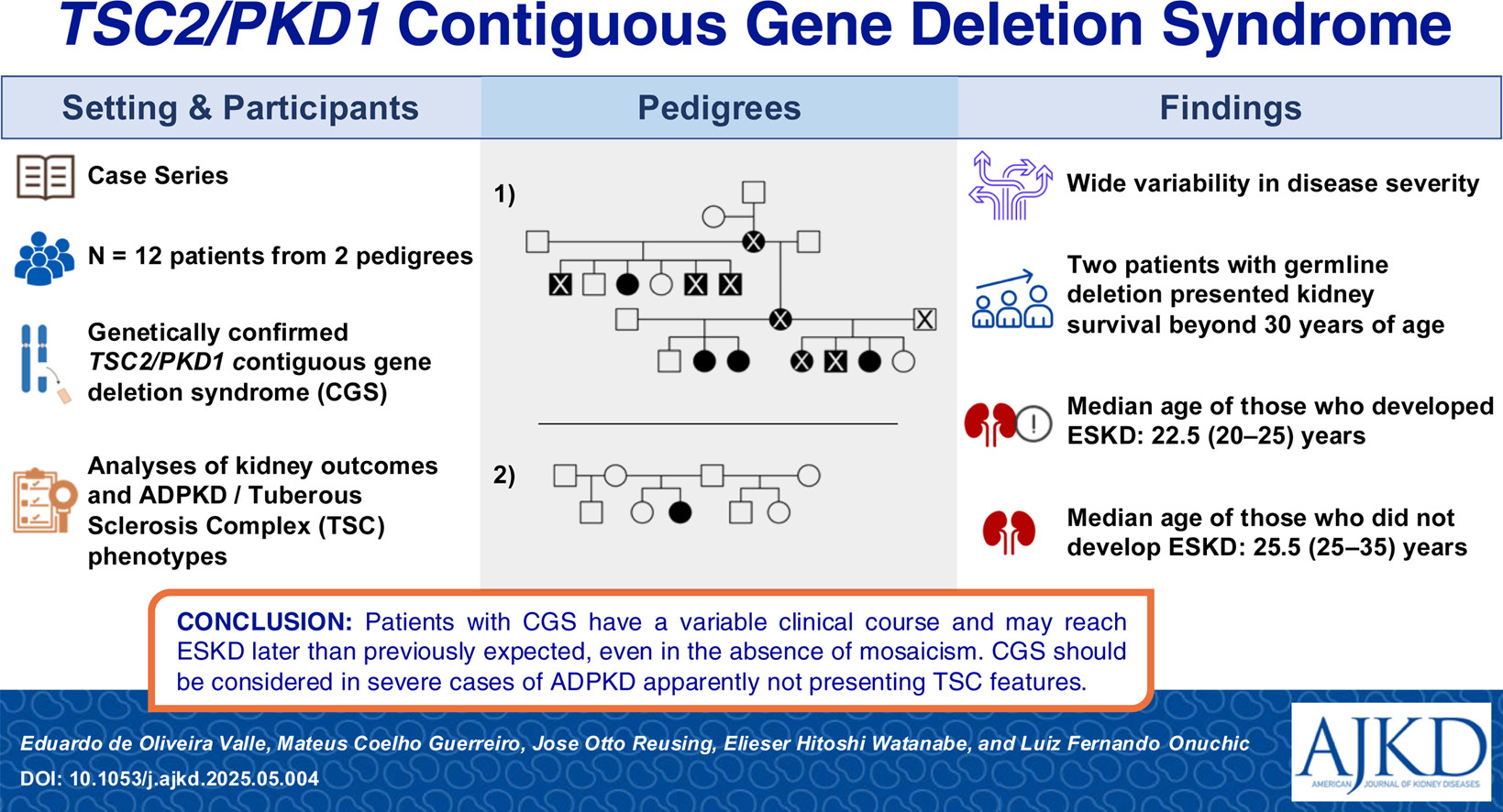
TSC2/PKD1 Contiguous Gene Deletion Syndrome: A Case Series by Eduardo de Oliveira Valle et al.
From the authors: The TSC2/PKD1 contiguous gene deletion syndrome (CGS) includes features of tuberous sclerosis complex (TSC) and autosomal dominant polycystic kidney disease (ADPKD). It has been associated with fast progression to end-stage kidney disease (ESKD) in children and young adults, but more recent data suggest a more variable clinical course. This case series, including 12 CGS-affected individuals, brings key information to the characterization of this disorder’s clinical spectrum and natural history. This case series revealed a widely variable kidney prognosis even among patients with the same deletion, with the age of ESKD onset in milder cases overlapping with severe cases of ADPKD. CGS should, therefore, be considered in patients diagnosed with severe ADPKD who are apparently not presenting TSC manifestations as well as in patients diagnosed with TSC with severe progression of cystic kidney disease.
DOI: 10.1053/j.ajkd.2025.05.004
Core Curriculum In Nephrology in the September 2025 issue:
Mixed Acid-Base Disturbances: Core Curriculum 2025 by Biff F. Palmer and Deborah J. Clegg [FREE]
Mixed acid-base disorders are frequently encountered in clinical practice and due to their complexity, diagnoses and treatment are challenging. The opposing effects of multiple disturbances can lead to blood pH levels that are near normal or separate acid-base disturbances can have an additive effect leading to more significant changes in blood and intracellular pH. A systematic evaluation of patient history, physical examination, and laboratory results (including acid-base balance, anion gap, electrolytes, and urine parameters) enables the rapid diagnosis of mixed acid-base disorders by analyzing the appropriateness of compensatory mechanisms, assessing changes in serum and urine electrolytes, and estimating urinary acid excretion. Eight cases are provided to illustrate the approach to mixed acid-base disturbances. Examples include mixed metabolic and respiratory acid-base disorders, mixed respiratory acid-base disorders, and mixed metabolic acid-base disorders.
DOI: 10.1053/j.ajkd.2025.04.014
 On the Cover:
At first glance, it’s just an apple tree, but the outreaching branches holding round objects reflect what Malpighi saw centuries ago in his stains of kidneys. These kidney stains revealed delicate vessels ending in tiny round structures, which Malpighi termed “minimae glandulae” but which we now call “glomeruli”. In this month’s issue of AJKD, Nicosia and Cassoli discuss this nearly forgotten kidney stain and Malpighi’s groundbreaking discovery of glomeruli.
Special thanks to Editorial Intern Somaya Zahran for curating the cover image and drafting the cover blurb for this issue.
The photograph “apple tree” by liz west is released on Flickr under the CC BY 2.0 Attribution Generic Deed license
SPECIAL COLLECTION: HIGHLY CITED

The articles in this special collection highlight the top cited Original Investigations published in 2022 and 2023 that contributed to AJKD’s 2024 Impact Factor of 8.2.
Leave a Reply