
2025 Editors’ Choice Award
In 2017, we established an annual celebration of articles that our editorial team designated as “Editors’ Choice” selections. The editors are delighted to recognize the articles listed below that have been selected to receive the 2025 Editors’ Choice Award. These articles will be freely available at AJKD.org until January 31, 2026. Congratulations to all the authors!

Continuous Kidney Replacement Therapy and Survival in Children and Young Adults: Findings From the Multinational WE-ROCK Collaborative by Michelle C. Starr, Katja M. Gist, Huaiyu Zang, Nicholas J. Ollberding, Shanthi Balani, Andrea Cappoli, Eileen Ciccia, Catherine Joseph, Aadil Kakajiwala, Aaron Kessel, Melissa Muff-Luett, María J. Santiago Lozano, Matthew Pinto, Stephanie Reynaud, Sonia Solomon, Cara Slagle, Rachana Srivastava, Weiwen V. Shih, Tennille Webb, Shina Menon, on behalf of the Worldwide Exploration of Renal Replacement Outcomes Collaborative in Kidney Disease (WE-ROCK) Collaborative (October 2024)
From the authors: In this large contemporary epidemiological study of children and young adults receiving continuous kidney replacement therapy in the intensive care unit, we observed that two thirds of patients survived at least until ICU discharge. However, patients with comorbidities appeared to have worse outcomes. Compared with previously published reports on continuous kidney replacement therapy practice, we observed greater use of continuous venovenous hemodiafiltration with regional citrate anticoagulation.
DOI: 10.1053/j.ajkd.2023.12.017
EDITORIAL: Continuous Kidney Replacement Therapy in Pediatric Intensive Care Unit: Little People, Big Gaps by Jia Xin Huang et al. [FREE]

Genetic Characterization of Kidney Failure of Unknown Etiology in Spain: Findings From the GENSEN Study by Miquel Blasco, Borja Quiroga, José M. García-Aznar, Cristina Castro-Alonso, Saulo J. Fernández-Granados, Enrique Luna, Gema Fernández Fresnedo, Marta Ossorio, María Jesús Izquierdo, Didier Sanchez-Ospina, Laura Castañeda-Infante, Ricardo Mouzo, Mercedes Cao, María L. Besada-Cerecedo, Ricardo Pan-Lizcano, Roser Torra, Alberto Ortiz, Patricia de Sequera, on behalf of the GENSEN Study Investigators (December 2024)
From the authors: The cause of kidney disease is unknown for 1 in 5 patients requiring kidney replacement therapy, reflecting possible prior missed treatment opportunities. We assessed the diagnostic utility of genetic testing in children and adults aged ≤45 years with either an estimated glomerular filtration rate of <15 mL/min/1.73 m2 or treatment with maintenance dialysis or transplantation. Genetic testing identified the cause of kidney disease in approximately 1 in 4 patients without a previously known cause of kidney disease, suggesting that genetic studies are a potentially useful tool for the evaluation of these patients.
DOI: 10.1053/j.ajkd.2024.04.021
BLOG POST: Uncovering the Unknowns in Nephrology by Becky Mingyao Ma [FREE]

Explaining International Trends in Mortality on Hemodialysis Through Changes in Hemodialysis Practices in the Dialysis Outcomes and Practice Patterns Study (DOPPS) by Keith P. McCullough, Hal Morgenstern, Hugh C. Rayner, Friedrich K. Port, Michel Y. Jadoul, Tadao Akizawa, Ronald L. Pisoni, William H. Herman, Bruce M. Robinson, on behalf of the DOPPS 7 (2018-2021) Country Investigators (January 2025)
From the authors: Case-mix adjusted survival of patients treated with hemodialysis has improved over the last 2 decades in the United States, Japan, and Europe. Some of this improvement can be explained by region-specific changes in 4 dialysis practices, namely increases in the proportions of patients achieving (1) Kt/V ≥1.2, (2) serum phosphorus levels <6 mg/dL, (3) interdialytic weight gain <5.7% of body weight, and/or (4) use of arteriovenous fistulas as vascular access, with the magnitude varying according to region-specific trends in these practices. These findings suggest that further improvement in these practice measures may be attended by further reductions in mortality among patients treated with maintenance hemodialysis.
DOI: 10.1053/j.ajkd.2024.06.017
EDITORIAL: Improved Survival in Patients Receiving Hemodialysis Through Changes in Practice Patterns: Does This Apply to Your Country? by Anneke Kramer et al. [FREE]

Stopping Versus Continuing Metformin in Patients With Advanced CKD: A Nationwide Scottish Target Trial Emulation Study by Emilie Lambourg, Edouard L. Fu, Stuart McGurnaghan, Bryan R. Conway, Neeraj Dhaun, Christopher H. Grant, Ewan R. Pearson, Patrick B. Mark, John Petrie, Helen Colhoun, Samira Bell, on behalf of the Scottish Diabetes Research Network Epidemiology Group (February 2025) [OPEN ACCESS]
From the authors: Current guidance recommends against the use of metformin in people with advanced kidney impairment despite a lack of evidence. It is therefore currently unclear how the decision to stop versus continue metformin in patients who reach stage 4 CKD impacts their risk of mortality and cardiovascular events. This study showed that stopping metformin after reaching stage 4 CKD was associated with reduced survival that did not appear to be mediated by an increase in adverse cardiovascular outcomes. These findings may support the continued use of metformin in patients with advanced kidney impairment, but further research is needed to confirm these observations.
DOI: 10.1053/j.ajkd.2024.08.012
EDITORIAL: Metformin in People With Diabetes and Advanced CKD: Should We Dare? by Jung-Im Shin et al. [FREE]

Prevalence of Severe Mental Illness and Its Associations With Health Outcomes in Patients With CKD: A Swedish Nationwide Study by Nanbo Zhu, Anne-Laure Faucon, Ralf Kuja-Halkola, Mikael Landén, Hong Xu, Juan Jesús Carrero, Marie Evans, and Zheng Chang (May 2025) [OPEN ACCESS]
From the authors: Patients with chronic kidney disease (CKD) frequently experience mental health problems, yet the prevalence and impact of severe mental illness (SMI) in this population remain uncertain. This Swedish nationwide study revealed that the prevalence of any SMI was 7.3% among patients with CKD (0.5% for schizophrenia, 2.1% for bipolar disorder, and 5.6% for major depressive disorder), representing a 56% higher prevalence than experienced by the Swedish general population. All 3 SMIs were associated with a higher mortality rate in patients with CKD, and bipolar disorder was also associated with a faster eGFR decline. Moreover, patients with CKD and schizophrenia or bipolar disorder exhibited a lower rate of initiating kidney replacement therapy. These findings highlight the need for improved recognition and management of SMI among people with kidney disease.
DOI: 10.1053/j.ajkd.2024.12.004
EDITORIAL: Severe Mental Illness in CKD: Why it Matters by S. Susan Hedayati [FREE]

~JAMES S. KAUFMAN EARLY CAREER AWARD~
“Recognizing early career achievement in nephrology research, this award also celebrates the dedication to and excellence in mentoring exemplified by Dr. Kaufman throughout his career”
Extreme Humid-Heat Exposure and Mortality Among Patients Receiving Dialysis by Matthew F. Blum, Yijing Feng, Cascade P. Tuholske, Byoungjun Kim, Mara A. McAdams DeMarco, Brad C. Astor, and Morgan E. Grams (November 2024)
From the authors: Patients who receive dialysis are vulnerable to extreme weather events, and rising global temperatures may bring more frequent extreme heat events. We sought to determine whether extreme heat exposure was associated with an increased risk of death in urban-dwelling patients receiving dialysis across the United States. We found that people receiving dialysis were more likely to die during extreme humid-heat events, defined by a heat index exceeding 40.6°C (105°F) for ≥2 days or 46.1°C (115°F) for ≥1day. These findings inform the nephrology community about the potential importance of protecting patients receiving maintenance dialysis from the risks associated with extreme heat.

~JAMES S. KAUFMAN EARLY CAREER AWARD~
“Recognizing early career achievement in nephrology research, this award also celebrates the dedication to and excellence in mentoring exemplified by Dr. Kaufman throughout his career”
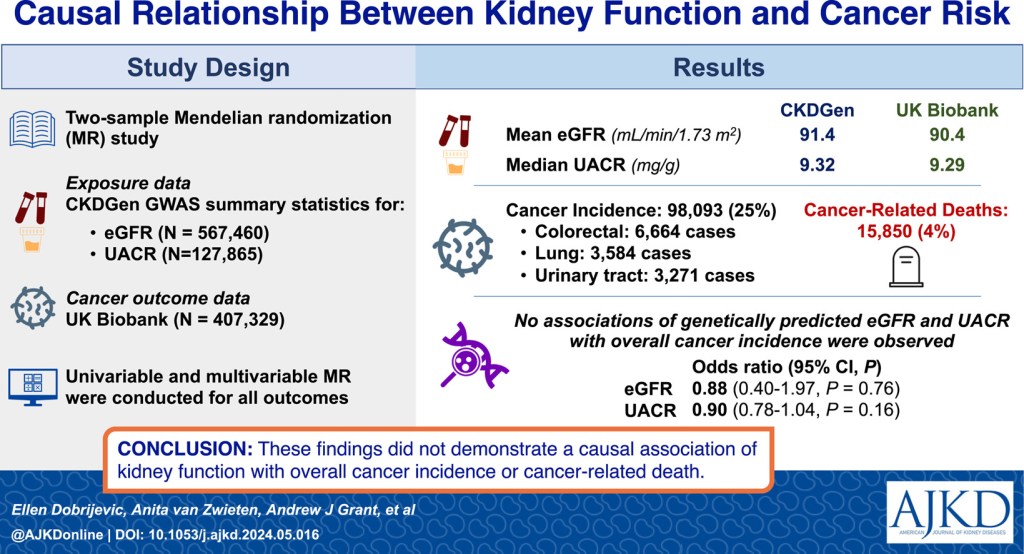
Causal Relationship Between Kidney Function and Cancer Risk: A Mendelian Randomization Study by Ellen Dobrijevic, Anita van Zwieten, Andrew J. Grant, Clement T. Loy, Jonathan C. Craig, Armando Teixeira-Pinto, and Germaine Wong (December 2024)
From the authors: Does reduced kidney function cause cancer? Patients with chronic kidney disease have been shown to have an increased risk of cancer and cancer-related death. However, it is not clear whether kidney disease is causally related to cancer or the association is due to other factors such as immune suppression and inflammation or a result of distortion of the analyses from unidentified variables (confounding). We used large, published genetic studies as well a database including 407,329 people in the United Kingdom in a series of Mendelian randomization analysis. Mendelian randomization uses the random assignment of genetic variants at birth to investigate causal relationships without confounding from measured and unmeasured confounders. We found that there is no evidence of a causal relationship between reduced kidney function and cancer.
DOI: 10.1053/j.ajkd.2024.05.016
EDITORIAL: Exploring the Causal Relationship Between Kidney Function and Cancer Risk: Insights and Limitations of Mendelian Randomization by Park et al. [FREE]
~NKF MISSION AWARD~
“Recognizing research published in AJKD that has great promise to enhance the lives of those affected by kidney disease”
Patient Education for CKD and Decision Support in Primary Care: Findings From the EPIK Pilot Study by Julie Wright Nunes, Eve Kerr, Akinlolu Ojo, Corey Powell, Audrey Fan, F. John Brinley, Anita Devine, Tammy Ellies, Katie Grzyb, Luis Garcia-Guzman, Tejpreet Nakai, Andrea Oliverio, Emily Chen, and Angela Fagerlin (March 2025)
Figure 1 from Nunes et al, © National Kidney Foundation.
From the authors: Most patients who have chronic kidney disease (CKD) are not aware of their illness. Few studies have explored whether patient education can increase patients’ knowledge about CKD or influence patients’ satisfaction with the care or communication they receive from their physicians. This study tested whether a short CKD education intervention implemented by the patient’s physician was associated with patients’ greater awareness of their CKD as well as their satisfaction with care and communication. This pilot study found that a decision aid for patients with CKD was implementable in a primary care setting. Patients who received CKD education felt more satisfied with their care and communication with their physicians compared with patients who did not receive the education.
DOI: 10.1053/j.ajkd.2024.10.005
EDITORIAL: Decision Aids in Kidney Care: The Need for Interventions Addressing Kidney Disease in Marginalized Populations by Delphine S. Tuot and Lilia Cervantes [FREE]

The full list of AJKD Editors’ Choice articles is available at AJKD.org.
Leave a Reply