
#NephMadness 2026: C3G – Treatments Look Poised to Win it All, A Massive Victory for Patients
Submit your picks! | @NephMadness | @nephmadness.bsky.social | NephMadness 2026
Anuja Java @anuja_java – @anujajava.bsky.social
Anuja Java is a transplant nephrologist at Washington University School of Medicine in St. Louis and Director of Kidney Transplantation at the John Cochran VA medical center in St. Louis. Her research focuses on defining the functional consequences of genetic variants identified in patients with complement-mediated diseases. She co-chairs the NIH-funded Clinical Genome Resource (ClinGen) complement gene curation expert panel.
Her clinical interests include taking care of patients after a kidney transplant, with a particular emphasis on those at risk for recurrent glomerular diseases. She chairs the transplant subcommittee in the National VA advisory board. Dr. Java has served on the American Society of Nephrology career advancement committee. She was an elected councilor in Women in Nephrology (WIN) and subsequently served as the WIN secretary. She is co-chair of the International Society of Nephrology (ISN) Education Working Group for Complement Pathway Disease and Genetics in Kidney Disease Curricula. She is also recipient of the 2022 National Kidney Foundation “Award of Excellence” for significant contributions to the field of kidney disease and the renal community.

Competitors for the C3G Region
Team 1: C3G Diagnosis
vs
Team 2: C3G Treatment
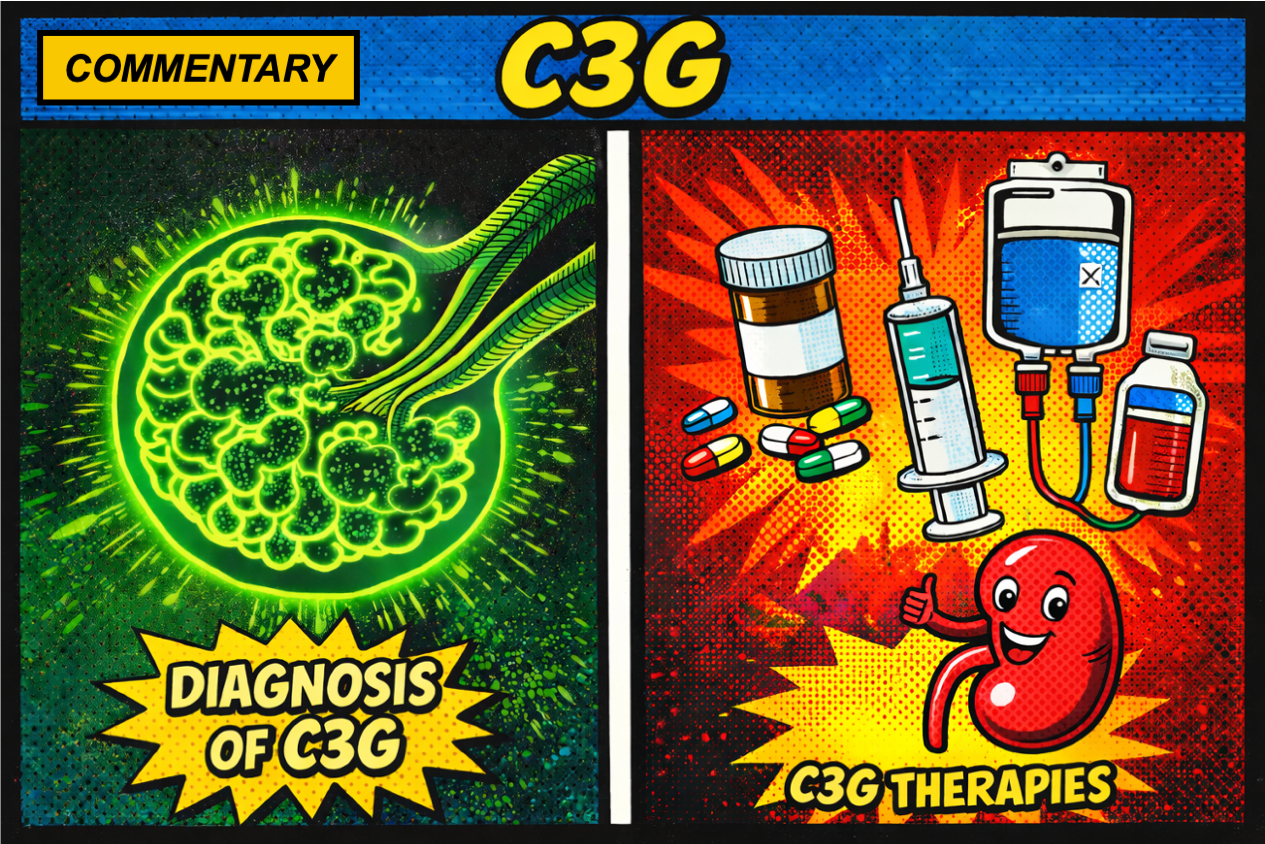
Image generated by Matthew Sparks using ChatGPT at http://chat.openai.com, February 2026. After using the tool to generate the image, Sparks and the NephMadness Executive Team reviewed and take full responsibility for the final graphic image.
NephMadness has always highlighted the tension between how well we understand a disease and how well we can treat it. Few conditions illustrate that gap more clearly than C3 glomerulopathy (C3G). For more than a decade, advances in complement biology have transformed our understanding of this disease, yet meaningful therapeutic options remained elusive. Since the formal recognition of C3G as a complement-mediated disease in 2013, the field has made remarkable advances in defining the mechanisms that drive it. We now recognize C3G as a disorder of alternative complement pathway dysregulation, arising from genetic variants, autoantibodies such as nephritic factors, and in some cases monoclonal gammopathy. These insights transformed how nephrologists conceptualize the disease, moving the field toward mechanism-based classification, and established C3G as one of the clearest examples of complement-mediated kidney injury. Yet for many years this expanding knowledge outpaced our ability to meaningfully change patient outcomes. In clinical practice, management remained largely limited to supportive therapy and empiric immunosuppression, approaches that were often inconsistent and rarely disease-modifying. For patients and clinicians alike, C3G was a disease we increasingly understood but still struggled to treat.
The past year has fundamentally altered that landscape. The approval of two proximal complement inhibitors, iptacopan and pegcetacoplan, marks the first time we have disease-targeted therapies for C3G. For a condition in which up to half of patients progress to kidney failure within a decade, the arrival of targeted therapy represents a major inflection point. After years of explaining to patients that we could describe the pathophysiology but had no reliable way to interrupt it, we now have treatments that directly address the underlying complement dysregulation driving the disease. For that reason, in this NephMadness matchup, the Team Treatment should advance. Improved diagnostics and mechanistic insights remain essential, but therapies ultimately determine whether our understanding translates into meaningful change for patients.
Importantly, these approvals are not the end of the story; they mark the start of a new chapter. With targeted therapies now available, the questions facing clinicians are evolving: who should be treated, how early therapy should begin, how long treatment should continue, and how best to integrate genetic and complement testing into clinical decision-making. At the same time, continued efforts to standardize diagnosis and management will be critical as the therapeutic landscape expands, ensuring that patients are identified early and treated appropriately. For more than a decade, the C3G field has focused on building the biologic framework of the disease. Now, for the first time, we are beginning to see that knowledge translate into therapies that may meaningfully alter its course.
So when the C3G bracket tips off, my vote goes to Team Treatment. Understanding the disease built the court, but new therapies are finally putting points on the board.
– Guest Post written by Anuja Java, MD
As with all content on the AJKD Blog, the opinions expressed are those of the author of each post and are not necessarily shared or endorsed by the AJKD Blog, AJKD, the National Kidney Foundation, Elsevier, or any other entity unless explicitly stated.
Submit your picks! | @NephMadness | @nephmadness.bsky.social | NephMadness 2026

Leave a Reply