
#NephMadness 2026: Cerebronephrology – The Case for Intense Focus on the Impact of CKD on the Brain
Submit your picks! | @NephMadness | @nephmadness.bsky.social | NephMadness 2026
Donald Molony
Donald A. Molony, MD is a Regents Distinguished Teaching Professor of the University of Texas System and Professor of Medicine in the Division of Renal Diseases and Hypertension and in the Institute for Clinical Research and Learning Healthcare at the University Of Texas Medical School in Houston. He currently directs the curriculum across all 4 years of the Medical School on EBM, Epidemiology and Biostatics and co-directs the medical student core Renal Curriculum. He co-directs the medical student scholarly concentration in Quality, Safety, and Evidence-based Medicine. He serves as faculty representative on the Executive committee of the Board of Director of the Memorial Hermann Hospital System – UTHealth Transplant Institute. His clinical interests include chronic kidney disease, Metabolic bone disease, ESKD, IgAN and C3GN and kidney disease due to environmental toxicants.
Dr. Molony is co-editor of Evidence-based Nephrology, now in its second edition. He has served as an associate editor of Advances in Chronic Kidney Diseases and of Clinical Nephrology, and as Editor of Literature Watch for Dialysis and Transplantation. He is past chair of the Medical Review Board of the ESRD Network of Texas and Past-President of the National Forum of ESRD Networks, and serves on both board of directors. His current research focuses on the influence of environmental toxicants and other factors on the progression of chronic kidney disease and on the application of the principles of evidence-based medicine to the delivery of health care and translation of evidence into clinical practice.

Competitors for the Cerebronephrology Region
Team 1: Cerebronephrology in CKD
vs
Team 2: Cerebronephrology in ESKD
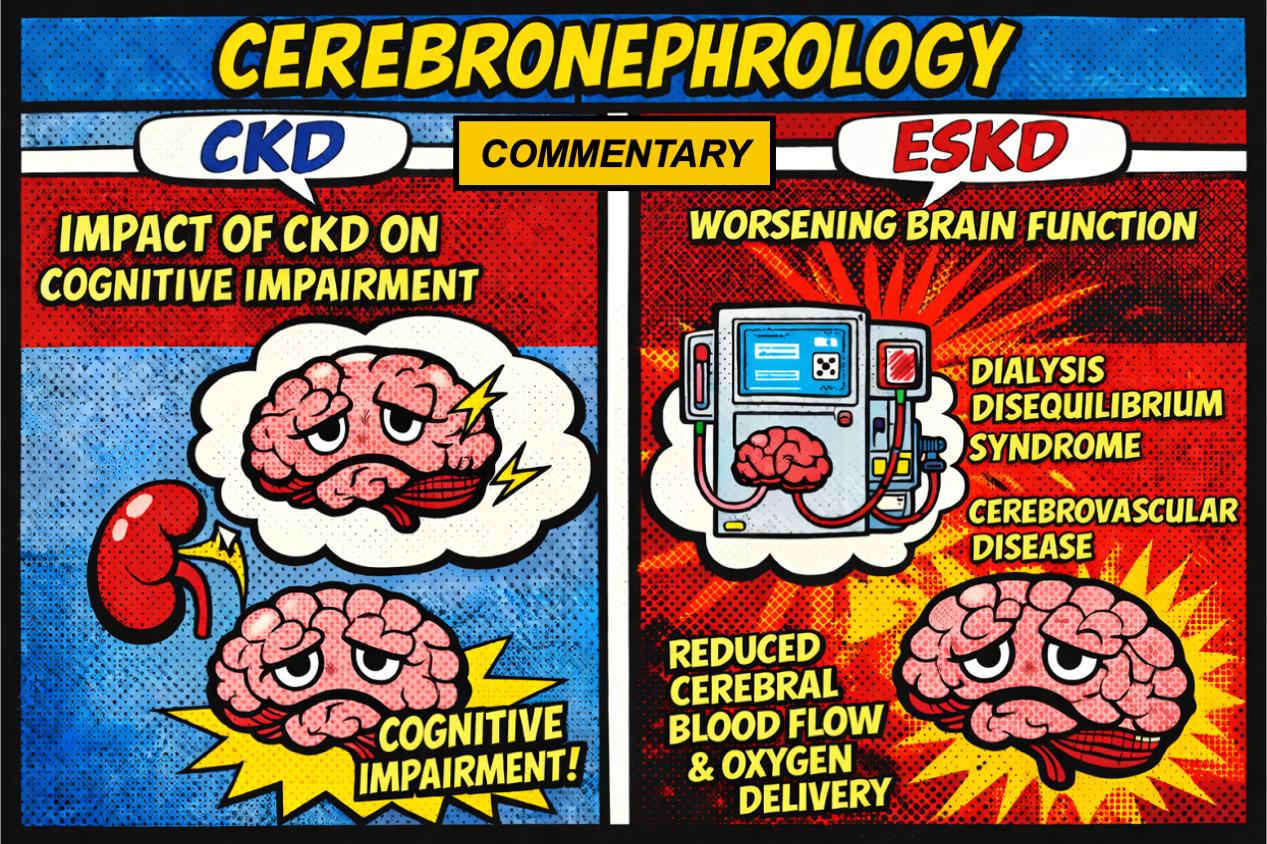
Image generated by Matthew Sparks using ChatGPT at http://chat.openai.com, February 2026. After using the tool to generate the image, Sparks and the NephMadness Executive Team reviewed and take full responsibility for the final graphic image.
In the last 2-3 years we have witnessed game changing therapeutic interventions that have slowed the progression of CKD and potentially reduced the number of individuals transitioning to ESKD and the need for renal replacement therapy.
Specific targeted diagnostic and management strategies of the increasing number of individuals recognized with CKD may have the potential of improving both their longevity and their quality of life. Key to a good quality of life and optimal health outcomes is the maintenance of normal or near normal cognitive function.
When specifically measured, diminished cognitive function classified either as cognitive impairment (CI) and more serious cognitive dysfunction identified as dementia is very common in CKD, with higher rates observed as CKD worsens. The risk appears to be amplified in ESKD especially in those with CI during CKD or transiently, as a consequence of AKI. Strategies to reduce CI and dementia in CKD therefore, will likely also impact the rate of CI and dementia observed in ESKD. Given the much larger population of CKD patients and the greater impact of early preventative measures in CKD on long-term morbidity and mortality, I will focus my comments on CKD rather than ESKD, with the knowledge that there are additional unique management strategies in patients on dialysis that might further reduce the risk of CI and dementia in ESKD during dialysis and after subsequent renal transplantation.
The management of CI-dementia in CKD patients depends on timely diagnosis, implementation of general and CKD specific therapeutic strategies, where the latter as it applies to brain health are informed by a growing appreciation of common mechanisms responsible for kidney brain pathophysiology.
Prevention of CI/dementia in the setting of CKD depends first on timely diagnosis. Despite the known benefits of early identification of individuals with CKD, the NKF KEEP program and others cross-sectional studies, show a persistent under diagnosis of CKD itself. Once identified, it should be appreciated that CKD is a known risk factor for a number of adverse health outcomes besides ESKD including CVD and CI. Most CKD patients are managed by primary care physicians often in collaboration with nephrologists and recent evidence confirms that most do not undergo routine periodic cognitive testing. The nephrologist should utilize MoCA or other tools to identify CI and once identified amplify treatments known to treat CKD and also protect brain health.
Known measures to protect brain health in CKD include importantly those that protect the integrity of the cerebrovascular system. Principle among these is control of BP to an optimal range for the subjects age and gender. The ALHAT, AASK trial and others have proven the CKD benefits of optimal BP control. Additional benefits from management of dyslipidemia cannot be ignored. A recent Cochrane review demonstrates the cardiovascular benefits of STATIN therapy especially in CKD prior to the development of ESKD.
More recently, the impact of metabolic dysfunction on CKD and CVD progression have been rigorously documented. If one considers albuminuria/proteinuria as one biomarker of inflammation and kidney damage as occurs in the metabolic syndromes, reduction in albuminuria might represent a possible biomarker of reduced inflammation. A number of studies have demonstrated an association between albuminuria/proteinuria and cognitive impairment and /or risk for development of dementia. And therapeutic interventions with RAAS blockade that reduce proteinuria, are associated with improvement in cognitive impairment. Whether this is a BP effect, a cardiac effect or due to reduced kidney and brain damage from inflammation cannot be determined. Future studies will clarify which is operative. A future finding that SGLT2i’s improve brain health in relationship to their reduction in proteinuria, in the absence of RAAS blockade, would strengthen the assumption that mechanisms other than the simple reduction in blood pressure or preservation of GFR were the principal drivers of the brain-health dividend from reduction in albuminuria in CKD.
A recent study with allogenic mesenchymal stem cells (MSC) in the treatment of a neurodegenerative disease may provide a window into future therapeutic possibilities in CKD, where benefit to both brain and the kidney might be seen. This possibility is enhanced by the similarities noted in the microvasculature of the brain and the kidney and their response to hypoxemia and hypoperfusion. In the study of allogenic MSC, older subjects with early Parkinson’s Disease were randomly assigned to IV infusion of allogenic stem cells (2 or 3 active infusions) or all placebo infusions. The 3 active infusion group demonstrated significant improvement in Parkinson’s outcomes and in a separate analysis, improvement in eGFR (where the other 2 groups demonstrated “age-appropriate” declines in function). Analysis of inflammatory markers is pending. This study suggests that a heightened inflammasome concurrent with CKD might drive some of the observed reduction in brain health in patients with CKD and possibly vice versa and as such, open up new therapeutic possibilities. Additional factors that might incite a kidney inflammatory response might include chronic exposure to toxicants such as uremic toxicants (insight provided by patients with ESKD) and environmental toxicants (potentially including agricultural chemicals, metals and PFAs). These exposures might mediate kidney brain health in both CKD and ESKD. Future research will clarify their role.
In summary, managing CKD while maintaining optimal brain health as an important goal, will have a tremendous impact on the overall health and quality of life of a large segment of our aging population. This focus on brain health in CKD is critical to overall population health. It is an issue that has been under appreciated, inadequately studied, and insufficiently managed. Recognition of CI and dementia in CKD/ESKD and the aggressive implementation of measures that we already know will improve long-term outcomes, will buy us time to investigate other newer therapeutic options. Current practices should include optimal management of BP (ideally including RAAS blockade) and dyslipidemia, recognition and reduction of cardio and cerebrovascular risk factors, and avoidance of toxicants. All of this will ideally be done in clinical practice in collaboration with primary care physicians and with other specialists in endocrinology, rheumatology, cardiology, and neurology. The astute nephrologist will remain vigilant for robust clinical trial evidence supporting future interventions based on our expanding knowledge of the pathogenesis of brain injury as a consequence of worsening CKD.
– Guest Post written by Donald Molony, MD
As with all content on the AJKD Blog, the opinions expressed are those of the author of each post and are not necessarily shared or endorsed by the AJKD Blog, AJKD, the National Kidney Foundation, Elsevier, or any other entity unless explicitly stated.
Click to read the Cerebronephrology Region
Submit your picks! | @NephMadness | @nephmadness.bsky.social | NephMadness 2026

Leave a Reply