
#NephMadness 2026: Genetics – May the Best Gene Win
Submit your picks! | @NephMadness | @nephmadness.bsky.social | NephMadness 2026
Farhana Begum
Dr. Farhana Begum earned her medical degree from New York Medical College in Valhalla, NY, in 2020. She subsequently completed her Internal Medicine residency and served as Chief Resident at the Donald and Barbara Zucker School of Medicine at Hofstra/Northwell. Dr. Begum is now completing nephrology fellowship at Columbia University Irving Medical Center and will be completing a glomerular disease fellowship after. Her professional interests include medical education, advancing women in medicine, and glomerular disease.
Mirtha Camila Almanzar
Camila Almanzar, MD, completed her Internal Medicine training at Lincoln Hospital in the Bronx, New York, and is currently a first-year nephrology fellow at Columbia University Irving Medical Center. Her clinical interests include polycystic kidney disease and peritoneal dialysis, with a growing focus on the role of genetics in kidney disease. She is passionate about advancing patient-centered care while improving access to nephrology services, promoting health equity, and reaching underserved communities.
Jordan G Nestor
Jordan Nestor is an Assistant Professor of Medicine and a physician-scientist in the Division of Nephrology, specialized in the diagnosis and management of hereditary kidney diseases. Her research focuses on advancing precision nephrology by expanding access to genomic testing and equipping nephrologists with real-time genomic data for personalized care. She develops clinical pathways and digital tools to help non-expert clinicians effectively integrate genomic data into patient care.
Dr. Nestor earned her MD from Albert Einstein College of Medicine in 2012, completed her internal medicine residency at Weill Cornell/New York-Presbyterian in 2015, and her nephrology fellowship at Columbia University in 2017. She then pursued three years of postdoctoral training in Precision Medicine and Kidney Genomics under Dr. Ali G. Gharavi as a T32 award recipient, followed by funding through TL1 (2018–2020) and KL2 (2020–2022) awards from Columbia University’s Irving Institute for Clinical and Translational Research. In 2024, she earned a Master of Science in Patient-Oriented Research from Columbia University’s Mailman School of Public Health. That same year, she received four years of funding through the Harold Amos Medical Faculty Development Program Award from the American Society of Nephrology/KidneyCure and the NIH’s K08 Mentored Clinical Scientist Development Award (NIDDK) to develop digital tools for precision nephrology.



Competitors for the Genetics Region
Team 1: PKD Masqueraders
vs
Team 2: Fabry Treatment
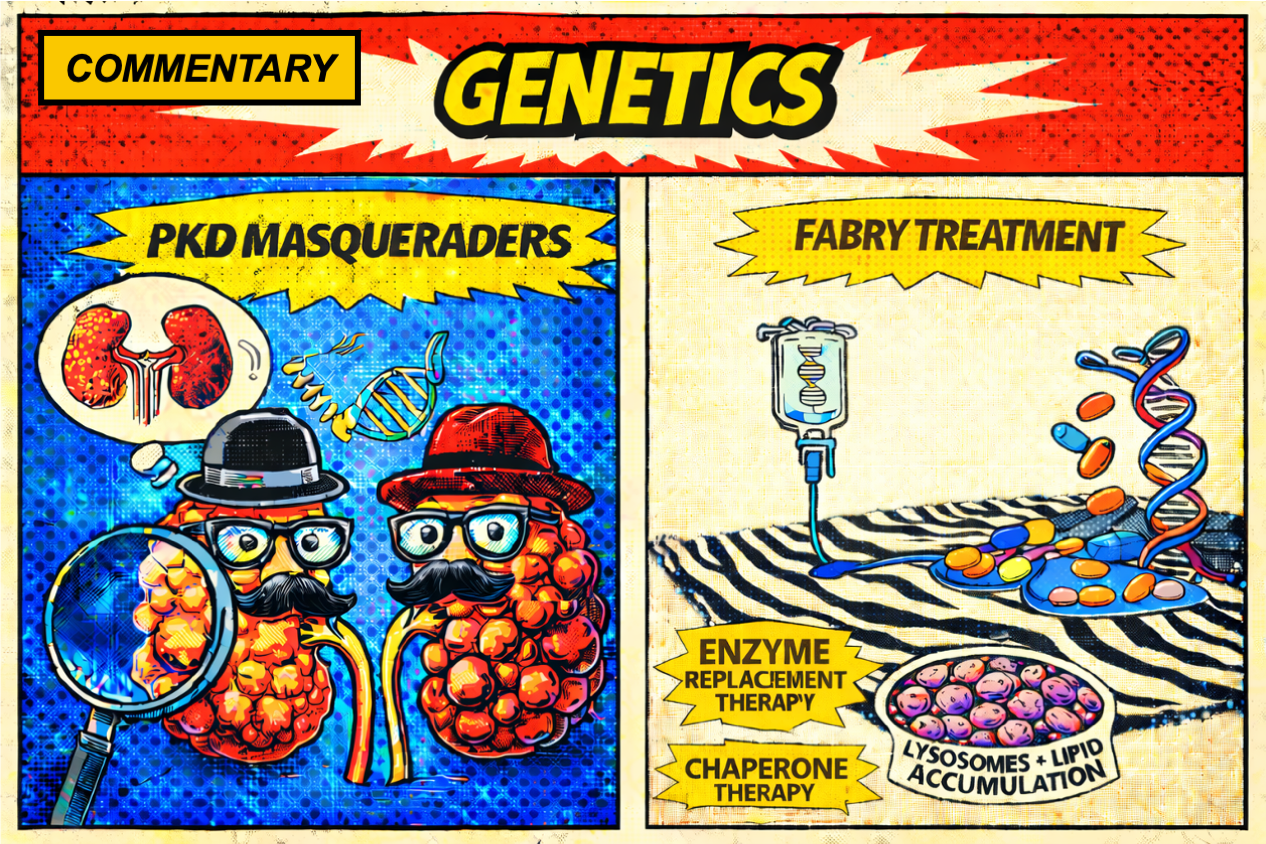
Image generated by Matthew Sparks using ChatGPT at http://chat.openai.com, February 2026. After using the tool to generate the image, Sparks and the NephMadness Executive Team reviewed and take full responsibility for the final graphic image.
It may be the millionth time you’ve heard a nephrologist say it, but truly — this is an exciting time to be in nephrology. The field is in the middle of a renaissance. Gone are the days when our therapeutic toolbox consisted primarily of ACE inhibitors, steroids, and dialysis. Today we debate aldosterone synthase inhibitors for hypertension, complement inhibitors and B-cell–directed therapies for glomerular disease, and deploy SGLT2 inhibitors, nonsteroidal MRAs, and GLP-1 receptor agonists to slow CKD progression.
But the most exciting frontier in nephrology right now may not be guideline-directed therapy at all. It’s genetics. Chronic kidney disease exists along a genetic spectrum. At one end are monogenic disorders driven by rare, high-impact variants; at the other are common alleles influencing diseases such as FSGS, IgA nephropathy, and kidney function traits like GFR and albuminuria. What was once a niche academic interest has rapidly become central to everyday kidney care.
With increasingly accessible genetic testing, we can now tell patients not only what disease they have — but why. For many families, this ends years of diagnostic uncertainty. Genetics now informs prognosis, targeted therapy, transplant eligibility, donor selection, and even post-transplant expectations.
The Genetics Region has been a fan favorite in prior #NephMadness tournaments — featuring ADTKD, APOL1 risk alleles, Alport syndrome, and genetic FSGS. This year, the competition returns with a heavyweight matchup: ADPKD and its mimickers vs. Fabry disease.
Two giant genetic topics. One advancing bracket spot. You decide.
The Case for ADPKD and Its Mimickers: When Polycystic Isn’t PKD
By Dr. Mirtha Camila Almanzar
Ms. MJ is a 52-year-old woman, a busy new owner of several food carts, who presents to the nephrology clinic to establish care after years of limited medical follow-up. Her medical history includes diet-controlled diabetes diagnosed at age 30, recurrent urinary tract infections, and congenital absence of the left ovary.
Her labs are concerning: creatinine 3.7 mg/dL (eGFR 19 ml/min), urine protein-to-creatinine ratio 400 mg/day, magnesium 1.4 mg/dL, and HbA1c 7.9%. Renal ultrasound reveals bilateral kidneys containing multiple cysts, and MRI confirms mildly to moderately enlarged kidneys with cysts of varying sizes.
The presumptive diagnosis seems straightforward: autosomal dominant polycystic kidney disease (ADPKD).
On further questioning, Ms. MJ had a paternal uncle who reportedly developed kidney failure at age 50, supporting the suspicion. As she started to be evaluated for preemptive living donor transplantation, both sisters volunteered as donors, and the initial evaluation showed normal kidney function and ultrasound imaging without proteinuria.
Everything seems to be moving toward transplant — until genetics enters the picture.
Because of a suspicious family history and atypical features, genetic testing is performed. Surprisingly, no pathogenic variants are found in PKD1 or PKD2. Expanded testing instead reveals a heterozygous deletion involving exons 1–9 of the HNF1B gene, consistent with HNF1B-related autosomal dominant tubulointerstitial kidney disease (ADTKD-HNF1B), previously known as renal cysts and diabetes (RCAD) syndrome.
Suddenly, the diagnosis — and the family’s future — changes.
Although both sisters initially appeared healthy, further evaluation identifies proteinuria in the eldest sister, excluding her as a potential donor. Expanded family testing uncovers subclinical disease in the sister with proteinuria. What began as transplant preparation becomes a multigenerational diagnosis of an inherited ciliopathy previously unrecognized within the family.
What began as a hopeful plan for preemptive transplantation turned into a defining moment for the entire family, uncovering a previously unrecognized inherited nephropathy. This case illustrates why genetics has become indispensable in modern nephrology. Genetic testing not only clarified the patient’s diagnosis but also prevented unintended harm to a related donor and reshaped care for multiple family members.
The Problem: PKD Doppelgängers
ADPKD is the fourth leading cause of kidney failure in the United States and is classically defined by progressive kidney enlargement and innumerable cysts. Yet many disorders can closely mimic its radiographic appearance.
These “PKD doppelgängers” include syndromic and tubulointerstitial diseases with overlapping imaging but fundamentally different biology, inheritance patterns, prognosis, and treatment implications.
- ADPKD-like genes: GANAB, DNAJB11, DZIP1L, PMM2 — often milder disease with smaller kidneys and slower progression
- Ciliopathies: NPHP genes, OFD1 — corticomedullary cysts with early tubulointerstitial fibrosis
- Tubulointerstitial disorders: UMOD, MUC1, HNF1B, SEC61A1 — small or normal kidneys, electrolyte abnormalities, minimal proteinuria
- Syndromic causes: TSC1/2, VHL, COL4A1 — cysts accompanied by systemic manifestations such as tumors or neurologic disease
Radiographic overlap with ADPKD often makes these conditions difficult to distinguish, yet subtle clinical clues — age of presentation, kidney size, cyst distribution, rate of progression, and extrarenal features — can raise suspicion for other causal gene disorders. Imaging alone may not be sufficient.
Genetic testing allows us to move beyond educated guesses toward precise diagnosis.
KDIGO 2022 guidelines recommend genetic testing when family history is unclear or clinical features are atypical. Increasingly, cases like Ms. MJ’s demonstrate why.
Why This Topic Wins the Bracket
PKD mimickers challenge one of nephrology’s longest-standing habits: diagnosing by appearance alone.
Mislabeling cystic kidney disease as ADPKD can lead to:
- inaccurate prognostic counseling
- inappropriate use of ADPKD-specific therapies
- unsafe living donor selection
- missed syndromic diagnoses affecting entire families
Genetics transforms ambiguity into actionable care — identifying the right disease, guiding transplant decisions, and protecting future generations.
In today’s era of precision nephrology, PKD Masqueraders make the strongest case that genetics is no longer optional.
It’s essential.
The Case for Fabry Disease: Small Genetic Change, System-Wide Impact
By Dr. Farhana Begum
Fabry disease is an X-linked lysosomal storage disorder caused by pathogenic variants in the GLA gene, resulting in deficient or absent activity of the enzyme α-galactosidase A. The enzymatic defect leads to progressive accumulation of globotriaosylceramide (Gb3) and related glycosphingolipids within lysosomes, ultimately producing a multisystem disease with profound renal, cardiac, and neurologic consequences.
In the kidney, Gb3 accumulates within podocytes, tubular epithelial cells, and vascular endothelial cells. This deposition drives podocyte injury, chronic inflammation, and fibrosis, clinically manifesting as proteinuria, progressive glomerulosclerosis, and chronic kidney disease. On kidney biopsy, electron microscopy reveals the pathognomonic “zebra bodies” — concentric lamellar inclusions that remain one of nephropathology’s most recognizable findings.
But Fabry disease is far more than a kidney disorder.
A Multisystem Disease Hiding in Plain Sight
Clinical manifestations often begin in childhood or adolescence but are frequently overlooked or misattributed. Early symptoms include:
- acroparesthesias — burning neuropathic pain in the hands and feet
- hypohidrosis and heat intolerance
- angiokeratomas
- gastrointestinal symptoms such as abdominal pain and diarrhea
As patients age, progressive glycosphingolipid accumulation leads to major organ involvement:
- left ventricular hypertrophy and heart failure with preserved ejection fraction
- arrhythmias and myocardial fibrosis
- cerebrovascular disease, including strokes and white matter lesions
Cardiac complications ultimately represent the leading cause of mortality.
While hemizygous males typically develop earlier and more severe disease, heterozygous females exhibit highly variable expression due to X-chromosome inactivation and may present later with isolated cardiac or kidney involvement. For this reason, genetic testing is essential, even when enzyme activity appears normal.
Despite an estimated prevalence of approximately 1 in 40,000 individuals, Fabry disease remains significantly underdiagnosed. Many patients are labeled with CKD of unknown etiology, hypertensive nephrosclerosis, or nonspecific proteinuric disease while systemic manifestations go unrecognized.
And this is where nephrologists play a pivotal role.
Diagnosis That Changes the Clinical Trajectory
A timely diagnosis does far more than explain proteinuria.
It prompts multidisciplinary surveillance — including cardiac MRI and neuroimaging — aimed at preventing heart failure progression and cerebrovascular events. For many patients, diagnosis also provides long-awaited validation for years of unexplained pain and systemic symptoms.
Most importantly, Fabry disease is treatable with mechanism-based therapies.
Available disease-specific treatments include:
- Enzyme replacement therapy (ERT) with agalsidase alfa or beta, and newer formulations such as pegunigalsidase alfa with longer half-life and potentially fewer infusion reactions
- Oral chaperone therapy (migalastat) for patients with amenable GLA variants, stabilizing misfolded enzyme and restoring lysosomal trafficking
- Substrate reduction therapies (e.g., lucerastat, venglustat) currently under investigation to decrease glycosphingolipid accumulation
- Gene therapy approaches in early clinical trials aiming for sustained endogenous enzyme production — raising the possibility of long-term disease modification
Although ERT cannot reverse advanced organ damage, early initiation slows disease progression and reduces substrate accumulation, underscoring the importance of early recognition.
Diagnosis also triggers cascade genetic screening, allowing identification of affected relatives before irreversible kidney, cardiac, or neurologic injury occurs. A single diagnosis can therefore alter outcomes across multiple generations.
Why Fabry Should Advance in This Bracket
While ADPKD is more common, Fabry disease uniquely captures the intersection of genetic diagnosis, systemic disease, and precision therapy.
It is:
- underrecognized
- multisystemic
- mechanistically defined
- and increasingly treatable
Unlike disorders that remain clinically silent for decades, Fabry disease often begins with debilitating symptoms early in life. For many patients — especially children — receiving a diagnosis transforms unexplained suffering into a defined, actionable condition.
Diagnosing Fabry disease does not simply delay ESKD. It can prevent strokes, alter cardiac outcomes, guide family screening, and fundamentally change life expectancy.
In the Genetics Region of NephMadness 2026, Fabry Disease represents the promise of modern nephrology: identify the mutation, understand the mechanism, intervene with targeted therapy, and protect the family.
– Guest Post written by Farhana Begum, Mirtha Camila Almanzar, and Jordan G. Nestor
As with all content on the AJKD Blog, the opinions expressed are those of the author of each post and are not necessarily shared or endorsed by the AJKD Blog, AJKD, the National Kidney Foundation, Elsevier, or any other entity unless explicitly stated.
Click to read the Genetics Region
Submit your picks! | @NephMadness | @nephmadness.bsky.social | NephMadness 2026

Leave a Reply