
COVID-19 and Vaccination in Primary Glomerular Disease: An Interview
AJKDBlog Interviews Editor Timothy Yau (@Maximal_Change) talked with Chia-Shi Wang about her recently published AJKD Orginal Investigation examining the associations of COVID-19 versus COVID-19 vaccination with longitudinal kidney function and proteinuria.
Dr. Chia-shi Wang is a pediatric nephrologist in Atlanta and an Associate Professor of Pediatrics at Emory University School of Medicine. Her clinical and research interests include glomerular diseases and behavioral aspects of chronic disease management.

AJKDBlog: Thanks for publishing such an important paper – this issue the immune response to the COVID vaccine and the possible effect on patients with primary glomerular disease were everywhere when vaccines were rolling out in 2021. You and the other authors of this paper utilized data from the NIH-sponsored Cure Glomerulonephropathy (CureGN) study. Can you first tell us what CureGN is and the patients that make up the cohort.
Dr Wang: We appreciate the opportunity to share our findings. CureGN is a prospective observational cohort study of adults and children with primary glomerular disease funded by the National Institute of Health. The study began in 2014, with the goal to advance understanding of the pathogenesis, outcome, and response to treatment of minimal change disease, focal segmental glomerulosclerosis, membranous nephropathy, and IgA nephropathy/vasculitis. CureGN is one of the largest cohorts of patients with primary glomerular disease, with >2,600 participants, approximately 20% children, recruited from 65 centers in the U.S., 4 in Canada, and 2 in Europe.
AJKDBlog: Can you tell us about the data you collected regarding COVID-19 infections and vaccination, in addition to the outcomes you examined?
Dr Wang: The focus of the paper is to compare and contrast the effects of COVID-19 infection vs vaccination on our patient’s kidney function and kidney disease activity. During the course of the study, we also collected information on the severity of the infections. In a future analysis, we plan to use the rich information collected as part of routine CureGN procedures, such as what medications participants received for their kidney disease, risk factors for more severe COVID-19 infection, as well as how vaccination may modify this risk.
AJKDBlog: There’s a lot in the results, so let’s break it down by sections. What percentage of patients in the CureGN cohort contracted COVID-19 infection, what percentage of patients received a vaccine, and how do these rates compare to general population in the US at the time?
Dr Wang: During the study timeframe, 35% of the CureGN cohort experienced COVID-19 infection at least once, with an incidence rate of 15.2 per 100 person-years. Within our cohort, we found “waves” of infections that mirrored what was happening in the general U.S. population. We depicted this in Figure 1. This trend suggested to us that our patients with glomerular disease are vulnerable and not spared from the waves of COVID-19 infection. Significantly, 13% were hospitalized due to COVID-19 infection and there were 3 deaths.
68% of the CureGN cohort received at least one COVID-19 vaccine, and 65% were fully vaccinated based on the CDC definition as of January 2023. Similar to the general U.S. population, vaccine uptake was highest among those 65 years and older at 85% but dropped among younger patients. Vaccine uptake was just around 40% for pediatric patients. We also observed a concerning trend that the proportion of individuals who received their first COVID-19 vaccine didn’t improve much after the first year that COVID-19 vaccines were made available. This suggested to us that more work needs to be done to help patients and their caregivers reach the decision to vaccinate.
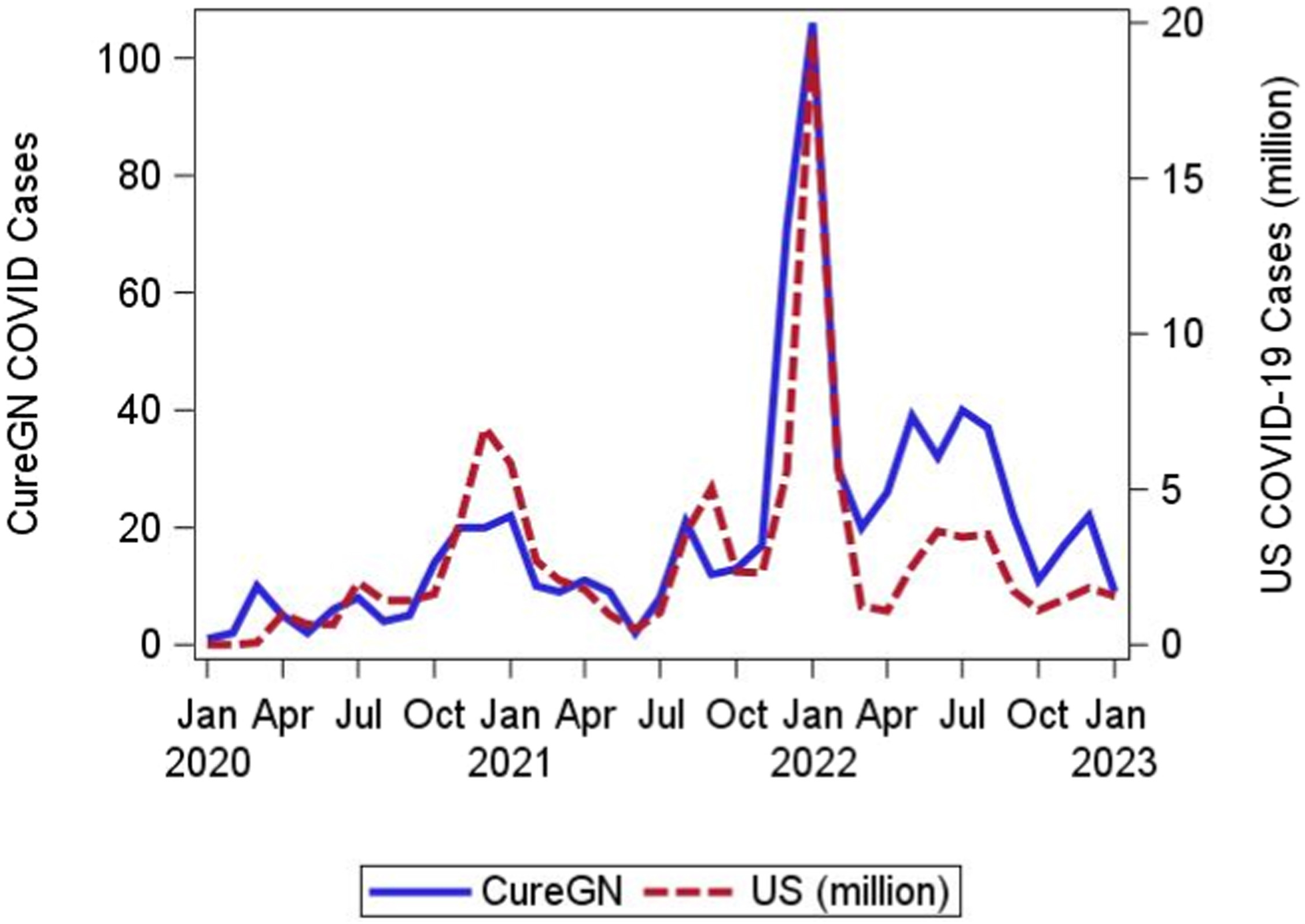
COVID-19 case counts over calendar time among surveyed CureGN study participants with primary glomerular disease, compared to US COVID-19 counts. Figure 1 from Wang et al, AJKD.
AJKDBlog: Of the patients that developed COVID infections, did you find any association between infections and adverse kidney outcomes?
Dr Wang: Such an important question, and yes we did. Compared to participants who did not develop COVID-19 infection, those who experienced an infection had a 35% increase in risk of worsening glomerular disease activity based on proteinuria. We defined this as a doubling (or more) of urine protein to creatinine ratio to at least 1.5g/g or increase in dipstick urine protein by 2 ordinal levels to at least 3+ (300mg/dL). This is similar to a disease relapse for those who were previously in remission or a significant worsening of disease activity for those who have ongoing proteinuria.
AJKDBlog: Recognizing that there is overlap between those who developed COVID and those that were vaccinated, let’s look at the other side. 68% or 1,407 CureGN participants received a COVID-19 vaccination. What did you find when you looked at the outcomes in this group?
Dr Wang: Importantly, we found that vaccination did not adversely affect kidney function (based on eGFR) or glomerular disease activity (based on proteinuria). Comparing disease activity between those who were vaccinated vs. those who were not, vaccination was not associated with higher risk of subsequent disease worsening (HR, 1.02, 95% CI 0.79-1.33, p=0.87).
AJKDBlog: Based on your study (and similar findings seen in other studies evaluating immunocompromised patients), we can hopefully use this as a teaching point for patients with immune mediated kidney disease that are hesitant about the vaccines. How would you simplify this data to support vaccine uptake rates in this vulnerable population?
Dr Wang: In this large cohort of 2,055 adults and children with glomerular disease, we found that our patients are vulnerable to COVID-19 infection. 1 in 8 patients who developed COVID-19 needed hospitalization and 3 died from COVID-19. COVID-19 infection also increased the risk of worsening proteinuria including relapse. 1,407 patients with primary glomerular disease received COVID-19 vaccine in our cohort. Vaccination did not worsen proteinuria or affect kidney function. The big takeaway is that vaccination protected patients with glomerular disease from COVID-19 infection and the adverse effects COVID-19 can have on their kidney function.
AJKDBlog: Thank you for taking the time for this interview!
To view Wang et al [FREE], please visit AJKD.org:
Title: Association of COVID-19 Versus COVID-19 Vaccination With Kidney Function and Disease Activity in Primary Glomerular Disease: A Report of the Cure Glomerulonephropathy Study
Authors: Chia-shi Wang, Dorey A. Glenn, Margaret Helmuth, Abigail R. Smith, Andrew S. Bomback, Pietro A. Canetta, Gaia M. Coppock, Myda Khalid, Katherine R. Tuttle, Raed Bou-Matar, Larry A. Greenbaum, Bruce M. Robinson, Lawrence B. Holzman, William E. Smoyer, Michelle N. Rheault, Debbie Gipson, and Laura H. Mariani on behalf of theCure Glomerulonephropathy (CureGN) Study Consortium
DOI: 10.1053/j.ajkd.2023.07.008
We would like to invite blog post submissions related to next year’s World Kidney Day (WKD) campaign theme: “Kidney Health for All: Advancing equitable access to care and optimal medication practice”. Submissions should be between 800-1,200 words and sent to AJKD@pennmedicine.upenn.edu by February 14th, 2024.

Leave a Reply