
Highlights from the February 2025 Issue
Editor’s Note: We asked authors of Original Investigations to provide short plain-language summaries that would briefly summarize what inspired their study, the basic approach taken, what was learned, and why it matters. We hope our readers will find this valuable in helping them keep up with the latest research in the field of nephrology.
Highlights from the February 2025 issue:
Associations Among Circle-Based Kidney Allocation, Center Waiting Time, and Likelihood of Deceased-Donor Kidney Transplantation by David C. Cron et al.
From the authors: This study examines how a recent policy change, KAS250, aimed at broadening the geographic sharing of deceased-donor kidneys, has impacted likelihood of kidney transplantation in the United States. Historically, kidney allocation occurred within local geographic boundaries, leading to unequal rates of transplantation across regions. KAS250, implemented in March 2021, replaced this system with a broader allocation radius of 250 miles around the donor hospital. Using national registry data, the study found that while there was no overall significant increase in the likelihood of transplantation nationally under KAS250, the policy’s effect varied widely even among neighboring transplant centers. One quarter of centers experienced a decrease in the likelihood of DDKT after KAS250. In contrast, centers with longer pre-KAS250 waiting times experienced an increased likelihood of transplantation, suggesting some success in reducing disparities between centers. Ongoing surveillance will be needed to ensure KAS250 is meeting the intended aim of more equitably distributing organs.
DOI: 10.1053/j.ajkd.2024.07.014
EDITORIAL: Short-term Pains for Long-term Gains? In Search of More Solutions to Inequities in Kidney Transplantation by Xingxing S. Cheng et al. [FREE]
Stopping Versus Continuing Metformin in Patients With Advanced CKD: A Nationwide Scottish Target Trial Emulation Study by Emilie J. Lambourg et al. [OPEN ACCESS]
From the authors: Current guidance recommends against the use of metformin in people with advanced kidney impairment despite a lack of evidence. It is therefore currently unclear how the decision to stop versus continue metformin in patients who reach stage 4 CKD impacts their risk of mortality and cardiovascular events. This study showed that stopping metformin after reaching stage 4 CKD was associated with reduced survival that did not appear to be mediated by an increase in adverse cardiovascular outcomes. These findings may support the continued use of metformin in patients with advanced kidney impairment, but further research is needed to confirm these observations.
DOI: 10.1053/j.ajkd.2024.08.012
EDITORIAL: Metformin in People With Diabetes and Advanced CKD: Should We Dare? by Jung-Im Shin et al. [FREE]

Forearm Versus Upper Arm Location of Arteriovenous Access Used at Hemodialysis Initiation: Temporal Trends and Racial Disparities by Melandrea L. Worsley et al
Use of a forearm AVA for HD initiation has declined and racial differences have persisted, with Black and Hispanic patients being less likely than White patients to have an AVA in the forearm location. Research toward understanding the causes and consequences of these trends and disparities is warranted..
DOI: 10.1053/j.ajkd.2024.07.010

Medical Suitability and Willingness for Living Kidney Donation Among Older Adults by Cédric Villain et al.
From the authors: Although potentially beneficial, kidney transplantation remains infrequent among older adults aged≥70 years with kidney failure. Study evaluated the potential to increase living kidney donation among older adults, including their medical suitability as well as willingness to donate. Among 2,069 community-dwelling older adults (median age 80 years), 5% to 6% had no exclusion to donation. Among these individuals, 11% to 12% remained suitable for donation during 8 years of follow-up. Most exclusions were not related to eGFR and albuminuria. Willingness to living donation was high (73%). These findings highlight the potential benefits from expanding the pool of transplantable kidneys through the use of living donation in older adults.
DOI: 10.1053/j.ajkd.2024.07.010
AJKDBlog COMMENTARY Advanced Age Living Kidney Donation: How Old is Too Old? by Akshta Pai [FREE]

Association of Coprescribing of Gabapentinoid and Other Psychoactive Medications With Altered Mental Status and Falls in Adults Receiving Dialysis by Rasheeda K. Hall et al. [OPEN ACCESS]
From the authors: Among people on dialysis, gabapentinoids may lead to confusion and falls. Often they are prescribed with other sedatives drugs or opioids, which can increase these risks. This study of adults with kidney failure receiving maintenance dialysis in the United States found that those who were prescribed both gabapentinoids and other psychoactive drugs were more likely to have confusion and falls compared with those who only took gabapentinoids. These relationships were seen at all levels of frailty although the relative risk of confusion related to an additional psychoactive drug was somewhat lower in the setting of greater frailty. Clinicians should consider elevated risks of confusion and falls when prescribing psychoactive drugs to patients receiving dialysis who are also prescribed gabapentinoids.
DOI: 10.1053/j.ajkd.2024.07.013

KDOQI Commentary in the February 2025 issue:
KDOQI US Commentary on the KDIGO 2024 Clinical Practice Guideline for the Evaluation and Management of CKD by Sankar D. Navaneethan et al [FREE]
In general, the KDOQI Work Group concurs with several recommendations and practice points proposed by the KDIGO guidelines regarding CKD evaluation, risk assessment, and management options (both lifestyle and medications) for slowing CKD progression, addressing CKD-related complications, and improving cardiovascular outcomes. The KDOQI Work Group acknowledges the growing evidence base to support the use of several novel agents such as sodium/glucose cotransporter 2 inhibitors for several CKD etiologies, and glucagon-like peptide 1 receptor agonists and nonsteroidal mineralocorticoid receptor antagonists for type 2 CKD in setting of diabetes. Further, KDIGO guidelines emphasize the importance of team-based care which was also recognized by the work group as a key factor to address the growing CKD burden. In this commentary, the Work Group has also assessed and discussed various barriers and potential opportunities for implementing the recommendations put forth in the 2024 KDIGO guidelines while the scientific community continues to focus on enhancing early identification of CKD and discovering newer therapies for managing kidney disease.
DOI: 10.1053/j.ajkd.2024.08.003
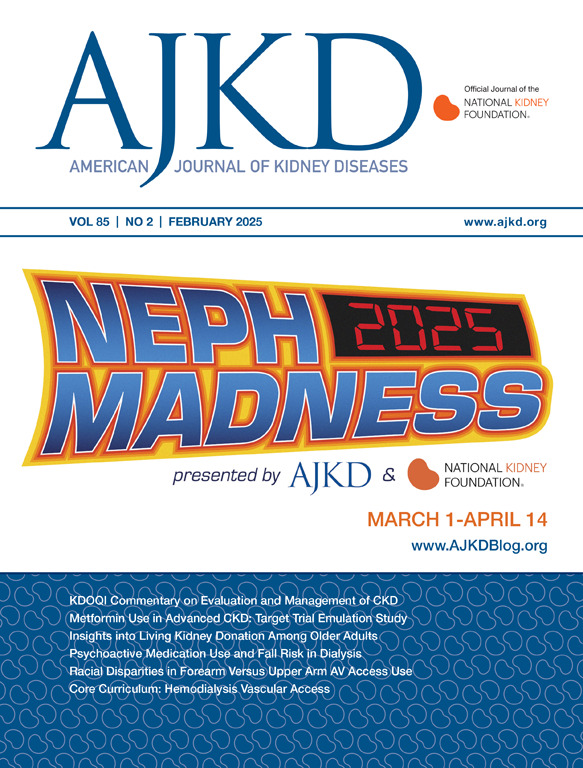 On the Cover:
AJKD is honored to present the 13th annual NephMadness, organized by Executive Team members Matthew Sparks, Anna Burgner, Anna Vinnikova, Elena Cervantes, Jeffrey Kott, Ana Catalina Alvarez-Elías, Dia Waguespack, and Krithika Mohan. This educational initiative highlights 8 important nephrology topics and encourages participants to select the one most likely to change kidney disease care in the next 5 years. US-based physicians can claim up to 8.0 CME credits for this activity. The fun and learning will begin on March 1, 2025, at www.AJKDBlog.org.
The NephMadness 2025 logo is created by Graham T. Gipson, © AJKD

The editors are delighted to share the most popular articles from the January-December 2024 issues of AJKD in this collection.
Leave a Reply