
Highlights from the July 2025 Issue
Editor’s Note: We asked authors of Original Investigations to provide short plain-language summaries that would briefly summarize what inspired their study, the basic approach taken, what was learned, and why it matters. We hope our readers will find this valuable in helping them keep up with the latest research in the field of nephrology.
Highlights from the July 2025 issue:
Cardiovascular Disease Risk Estimates in the US CKD Population Using the PREVENT Equation by Carl P. Walther et al.
Estimating the risk for developing cardiovascular disease (CVD) can guide prevention. Equations to predict cardiovascular risk are available, but the additional risk due to kidney disease has usually been neglected. The 2023 American Heart Association’s Predicting Risk of Cardiovascular Disease EVENTs (PREVENT) equations include kidney measures. We compared the estimated risk of CVD using PREVENT with that using a prior equation (without kidney measures) in people in the United States with chronic kidney disease. We found that the estimated risk of atherosclerotic CVD with the PREVENT equation was lower than with the prior equation, except for in people with the most advanced kidney disease. Despite the reduction in estimated risk, most individuals whose risk qualifies for statins did not report taking them. This highlights a major opportunity to prevent CVD.
DOI: 10.1053/j.ajkd.2025.01.012
EDITORIAL: CKD, Cardiovascular Risk Estimation, and Gaps in Therapy: A Shift to PREVENT by Tyrone G. Harrison and Matthew T. James [FREE]
Trends in Sex Disparities in Access to Kidney Transplantation: A Nationwide US Cohort Study by Jessica L. Harding et al.
From the authors: Women with kidney failure have historically had poorer access to kidney transplantation than men. The goal of the current study was to see whether access to transplantation, defined as placement onto the transplant waitlist or living (LDKT) or deceased donor kidney transplantation (DDKT), has changed over time using national registry data from>2.3 million adults initiating kidney replacement therapy in the United States. Overall, this study showed that since 1997 sex inequities in placement on the transplant waitlist have improved but remain significant, especially for women who are older or have diabetes. Unfortunately, sex inequities in LDKT favoring men have worsened over time while declines in DDKT appear to have impacted men more than women. These findings have implications for the design of policies and interventions to improve transplant equity.
DOI: 10.1053/j.ajkd.2024.12.008
EDITORIAL: Sex Inequities in Kidney Transplantation: A Persistent and Multifaceted Challenge by Priti Meena and Silvi Shah [FREE]

Arterial Stiffness and Subsequent Incidence of CKD and Kidney Function Decline in a Large Longitudinal Community Cohort: The Atherosclerosis in Communities (ARIC) Study by Zhiqi Yao et al. [OPEN ACCESS]
Prior studies have shown a cross-sectional correlation between greater arterial stiffness and worse kidney function. We wanted to understand whether arterial stiffness is linked to the development of kidney disease. To explore this, we studied a group of adults over several years, measuring how stiff their arteries were using different pulse wave velocities from different sites. We found that people with stiffer arteries, particularly those with higher stiffness in specific areas like the carotid and femoral arteries, were more likely to develop chronic kidney disease. They also experienced a faster decline in kidney function. This suggests that artery stiffness may play a role in worsening kidney health over time. Our findings highlight the importance of managing artery stiffness to help prevent kidney disease in older adults.
DOI: 10.1053/j.ajkd.2024.11.011
AJKDBlog COMMENTARY: Stiff Arteries, Fragile Kidneys: The Link to Chronic Kidney Disease by Api Chewcharat [FREE]
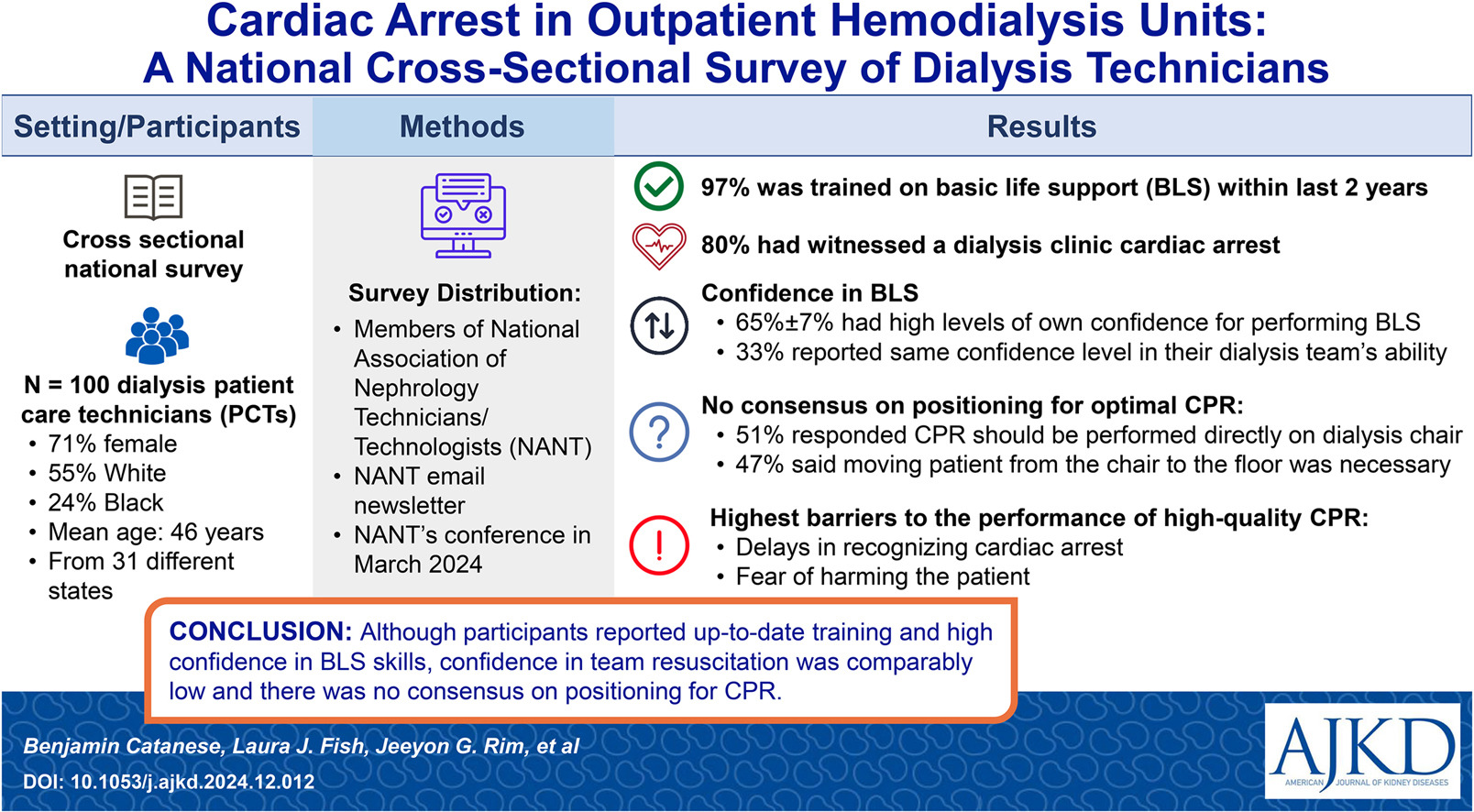
Cardiac Arrest in Outpatient Hemodialysis Units: A National Cross-Sectional Survey of Dialysis Technicians by Benjamin Catanese et al.
From the authors: Despite the need for a rapid response to cardiac arrest, cardiopulmonary resuscitation (CPR) is not always initiated by staff in the dialysis unit before the arrival of emergency medical services. Little is known about the barriers that dialysis patient care technicians (PCTs) face in performing CPR in outpatient dialysis units. We surveyed dialysis PCTs on their experience with CPR training and performance. We found that dialysis PCTs were up to date on training and were individually confident in their CPR skills but were less confident in their teams’ abilities to perform effective CPR. There was a lack of agreement on how to position patients for CPR. Future efforts should focus on improving team training and addressing the unique challenges of treating cardiac arrests that occur in the dialysis clinic.
DOI: 10.1053/j.ajkd.2024.12.012
Evaluating Long-Term Outcomes Among Hispanic Kidney Transplant Recipients by Sixto Giusti et al.
From the authors: Hispanic patients have a higher burden of chronic kidney disease (CKD) and faster progression to kidney failure when compared with non-Hispanic White (NHW) patients. Hispanic patients experience disparities in access to kidney care, making it harder to undergo transplantation. We evaluated outcomes after kidney transplantation in this population with the goal of gaining insights into these health disparities. We found that Hispanic kidney transplant recipients had lower rates of the composite outcome of death or kidney allograft loss compared with NHW recipients. We also observed a similar benefit in the immigrant and undocumented Hispanic population. Future research on access to transplantation and rates of CKD progression may be warranted to improve clinical outcomes among individuals of Hispanic ethnicity with kidney disease.
DOI: 10.1053/j.ajkd.2025.01.013

AJKDBlog COMMENTARY: Kidney Transplant Outcomes Among Hispanic Recipients: An Interview by Sixto Giusti [FREE]
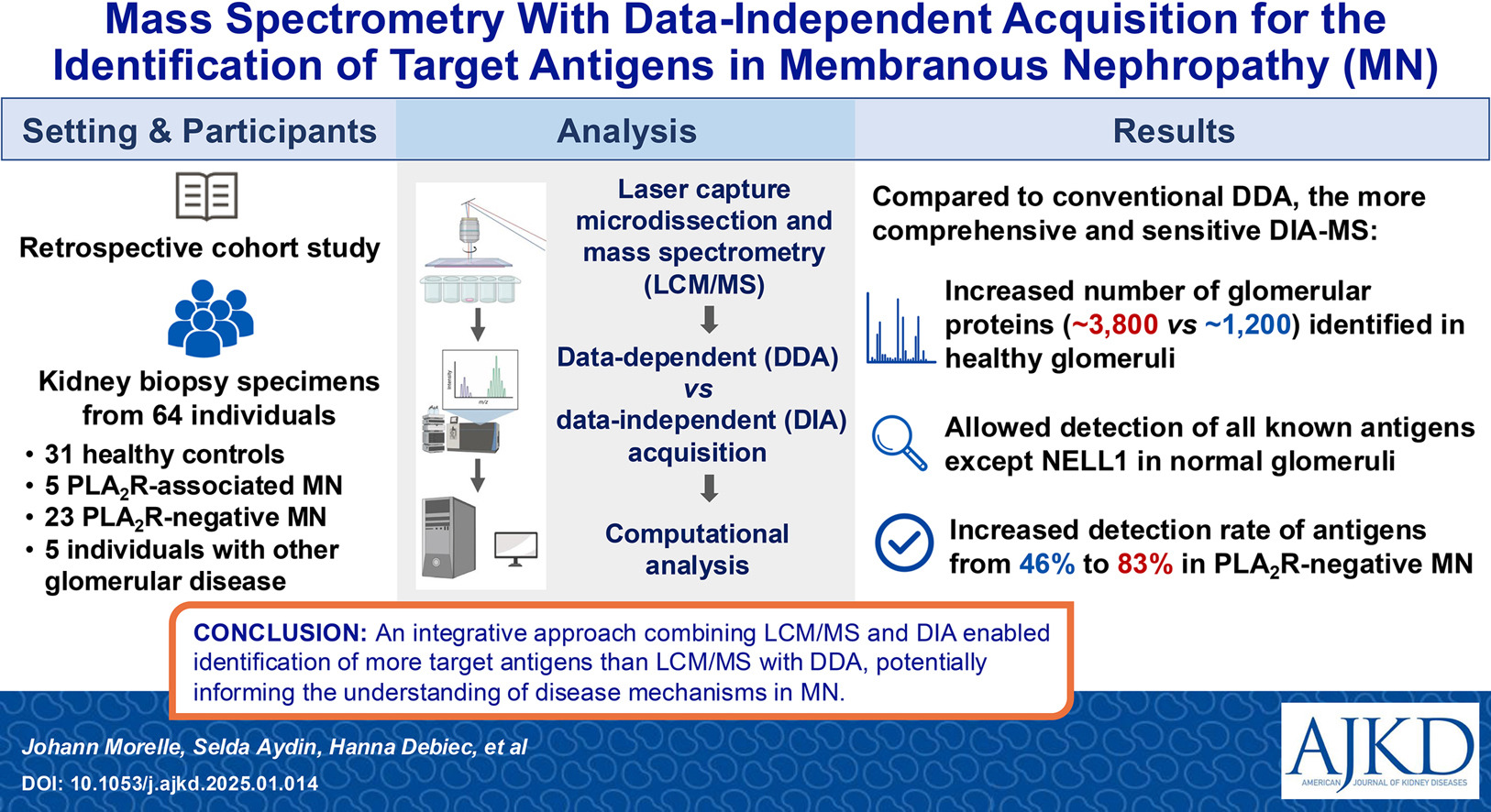
Mass Spectrometry With Data-Independent Acquisition for the Identification of Target Antigens in Membranous Nephropathy by Johann Morelle et al. [OPEN ACCESS]
From the authors: Membranous nephropathy is an autoimmune kidney disease characterized by circulating autoantibodies that recognize antigens in podocytes or in the glomerular basement membrane. To date, more than 10 different antigens have been identified, with specific associations with various etiologies and potential impact on management. In this study, proteomic analyses were implemented on glomeruli microdissected from kidney biopsies in patients with membranous nephropathy and appropriate controls. The original technique of proteomic analysis developed by Sethi and coworkers was expanded by applying a specific and more sensitive mass spectrometry method (data-independent acquisition) combined with bioinformatics analysis. We showed that this approach is a powerful tool to detect target antigens, and it may provide insights into disease mechanisms, with the potential to inform clinical diagnosis and classification of membranous nephropathy.
DOI: 10.1053/j.ajkd.2025.01.014
Pediatric Nephrology Practice in the United States: Survey of Pediatric Nephrology Division Directors by Priya S. Verghese et al.
From the authors: An imbalance exists between the increasing demand for services provided by pediatric nephrologists and the capacity of the pediatric nephrology workforce. The challenges of this imbalance are compounded by professional stress and burnout among pediatric nephrologists and a low level of interest in pediatric nephrology training. This study aimed to characterize the diverse pediatric nephrology practices across the United States by implementing a survey of the division heads of pediatric nephrology programs and classifying the findings into subgroups defined by the size of these programs. Pediatric nephrologists in medium-sized programs had the highest volume of clinical work, and administrative support for transplant, dialysis, and fellowship programs was often limited. These findings may inform the design of interventions to enhance pediatric nephrology care.
DOI: 10.1053/j.ajkd.2025.01.025
Associations Between Serum Sodium, Peritoneal Dialysis–Associated Peritonitis, and Mortality in the Peritoneal Dialysis Outcomes and Practice Patterns Study (PDOPPS) by Isaac Teitelbaum et al.
Variations in serum sodium were associated with death but not peritonitis risk. Future studies are needed to understand the mechanisms underpinning these associations and whether modification of serum sodium would improve outcomes among those receiving PD.

DOI: 10.1053/j.ajkd.2025.02.605
Core Curriculum In Nephrology in the July 2025 issue:
Kidney Dysfunction in Heart Failure: Core Curriculum 2025 by Kevin Bryan Lo et al. [FREE]
The authors explore commonly implicated pathophysiological mechanisms in kidney dysfunction in heart failure and discuss the principles behind effective decongestion and assessment of adequacy of natriuresis. They also discuss the interpretation of the changes in kidney function in response to decongestion and the use of GDMTs, including strategies to mitigate related adverse effects, especially in the setting of impaired kidney function.
DOI: 10.1053/j.ajkd.2024.12.006
 On the Cover:
The first peritoneal dialysis (PD) procedure was performed by Dr. Georg Ganter in 1923 on ureter-ligated guinea pigs and rabbits. He showed that repeated dwells of physiologic saline solution were effective in improving blood urea nitrogen level and reversing uremic symptoms. Dr Ganter also suggested the use of a hypertonic dwell to manage symptoms of volume overload. Despite this early success, the implementation of long-term PD remained challenging due to the need for intrabdominal access and elevated risk of peritonitis. The first description of PD for treatment of chronic kidney failure was not reported until the late 1950s, and continuous ambulatory PD was first implemented in 1978. In this issue, Perl et al describe a complex interplay between PD modality, PD solution type, serum sodium and mortality.
Special thanks to Editorial Intern Madhumitha Rajagopal for curating the cover image and drafting the cover blurb for this issue. The photograph “The Organic Lawnmower” by Andy Miccone is available via Flickr and released into the public domain.
SPECIAL ANNOUNCEMENT:
The NKF is actively seeking applications for an Editor-in-Chief to manage and lead the American Journal of Kidney Diseases (AJKD) for a 5-year term beginning January 1, 2027. Letters of Intent and a CV must be submitted by July 15, 2025. Please review the Call for Applications for complete details.

Leave a Reply