
Highlights from the August 2025 Issue
Editor’s Note: We asked authors of Original Investigations to provide short plain-language summaries that would briefly summarize what inspired their study, the basic approach taken, what was learned, and why it matters. We hope our readers will find this valuable in helping them keep up with the latest research in the field of nephrology.
Highlights from the August 2025 issue:
Associations of Urine Biomarkers During Ambulatory Acute Kidney Injury With Subsequent Recovery in Kidney Function: Findings From the SPRINT Study by Simon B. Ascher et al. [OPEN ACCESS]
Increases in serum creatinine concentration can occur when treating hypertension and complicate clinical management, but there are few tools available to distinguish whether an individual’s kidney function will subsequently recover. In this study, we investigated the association of kidney biomarkers measured in the urine with subsequent kidney function among individuals in the outpatient setting in whom an increase in serum creatinine occurs. We found that biomarkers reflecting worse glomerular injury and tubular dysfunction are associated with the risk of an individual’s kidney function not recovering. These results suggest that a broader assessment of kidney health when serum creatinine increases in the outpatient setting may help distinguish subsequent trajectories in kidney function.
DOI: 10.1053/j.ajkd.2025.02.607
EDITORIAL: To Stay or to Fold: Biomarkers and the Management of Potentially Hemodynamic Acute Kidney Injury by Justin M. Belcher [FREE]
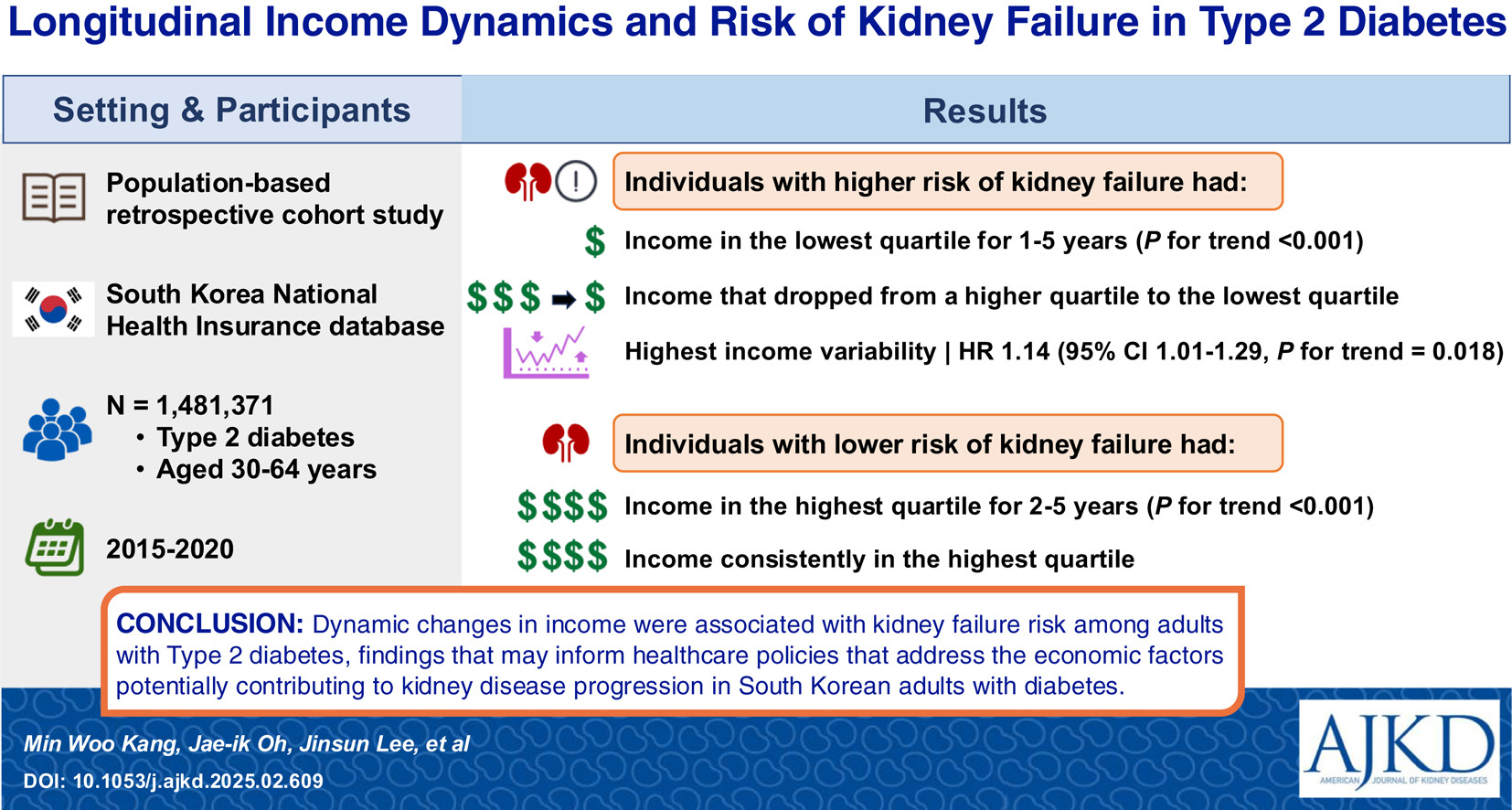
Longitudinal Income Dynamics and Risk of End-Stage Kidney Disease in Type 2 Diabetes: A South Korean Population–Based Cohort Study by Min Woo Kang et al.
From the authors: Managing diabetes can be expensive, and financial challenges may affect access to proper care. This study investigated the association between changes in income over time with the risk of end-stage kidney disease (ESKD) in adults with type 2 diabetes in South Korea. Using a large national health database, we examined the relationship between income levels, income changes, and the likelihood of developing ESKD. We found that remaining in the lowest income group or experiencing a decline in income was associated with a higher risk of ESKD. Conversely, maintaining a high income was associated with a lower risk. These findings suggest that stable financial resources are associated with a lower risk of ESKD progression in individuals with diabetes, highlighting the potential relationship between economic factors and health outcomes.
DOI: 10.1053/j.ajkd.2025.02.609
EDITORIAL: Financial Nephrotoxicity: Prevention Is Better Than Cure by Sawhney et al. [FREE]
Inflammatory and Cardiovascular Events in CKD: The Multi-Ethnic Study of Atherosclerosis (MESA) by Gautam R. Shroff et al. [OPEN ACCESS]
In this observational study, we used a large community-based sample from the Multi-Ethnic Study of Atherosclerosis to evaluate the likelihood of, and risks associated with, inflammatory conditions with worsening kidney function. We studied a novel diagnostic entity called chronic inflammation–related disease (ChrIRD) encompassing several infectious and noninfectious inflammatory conditions. Over 19 years of follow-up, we demonstrated progressively higher risk of ChrIRD with worsening kidney function. The risks of ChrIRD are apparent in individuals with low levels of proteinuria and exceed cardiovascular disease at most stages of kidney function. This study highlights the importance of recognizing both infectious and noninfectious inflammatory conditions with worsening kidney function. Future studies should focus on ways to further understand this association and mitigate the risks.
DOI:10.1053/j.ajkd.2025.03.020
EDITORIAL: Reframing Risk in CKD: Inflammation at the Center Stage by Peter Stenvinkel [FREE]

Complex Etiologies of the Discordance Between Cystatin C– and Creatinine-Based Estimated GFR and Its Adverse Associations: Findings From the CRIC Study by Ian E. McCoy et al.
From the authors: The difference between estimated glomerular filtration rates (eGFRdiff) using serum creatinine and cystatin C (eGFRcys−eGFRcr) has been repeatedly associated with adverse outcomes, including death and heart failure. The biological mechanisms underlying eGFRdiff are unclear. In this study of adult patients with CKD, we found that adjustment for these proposed causes of eGFRdiff, including measures of muscle mass and protein intake (daily urine creatinine excretion) and kidney clearance of larger molecules (β2-microglobulin and β-trace protein levels relative to measured GFR), did not change the associations between eGFRdiff and subsequent adverse outcomes. Only 36% of the variance in eGFRdiff was accounted for by the proposed causes. Further research is needed to uncover the pathophysiology behind these associations.
DOI: 10.1053/j.ajkd.2025.03.018
EDITORIAL: Why Do Creatinine- and Cystatin C–Based Estimated GFR Values Often Differ? by Créon et al. [FREE]
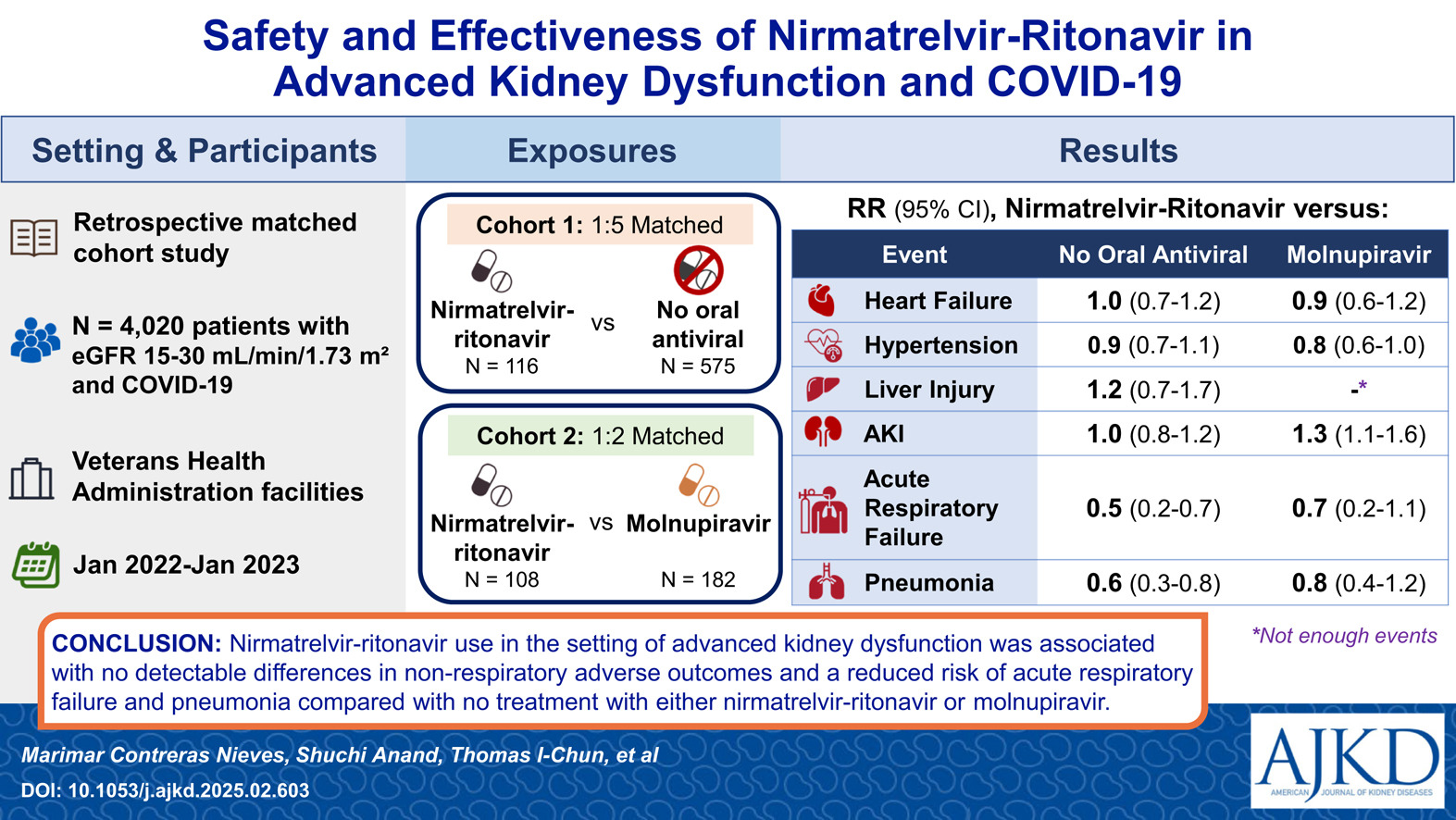
Safety and Effectiveness of Nirmatrelvir-Ritonavir in Patients With Advanced Kidney Dysfunction and COVID-19 by Marimar Contreras Nieves et al.
From the authors: COVID-19 can cause severe complications in patients with advanced kidney disease, yet nirmatrelvir-ritonavir, one of the first-line antiviral therapies, is not recommended in such patients due to safety concerns. We examined its safety and effectiveness among patients with advanced (stage IV) kidney disease. Using Veterans Health Administration records, we compared patients who received nirmatrelvir-ritonavir with those who were not treated with it nor with molnupiravir (a second-line therapy). We also compared treatment with nirmatrelvir-ritonavir with treatment with molnupiravir. We found that nirmatrelvir-ritonavir was associated with a reduced risk of serious lung problems without any evidence of increased risks of heart, liver, or kidney problems compared with not being treated with nirmatrelvir-ritonavir nor molnupiravir. The effectiveness and safety of nirmatrelvir-ritonavir were similar to that of molnupiravir. This study provides real-world evidence supporting nirmatrelvir-ritonavir use for patients with advanced kidney disease.
DOI: 10.1053/j.ajkd.2025.02.603
From the authors: Although electronic health records (EHRs) data holds great promise for advancing kidney research, little work has been done to accurately identify ESKD cases in these data. This study developed and validated an algorithm using diagnosis and procedure codes to identify ESKD in EHRs. Our findings showed that the algorithm performed consistently in 2 different health systems, demonstrating high specificity and negative predictive values but lower sensitivity and positive predictive value. This algorithm may inform future ESKD research using EHR data.
DOI: 10.1053/j.ajkd.2025.03.021

Long-Term Exposure to Uranium and Arsenic in Community Drinking Water and CKD Risk Among California Women by Danielle N. Medgyesi et al.
From the authors: Metals, including uranium and arsenic, can damage kidney function and may increase chronic kidney disease (CKD) risk. These contaminants are often present in groundwater and are regulated in US community water supplies. In a cohort of California women, we examined long-term uranium and arsenic exposure from households using community water. Higher uranium concentrations were associated with CKD. Those exposed to 10-15μg/L (or one-third to one-half the regulatory limit) had an approximately 30% greater risk compared with those below the World Health Organization 1998 guideline (2μg/L). Arsenic was not clearly associated with risk of CKD overall. However, we observed a higher risk among younger individuals and those who developed cardiovascular disease or diabetes. Uranium in community water may be linked to CKD, underscoring the need for further clinical investigation and policy evaluation.
DOI: 10.1053/j.ajkd.2025.04.008

Core Curriculum In Nephrology in the August 2025 issue:
Safe Patient Care in CKD: Core Curriculum 2025 by Prasheen Shah et al. [FREE]
Quality and safety in health care have garnered scrutiny in recent decades. Complete prevention of unintended harm remains elusive. Patients with chronic kidney disease are at risk for adverse events because of the complexity of this illness and the impact of declining kidney function on choices for diagnostic studies and therapies. Nephrologists must be knowledgeable about patient safety principles and methods for evaluating harm or near harm events and be prepared to learn from investigations to make improvements. Medication safety is particularly challenging in the context of progressive kidney disease, and safety has increased in scope due to the broader choices of therapeutics for such conditions as diabetic nephropathy and anemia of chronic kidney disease. Radiologic imaging and procedural safety are also influenced by impairment of kidney function. Technological applications for patient safety are evolving and hold promise for mitigating human error and engaging patients as phttps://doi.org/10.1053/j.ajkd.2025.03.022artners in care. In this Core Curriculum, the authors address essential nephrologist competency for maintaining patient safety in chronic kidney disease.
DOI: 10.1053/j.ajkd.2025.03.022
 On the Cover:
Vintage uranium glass is made with small amounts of uranium oxide, giving it a yellow-green tint that glows a vivid neon green under ultraviolet light. First produced in mid 19th-century Europe, it became especially popular from the 1880s through the 1940s and was commonly crafted into bowls, plates, barware, and decorative pieces. While its radiant glow appears harmless, it subtly hints at the presence of a hidden toxin much like crystal-clear community water supplies that may still contain trace amounts of uranium. In this issue, Medgyesi et al report an association between uranium contaminants in community water supplies and the risk of chronic kidney disease, underscoring the need for further scientific investigation into this potentially important environmental exposure.
Special thanks to Editorial Intern Api Chewcharat for curating the cover image and drafting the cover blurb for this issue.
The photograph “Uranium Glass under UV” by GorissM is released on Flickr under the CC BY-SA 2.0 license.
SPECIAL COLLECTION: HIGHLY CITED

The articles in this special collection highlight the top cited Original Investigations published in 2022 and 2023 that contributed to AJKD’s 2024 Impact Factor of 8.2.
Leave a Reply