
Highlights from the October 2024 Issue
Editor’s Note: We asked authors of Original Investigations to provide short plain-language summaries that would briefly summarize what inspired their study, the basic approach taken, what was learned, and why it matters. We hope our readers will find this valuable in helping them keep up with the latest research in the field of nephrology.
Highlights from the October 2024 issue:
Continuous Kidney Replacement Therapy and Survival in Children and Young Adults: Findings From the Multinational WE-ROCK Collaborative by Michelle C. Starr et al
From the authors: In this large contemporary epidemiological study of children and young adults receiving continuous kidney replacement therapy in the intensive care unit, we observed that two thirds of patients survived at least until ICU discharge. However, patients with comorbidities appeared to have worse outcomes. Compared with previously published reports on continuous kidney replacement therapy practice, we observed greater use of continuous venovenous hemodiafiltration with regional citrate anticoagulation.
DOI: 10.1053/j.ajkd.2023.12.017
EDITORIAL: Continuous Kidney Replacement Therapy in Pediatric Intensive Care Unit: Little People, Big Gaps by Jia Xin Huang et al [FREE]

Association of Race and Ethnicity With High Longevity Deceased Donor Kidney Transplantation Under the US Kidney Allocation System by Nour W. Asfour et al
From the authors: The US Kidney Allocation System prioritizes giving high-longevity, high-quality kidneys to patients on the waiting list who have a high estimated posttransplant survival (EPTS) score. EPTS is calculated based on the patient’s age, whether the patient has diabetes, whether the patient has a history of organ transplantation, and the number of years spent on dialysis. Our analyses show that Asian, Black or African American, and Hispanic or Latino patients were less likely to receive high-longevity kidneys compared with White patients, despite having similar or better posttransplant survival outcomes.
DOI: 10.1053/j.ajkd.2024.02.017
EDITORIAL: Mitigating the Disparate Impacts of Longevity Matching of Kidney Transplants by Sommer E. Gentry et al [FREE]
Vitamin D Metabolites Before and After Kidney Transplantation in Patients Who Are Anephric by Hanne Skou Jørgensen et al
From the authors: Vitamin D activation occurs in multiple tissues, but the kidneys are considered the only relevant source of circulating levels. This study investigates vitamin D activation outside the kidneys by measuring vitamin D metabolites in 38 patients without kidneys. Active vitamin D was detectable in all patients, indicating production outside of the kidneys. There was a strong relationship between active and precursor vitamin D levels, but no association with mineral metabolism hormones, indicating that vitamin D production was more substrate dependent than hormonally regulated. One year after kidney transplantation, active vitamin D levels increased 2-fold and breakdown products increased 3-fold, indicating that production and degradation of the hormone recovers after kidney transplantation. These findings are relevant for future research into vitamin D supplementation in kidney failure.
DOI: 10.1053/j.ajkd.2024.03.025
EDITORIAL: New Insights into Vitamin D Metabolism in Kidney Disease and Transplant by Charles Ginsberg and Joachim H. Ix [FREE]

Intensity-Specific Physical Activity Measured by Accelerometer, Genetic Susceptibility, and the Risk of Kidney Stone Disease: Results From the UK Biobank by Yashu Liu et al
From the authors: The association between the intensity of physical activity (PA) and the incidence of kidney stone disease (KSD) after accounting for genetic risk is unclear. We conducted a comprehensive prospective cohort study utilizing participants from the UK Biobank to assess the intensity of PA using accelerometers. Our study findings indicated that greater total PA, moderate-to-vigorous-intensity PA, and light-intensity PA were each associated with a lower risk of KSD irrespective of an individual’s genetic risk. Our study informs the understanding of risk factors for KSD.
DOI: 10.1053/j.ajkd.2024.03.022
EDITORIAL: Steps for Stopping Kidney Stones: Physical Activity Triumphant Over Genetics [FREE]

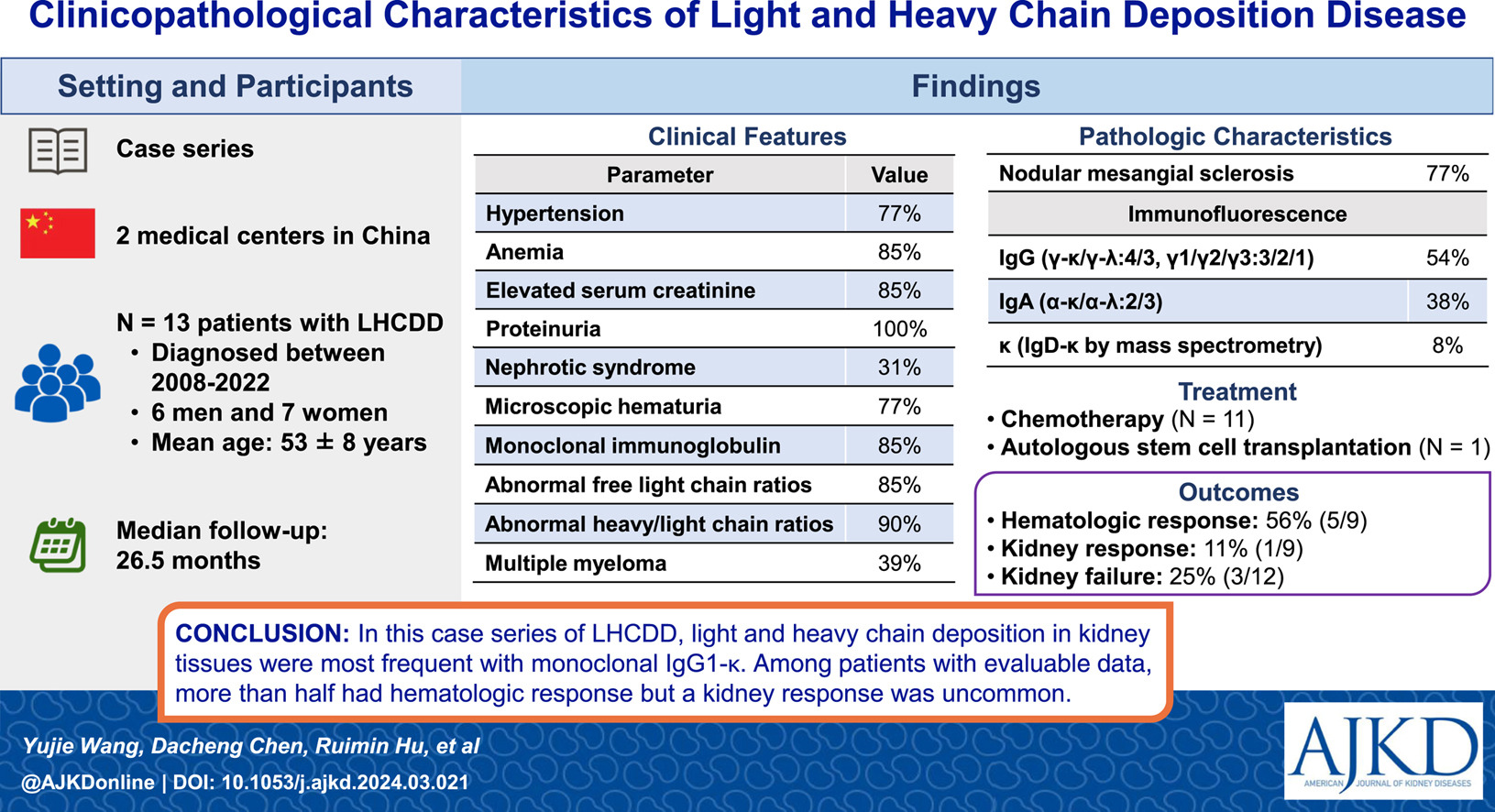
Clinicopathological Characteristics of Light and Heavy Chain Deposition Disease: A Case Series by Yujie Wang and Dacheng Chen
In this case series of LHCDD, light and heavy chain deposition in kidney tissues were most frequent with monoclonal IgG1-κ. Among patients with evaluable data, more than half had a hematologic response, but a kidney response was uncommon.
Organization and Structures for Detection and Monitoring of CKD Across World Countries and Regions: Observational Data From a Global Survey by Somkanya Tungsanga et al
From the authors: Early detection and management of chronic kidney disease (CKD) is crucial to prevent progression to kidney failure. A multinational survey across 167 countries revealed disparities in CKD detection programs. Only 19% reported CKD registries, and 25% implemented detection programs as part of their national policy. Half used a reactive approach while others actively pursued case-finding in at-risk populations. Routine case-finding was common for individuals with diabetes and hypertension. However, limited access to gold standard tools such as estimated glomerular filtration rate (eGFR) and urine albumin-creatinine ratio (UACR), especially in low-income and lower-middle income countries, may hinder CKD detection. A global effort to bridge these disparities is needed to optimally prevent the onset and progression of CKD and its complications.
DOI: 10.1053/j.ajkd.2024.03.024

Associations of Urine and Plasma Metabolites With Kidney Failure and Death in a Chronic Kidney Disease Cohort by Inga Steinbrenner et al
From the authors: Incomplete understanding of the variability of chronic kidney disease (CKD) progression motivated the search for new biomarkers that would help identify people at increased risk. We explored metabolites in plasma and urine for their association with unfavorable kidney outcomes or death in persons with CKD. Metabolomic analyses revealed 182 metabolites significantly associated with CKD progression or death. Many of these associations confirmed previously reported findings or were validated by analysis in an external study population. Our comprehensive screen of the metabolome serves as a valuable foundation for future investigations into biomarkers associated with CKD progression.
DOI: 10.1053/j.ajkd.2024.03.028
Review in the October 2024 issue:
Erythrocytosis and CKD: A Review by Mabel Aoun et al [FREE]
Erythrocytosis or polycythemia is defined as an increase in red blood cell concentration above the age- and sex-specific normal levels. Unlike anemia, which is very common in patients with chronic kidney disease (CKD), erythrocytosis is less frequent but requires specific understanding by health care professionals in order to provide the best care. Erythrocytosis, especially when undiagnosed and untreated, can lead to serious thrombotic events and higher mortality. This Review focuses on the pathogenesis, renal manifestations and management of polycythemia vera, the pathophysiology of erythrocytosis induced by SGLT2 inhibitors and the relevance of timely JAK2 mutation screening in these patients.
DOI: 10.1053/j.ajkd.2024.02.015
 On the Cover:
The Industrial Revolution and mass migration to cities led to an epidemic of rickets in a period with limited treatment options. The cover image shows metallic leg pieces used to correct the bony deformities of rickets in the early eighteenth century. In the twentieth century, food fortification quickly followed the identification of vitamin D as a critical public health intervention. Nonetheless, patients with advanced stages of chronic kidney disease represent a population prone to impaired vitamin D metabolism. Jørgensen et al report on vitamin D metabolism among a cohort of anephric patients who underwent kidney transplantation. The study suggests that, among patients who are anephric, extra-renal CYP27B1 activity maintains low-normal levels of active vitamin D, and the activity of the enzyme may be substrate-driven.
The photograph “Legpieces” is from the Wellcome Collection, available under the CC BY 4.0 license. Special thanks to Editorial Intern Emmanuel Adomako for curating the cover image and drafting the cover blurb for this issue
SPECIAL COLLECTION: CARDIORENAL

The notion of a clinical connection between disorders of the kidneys and the heart has been around since the days William Osler. In more recent years, it has been increasingly accepted that acute or chronic dysfunction of either organ often leads to acute or chronic dysfunction of the other. These AJKD articles highlight the cardiorenal connection, emphasizing what is known and reminding us that there is still much more to learn and understand.
Leave a Reply