
2024 Editors’ Choice Award
In 2017, we established an annual celebration of articles that our editorial team designated as “Editors’ Choice” selections. The editors are delighted to recognize the articles listed below that have been selected to receive the 2024 Editors’ Choice Award. These articles will be freely available at AJKD.org until January 31, 2025. Congratulations to all the authors!

Preeclampsia and Long-term Kidney Outcomes: An Observational Cohort Study by Nityasree Srialluri, Aditya Surapaneni, Alexander Chang A. Dhanya Mackeen, Michael J. Paglia, Morgan E. Grams (December 2023)
Covariate balance before and after propensity matching. Abbreviations: BMI, body mass index; DBP, diastolic blood pressure; eGFR, estimated glomerular filtration rate; SBP, systolic blood pressure. Figure 1 from from Srialluri et al, © 2024 by the National Kidney Foundation, Inc.
From the authors: Preeclampsia is a significant contributor to perinatal and maternal morbidity and is marked by new-onset hypertension and end-organ damage, including acute kidney injury or proteinuria. To gain insight into the long-term kidney effects of the disease, we compared adults with deliveries complicated by preeclampsia with those without preeclampsia in the Geisinger Health System, while also assessing postpartum testing rates. Our results demonstrate that pregnant individuals with preeclampsia are at a heightened risk for future hypertension, reduced eGFR, and albuminuria, with overall low rates of postpartum testing among both individuals with and without preeclampsia. These findings underscore the need to consider preeclampsia as an important risk factor for the development of chronic kidney disease. Further studies are required to determine optimal postpreeclampsia monitoring strategies.

Changes in Cognitive Function After Kidney Transplantation: A Longitudinal Cohort Study by Aditi Gupta, Jonathan D. Mahnken, Joshua Bernal, Palash Sharma, Rebecca J. Lepping, Robert N. Montgomery, David K. Johnson, Adam Parks, Jeffrey M. Burns, David A. Drew, Mark J. Sarnak, and William M. Brooks (July 2024) [Open Access]
From the authors: Cognitive impairment in kidney disease affects self-esteem, vocational abilities, quality of life, health care costs, and mortality. It is not clear whether kidney transplantation (KT) improves cognition and whether the improvement is uniform across cognitive domains. The distinction between reversible and irreversible cognitive impairment has important implications in the clinical care of patients before and after KT. We assessed cognition before KT and 3 months and 12 months after KT and discovered that episodic and verbal declarative memory normalized with KT. Semantic memory, verbal fluency, language, psychomotor speed, and visuospatial function also improved with KT but did not reach normal levels. Cognitive impairment in kidney disease is therefore at least partly reversible.
DOI: 10.1053/j.ajkd.2023.12.022
EDITORIAL: The Impact of Kidney Transplantation on a Breadth of Cognitive Measures by Nidhi Ghildayal, Dorry L. Segev, and Mara McAdams-DeMarco [FREE]

Association of Kidney Cysts With Progressive CKD After Radical Nephrectomy by Moldovan Sabov, Aleksandar Denic, Aidan F. Mullan, Anthony C. Luehrs, Timothy L. Kline, Bradley J. Erickson, Theodora A. Potretzke, R. Houston Thompson, Vidit Sharma, Peter C. Harris, and Andrew D. Rule (July 2024)
From the authors: Kidney cysts are common and often are considered of limited clinical relevance despite being associated with lower glomerular filtration rate. We studied a large cohort of patients who had a kidney removed due to a tumor to determine whether cysts in the retained kidney were associated with kidney health in the future. We found that more cysts in the kidney and, in particular, cysts in the deepest tissue of the kidney (the medulla) were associated with progressive kidney disease, including kidney failure where dialysis or a kidney transplantation is needed. Patients with cysts in the kidney medulla may benefit from closer monitoring.DOI: 10.1053/j.ajkd.2023.11.016
BLOG POST: Simple Kidney Cysts Not So Simple After All: Exploring the Connection Between Simple Kidney Cysts and Post-Nephrectomy Kidney Function Decline by George Vasquez Rios [FREE]

Human Factors Contributing to Infection Prevention in Outpatient Hemodialysis Centers: A Mixed Methods Study by Sarah Henrickson Parker, Matthew N. Jesso, Laurie D. Wolf, Kerry Avondet Leigh, Stephanie Booth, Nicole Gualandi, Renee E. Garrick, Alan S. Kliger, and Priti R. Patel (July 2024)
Link analysis visually capturing staff motion through the facility to complete environmental disinfection of the dialysis station in 2 facilities. Differences such as these could be the result of variation in the facility policies, layout, interruptions, and/or preferences of the individual staff performing the procedures. Figure 2 from Parker et al, © 2024 by the National Kidney Foundation, Inc.
From the authors: Infection prevention efforts in dialysis centers can avert patient morbidity and mortality but are challenging to implement. The objective of this study was to better understand how the design of the work system might contribute to infection prevention in outpatient dialysis centers. We used a systematic macroergonomic approach in multiple outpatient dialysis facilities to identify infection prevention barriers and facilitators related to human performance. Several features common across facilities – such as human performance, work system design, and extrinsic factors — were identified that may influence infection prevention in outpatient care and warrants further exploration.
DOI: 10.1053/j.ajkd.2023.12.024
EDITORIAL: Reducing Infections in Outpatient Hemodialysis: The Impact of Human Factors by Jeffrey I. Silberzweig [FREE]

Impact of Prior Abdominal Procedures on Peritoneal Dialysis Catheter Outcomes: Findings From the North American Peritoneal Dialysis Catheter Registry by Wazaira A. Khan, Matthew J. Oliver, John H. Crabtree, Alix Clarke, Sean Armstrong, Danielle Fox, Rachel Fissell, Arsh K. Jain, Sarbjit V. Jassal, Susie L. Hu, Peter Kennealey, Scott Liebman, Brendan McCormick, Bogdan Momciu, Robert P. Pauly, Beth Pellegrino, Jeffrey Perl, James L. Pirkle, Jr, Troy J. Plumb, Pietro Ravani, Rebecca Seshasai, Ankur Shah, Nikhil Shah, Jenny Shen, Gurmukteshwar Singh, Karthik Tennankore, Jaime Uribarri, Murray Vasilevsky, Robert Yang, and Robert R. Quinn (August 2024)
From the authors: Peritoneal dialysis (PD) is a life-saving therapy for individuals with kidney failure that can be done at home. PD requires the placement of a tube, or catheter, into the abdomen to allow the exchange of dialysis fluid during treatment. There is concern that individuals who have undergone prior abdominal procedures and are referred for a catheter might have scarring that could affect catheter function. In some institutions, they might not even be offered PD therapy as an option. In this study, we found that a history of prior abdominal procedures did not increase the risk of PD catheter complications and should not dissuade patients from choosing PD or providers from recommending it.
DOI: 10.1053/j.ajkd.2023.12.023
BLOG POST: Abdominal Surgery History and Peritoneal Dialysis Catheter Failure: Can We Really Know Who’s at Risk? by Michael Granda [FREE]

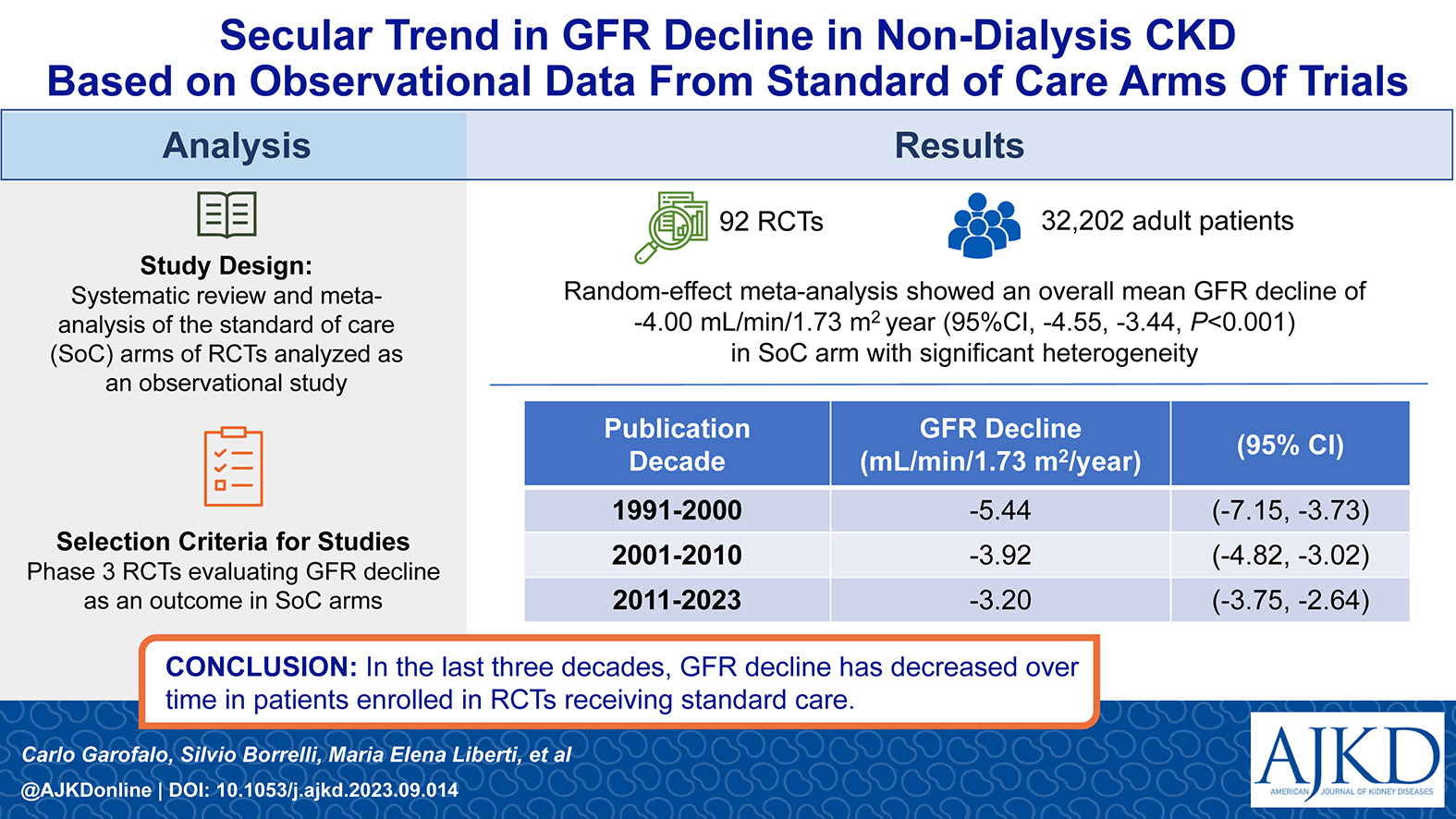
Secular Trend in GFR Decline in Non-Dialysis CKD Based on Observational Data From Standard of Care Arms of Trials by Carlo Garofalo, Silvio Borrelli, Maria Elena Liberti, Paolo Chiodini, Laura Peccarino1, Luigi Pennino, Lucio Polese, Ilaria De Gregorio, Mariarosaria Scognamiglio, Chiara Ruotolo, Michele Provenzano, Giuseppe Conte, Roberto Minutolo, and Luca De Nicola (April 2024) [Open Access]
From the authors: This study evaluated the secular trend in the change in glomerular filtration rate (GFR) decline in the placebo arms of randomized controlled trials (RCTs) that were studying approaches to protect the kidneys in the setting of chronic kidney disease. The placebo groups of RCTs are useful for examining whether the rate of progression of kidney disease has changed over time. We found an improvement in the slope of change in GFR over time. These findings suggest that adherence to standards of kidney care as implemented in clinical trials may be associated with improved clinical outcomes, and these data may inform the design of future RCTs in nephrology.DOI: 10.1053/j.ajkd.2023.09.014
EDITORIAL: Improvements in Kidney Outcomes Over the Years: Reason for Optimism but a Challenge for Trialists by Doreen Zhu, Parminder K. Judge, and Richard Haynes [FREE]
~2024 NKF MISSION AWARD~
“Recognizing research published in AJKD that has great promise to enhance the lives of those affected by kidney disease”
Development and Validation of the Rating of CKD Knowledge Among Older Adults (Know-CKD) With Kidney Failure by Susan Koch-Weser, Kristen Kennefick, Hocine Tighiouart, John B. Wong, Elisa J. Gordon, Tamara Isakova, Dena Rifkin, Ana Rossi, Daniel E. Weiner, and Keren Ladin (May 2024)
Table 2 from Koch-Weser et al, © National Kidney Foundation.
From the authors: The Rating of CKD Knowledge Among Older Adults (Know-CKD) study measures knowledge of chronic kidney disease (CKD) and is designed for older adults. Most existing knowledge measures for CKD focus on people of all ages and all CKD stages. This measure is useful because it will allow researchers to assess how well patient education efforts are working. Patient education is a way to help patients make decisions about their care. We describe how the measure was developed by a team of doctors, researchers, and patients, and how the measure performed among persons with advanced CKD aged 70 years and older. Know-CKD can inform efforts to improve shared decision-making research and practice for older patients with kidney disease.
DOI: 10.1053/j.ajkd.2023.09.024
EDITORIAL: Challenges to Informed, Patient-Centered, and Shared Decision Making for Treatment of Kidney Failure in Older Adults by Elizabeth Kiernan and Susan P.Y. Wong [FREE]

The full list of AJKD Editors’ Choice articles is available at AJKD.org.
Leave a Reply