
Quantifying Proteinuria: An Interview
Proteinuria plays a central role in the diagnosis of kidney disease and has a high prognostic value. The test methods used differ considerably regarding their impact on test accuracy, sensitivity, and specificity. In a recent Review by Hodel et al, the different types of tests for proteinuria and their underlying methodologies and strengths and weaknesses are discussed.
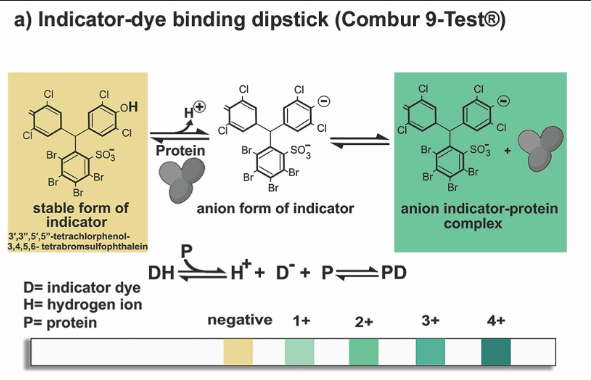
Principles of semiquantitative urine dipstick diagnostics. (A) Indicator dye–based dipstick test. Figure 1 from Hodel et al, © National Kidney Foundation.
AJKDBlog’s Interviews Editor, Timothy Yau (@Maximal_Change), sat down with Drs. Roger Rodby (@NephRodby) and William Whittier (@TWhittier_RUSH) to explore the difference between microalbuminuria, overt albuminuria, the UPCR, and the pros and cons of all these different measurements.
If the embedded player above doesn’t work, please click here to watch the video interview. Special thanks to Drs. Rodby and Whittier for their time and insight!
To view this Review by Hodel et al [Open Access], please visit AJKD.org:
Title: Methods for Diagnosing Proteinuria—When to Use Which Test and Why: A Review
Authors: Nikolai Carl Hodel, Katharina M. Rentsch, Daniel Henry Paris, Michael Mayr
DOI: 10.1053/j.ajkd.2024.09.017
Leave a Reply