
Highlights from the October 2025 Issue
Editor’s Note: We asked authors of Original Investigations to provide short plain-language summaries that would briefly summarize what inspired their study, the basic approach taken, what was learned, and why it matters. We hope our readers will find this valuable in helping them keep up with the latest research in the field of nephrology.
Highlights from the October 2025 issue:
Primary Care Use and Clinical Outcomes Among Patients Initiating Hemodialysis by Dustin Le et al.
DOI: 10.1053/j.ajkd.2025.04.017
EDITORIAL: Missed Opportunities: Rethinking Primary Care Engagement in Dialysis-Dependent Populations by Brittany Watson and Clarissa Diamantidis [FREE]

Incidence and Adverse Outcomes of Acute Kidney Disease: A Systematic Review and Meta-Analysis by Changyuan Yang et al. [OPEN ACCESS]
From the authors: In this systematic review and meta-analysis of 59 studies involving nearly 6 million participants, we found that acute kidney disease (AKD) is globally prevalent and is associated with higher risks of adverse outcomes, including all-cause mortality, chronic kidney disease, and kidney failure. Estimates of AKD incidence and AKD-associated risks of clinical outcomes vary significantly depending on the definition of AKD used. The selection of the definition for AKD and the presence of baseline acute kidney injury influence the estimate of AKD incidence and its association with health consequences. The findings of this study should guide efforts to refine clinical guidelines and inform public health strategies to address the global burden of AKD more effectively.
DOI: 10.1053/j.ajkd.2025.05.008
EDITORIAL: Reframing Acute Kidney Disease: Two Coins or Two Sides? by Christopher H. Grant, Simon Sawhney, and Samira Bell [FREE]
Carbon Emissions From Different Dialysis Modalities: A Life Cycle Assessment by Katherine A. Barraclough et al. [OPEN ACCESS]
From the Authors: As climate change intensifies, there is growing pressure on health care systems to reduce their greenhouse gas emissions. To do this effectively, it is important to understand the carbon footprint of different treatment options and identify key areas where emissions are highest. This study compared greenhouse gas emissions from 4 types of dialysis: hemodialysis performed in a health care facility (in-center hemodialysis), home hemodialysis, automated peritoneal dialysis (APD), and continuous ambulatory peritoneal dialysis (CAPD). We found that in-center hemodialysis had the highest carbon footprint, primarily due to the impact of patient travel. Among the home therapies, APD was responsible for higher emissions than home hemodialysis while CAPD had the lowest carbon footprint. Across all treatment types, consumables were the largest source of carbon emissions.
DOI: 10.1053/j.ajkd.2025.04.019
EDITORIAL: Operationalizing Environmental Sustainability in Kidney Care at System and Provider Levels: Knowledge Is the First Step by Isabelle Ethier and Caroline Stigant [FREE]

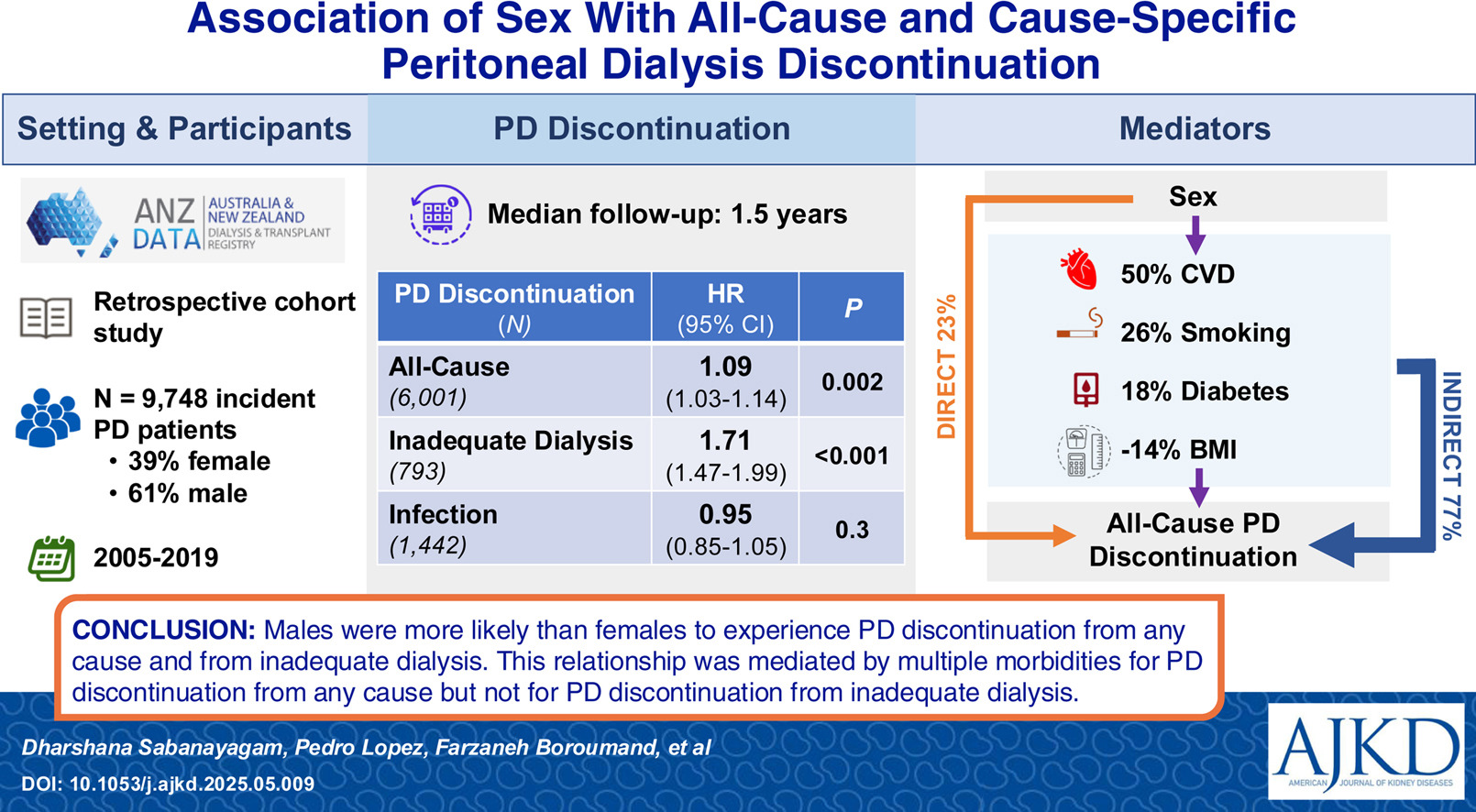
Association of Sex With All-Cause and Cause-Specific Peritoneal Dialysis Discontinuation by Dharshana Sabanayagam et al.
From the authors: Sex and gender differences can influence kidney disease risk, progression, access to care, and outcomes. However, their role in peritoneal dialysis (PD) discontinuation is not well understood. We studied the association between sex and PD discontinuation in Australian patients with kidney failure from 2005 to 2019, and whether sociodemographic factors and comorbidities influenced this relationship. We found that men were more likely to discontinue PD overall and because of inadequate dialysis but not because of infectious complications. Cardiovascular disease, smoking, and diabetes explained most of the differences between men and women for all-cause PD discontinuation but not for discontinuation due to inadequate dialysis. These findings may inform future studies evaluating biological and sociodemographic factors that may contribute to these observed sex differences.
DOI: 10.1053/j.ajkd.2025.05.009
EDITORIAL: From What to Why: Mechanistic Understandings Behind Sex Differences in Peritoneal Dialysis Discontinuation by Sandipan Shringi, Edward Medeiros, and Ankur D. Shah [FREE]
Association Between the Ideal Cardiovascular Health Score and Cardiovascular-Kidney Outcomes in Young Adults by Hyeok-Hee Lee et al.
From the authors:
DOI: 10.1053/j.ajkd.2025.03.024
Core Curriculum In Nephrology in the October 2025 issue:
Autosomal Dominant Polycystic Kidney Disease: Core Curriculum 2025 by Craig E. Gordon et al. [FREE]
DOI: 10.1053/j.ajkd.2025.05.010
 On the Cover:
Rural landscapes make up greater than 95% of the United States’ land area, but are populated by just 20% of the population. The burden of chronic kidney disease (CKD) is significantly higher in rural populations. The higher risk of CKD in rural compared to urban areas has been attributed to several factors including barriers to accessing health care or health insurance, greater prevalence of diabetes and hypertension, and socioeconomic factors. In this issue, Koppula et al. explore these unique challenges and discuss strategies to achieve health equity in rural CKD care by promoting early detection of CKD, improving health care access, harnessing telehealth and telemonitoring technologies, and improving access to in-center and home dialysis modalities.
Special thanks to Editorial Intern Madhumitha Rajagopal for curating the cover image and drafting the cover blurb for this issue. The photograph “Rural abode” by william dorward is released on Flickr under the CC BY-SA 2.0 license.
SPECIAL COLLECTION: HIGHLY CITED

The articles in this special collection highlight the top cited Original Investigations published in 2022 and 2023 that contributed to AJKD’s 2024 Impact Factor of 8.2.
Leave a Reply