
Highlights from the December 2025 Issue
Editor’s Note: We asked authors of Original Investigations to provide short plain-language summaries that would briefly summarize what inspired their study, the basic approach taken, what was learned, and why it matters. We hope our readers will find this valuable in helping them keep up with the latest research in the field of nephrology.
Highlights from the December 2025 issue:
Intronic and Coding Genetic Variants in Autosomal Recessive Polycystic Kidney Disease Among Israeli Bedouins of Arabian Peninsula Ancestry by Nadav Agam et al.
DOI: 10.1053/j.ajkd.2025.06.011
EDITORIAL: A Novel Founder PKHD1 Disease Causing Variant in Israeli Bedouins With Autosomal Recessive Polycystic Kidney Disease by John A. Sayer and Joshua Pillai et al. [FREE]

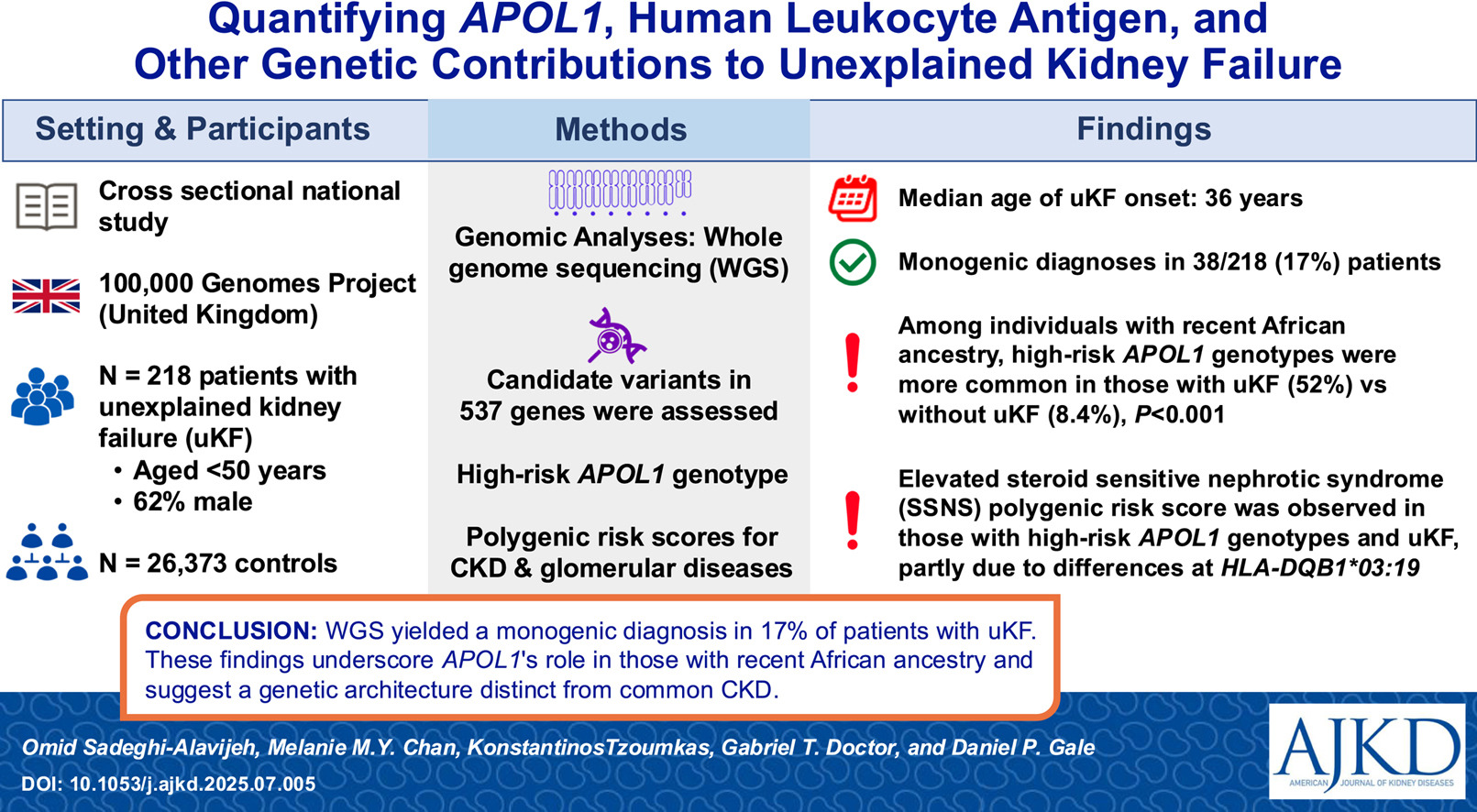
Quantifying APOL1, Human Leukocyte Antigen, and Other Genetic Contributions to Unexplained Kidney Failure by Omid Sadeghi-Alavijeh et al.
From the authors: Our study was motivated by the difficulty in understanding why some people experience kidney failure (KF) without a clear cause. Many patients face uncertainty about their future health and treatment because doctors cannot always find an explanation for their condition. To address this challenge, we examined the complete genetic blueprint of individuals with unexplained KF. We looked for genetic clues that might reveal hidden risks. Our work uncovered specific genetic factors that appear to contribute to KF, especially among people with African heritage. These insights are important because they may help explain why KF happens in some cases and inform personalized diagnosis and treatment.
DOI: 10.1053/j.ajkd.2025.07.005
EDITORIAL: Gaining a Genomic Foothold on Unexplained Kidney Failure by Janewit Wongboonsin et al. [FREE]
Perceptions About Influenza and COVID-19 Vaccines Among People With CKD: Findings From the Chronic Renal Insufficiency Cohort (CRIC) Study by Guangchen Zou et al.
From the Authors: People with chronic kidney disease (CKD) are at higher risk for infections, but some are hesitant to get vaccines. This study surveyed 278 CKD patients to understand why some avoid flu and COVID-19 vaccines. The study found about 17% were hesitant about each vaccine. People who were hesitant often believed the vaccines could be harmful or doubted their benefits. For example, some thought the flu vaccine could cause the flu or that vaccine benefits were exaggerated. By contrast, those who believed vaccines prevent serious illness were less hesitant. These findings suggest that clear, trustworthy information about vaccine safety and effectiveness—shared in ways that address patient concerns—could help increase vaccination rates in people with CKD.
DOI: 10.1053/j.ajkd.2025.07.008
EDITORIAL: Vaccines as a Core Conversation in Nephrology by Nivetha Subramanian and Shuchi Anand [FREE]

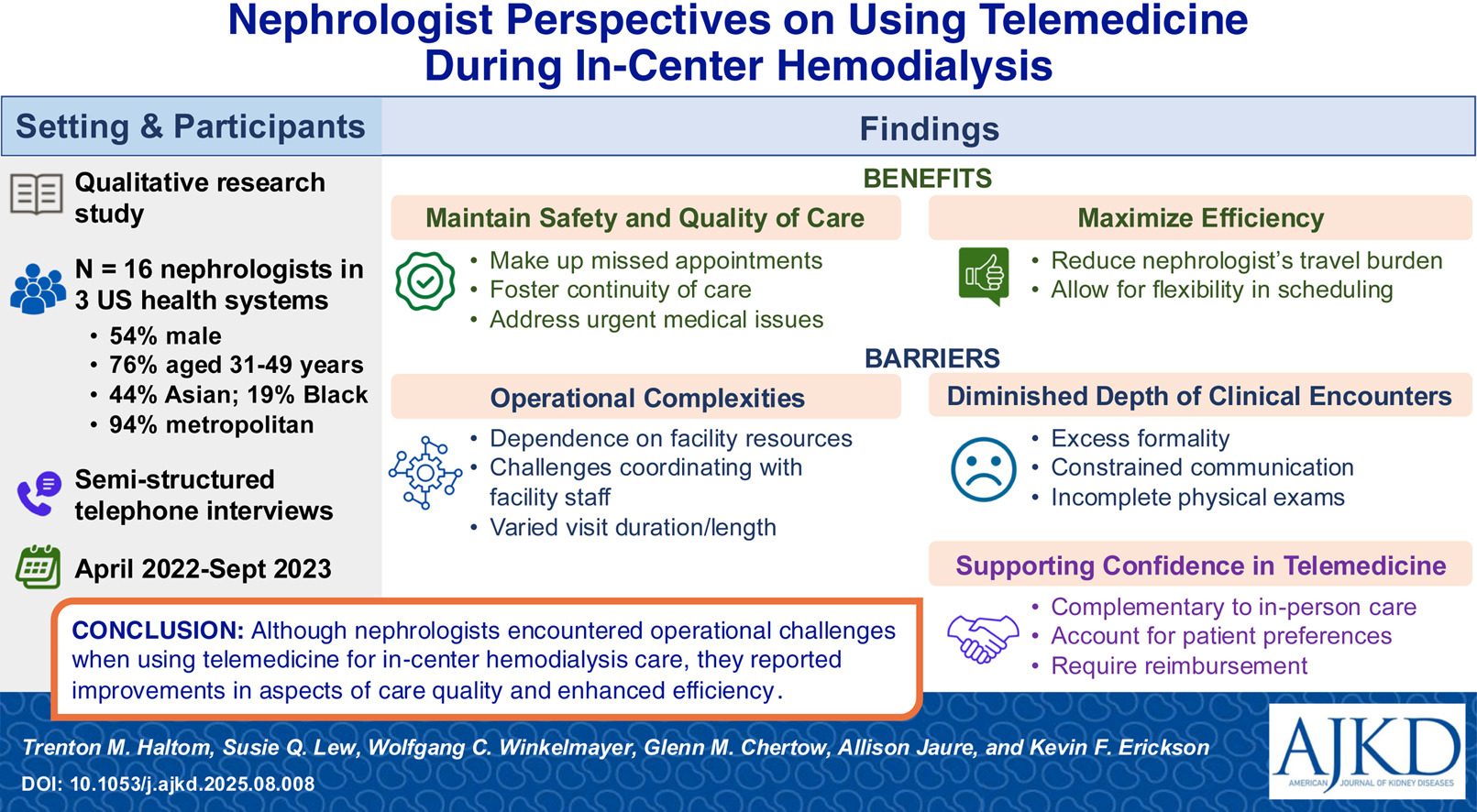
Nephrologist Perspectives on Using Telemedicine During In-Center Hemodialysis: A Qualitative Study by Trenton M. Haltom et al.
From the authors: We describe nephrologists’ perspectives and experiences with delivery of care using telemedicine at dialysis facilities during the COVID-19 pandemic. The nephrologists participating in this study suggested telemedicine is beneficial to maintaining patient safety and quality of care and maximizing physicians’ efficiency. Nephrologists experienced barriers given operational complexities such as technical and personnel support from dialysis facilities. Clinical encounters were also less personal and more formal. Nevertheless, the experiences of participating nephrologists suggest that a hybrid care model with both in-person and telemedicine visits may help maintain high-quality care while increasing the efficiency of delivering clinical care. These findings inform the potential use of a hybrid in-center hemodialysis care delivery model.
DOI: 10.1053/j.ajkd.2025.08.008
EDITORIAL: Telemedicine in Dialysis: Established Gains Yet Enduring Gaps to Enhance the Quality of Care by Alyssa Steitz and Devika Nair [FREE]
Development and Evaluation of Machine Learning Models to Predict the Risk of Major Cardiac Events and Death for People With Kidney Failure Having Non-Cardiac Surgery by Gurpreet S. Pabla et al.
From the authors: People with kidney failure face high risks of cardiovascular problems and death after noncardiac surgery, but the current tools to predict these risks do not work well. This study developed new machine learning–based risk prediction models to help identify which patients are at higher risk after having noncardiac surgery. The models used a small number of easily available variables such as type of surgery, surgery setting, and laboratory results. We tested the models by using data from 2 Canadian provinces and found them to be accurate and reliable. These models may allow clinicians to inform patients of their individualized risk, which may support shared perioperative decision making. More research is needed to see how they perform in other geographic locations and health care systems.
DOI: 10.1053/j.ajkd.2025.07.006
Effectiveness of Bivalent mRNA COVID-19 Vaccine Among Adults With Kidney Failure Receiving Dialysis: A Cohort Study From the Centers for Medicare and Medicaid Services by Amanda Payne et al.
From the authors: People with kidney failure treated with maintenance dialysis are at increased risk of severe COVID-19. The role of COVID-19 vaccination in this population is not well characterized. Between September 4, 2022, and April 1, 2023, the relative effectiveness of a bivalent mRNA COVID-19 vaccine dose compared with receipt of original monovalent COVID-19 vaccine doses alone among adults aged ≥18 years with kidney failure treated with maintenance dialysis but without additional immunocompromising conditions was 41% (95% CI, 37%-46%) against medically attended COVID-19, with the estimated effectiveness being similar for severe outcomes like COVID-19–associated hospitalization and COVID-19–associated death. COVD-19 vaccine effectiveness among these adults waned with more time since vaccination.
DOI: 10.1053/j.ajkd.2025.07.012
Core Curriculum In Nephrology in the December 2025 issue:
Hematologic Considerations in Kidney Transplantation: Core Curriculum 2025 by Leigh-Anne Dale and Jason Freed
DOI: 10.1053/j.ajkd.2025.07.010
 On the Cover:
The word vaccine comes from vacca, Latin for “cow.” The cowpox virus (Vaccinia virus) was used in Edward Jenner’s first vaccine against smallpox, which was ultimately eradicated. In this issue of AJKD, Zou et al report on COVID-19 vaccine hesitancy among adults with CKD and suggest clinicians should address patient concerns with clear, trustworthy information.
Special thanks to Editorial Intern Jillian Caldwell for curating the cover image and drafting the cover blurb for this issue. The photo “dairy_cow” by Kabsik Park is released on Flickr under the CC BY-SA 2.0 license.

The editors are delighted to recognize these articles that have been selected to receive the 2025 AJKD Editors’ Choice Award (all articles are freely available until February 1, 2026).
Leave a Reply