
#NephMadness 2025: The Effluent Eight
It’s time to announce the winners of each region! Is your pick for the eventual champion still alive, or have your hopes been dashed by the Blue Ribbon Panel? Check out the Current Standings and tweet your reaction and score with the hashtag #NephMadness
We proudly present:
Current Standings | Match Results | @NephMadness | @nephmadness.bsky.social
Many thanks to Krithika Mohan @krithicism for the scoreboard graphics!
Resistant Hypertension Region

Highly touted Team Renal Denervation didn’t even show up to play. Team Novel Drugs for Hypertension with the easy first round victory.
Novel Rx for HTN wins 8-1
Comments from the BRP:
“With so many tried and true meds (and emerging options!), why risk the unknowns of denervation?”
“In my opinion, if you are going to do something like this, do it with style [referring to the innovative treatment with accessible application and, above all, useful].”
“Renal denervation is like using a (fancy) sledgehammer to crack a nut. First, let’s improve getting to an optimal regimen, adherence, and access to medications. My vote is for Novel Rx for HTN… though I have no idea how to pronounce any of them except semaglutide.”
“I’m going with Novel Rx for HTN because it brings new meds that actually target the root causes of high blood pressure, including options that last for months with just one dose. Renal Denervation is an interesting idea, but it’s a procedure that doesn’t always work, and nerves can grow back over time. Plus, it’s expensive. Both had great points though.”
“Denervation has been the disappointment that just keeps disappointing. It is time to get better medications and the scouting report has promising rookies. Some of them show real BP reduction promise, not that piddly 4-6 mmH Hg that is so bleh to the resistant HTN we deal with. Meds for the win.”
“Two things. 1) I’m a physician, I prescribe medicines. 2) NOT THIS AGAIN SURELY?! (guess…). I think those 2 points make my choice.”
Disaster Nephrology Region

This match up was expected to be a fierce battle but Team Kidney Care In Natural Disasters‘ full court press was no match for Team Kidney Care In Conflict. In Natural Disasters with the easy victory.
In Natural Disasters wins 7-2
Comments from the BRP:
“It’s almost unnatural how often natural disasters are happening!”
“’I guess you guys aren’t ready for that yet. But your kids are gonna love it.’”
“Wow. This one was impossible. Either of teams could win it all. Coin flip simulator chose ‘In Natural Disasters’ (Best of 5: Heads 3, Tails 2).”
“Disaster Nephrology in Conflicts because war zones create ongoing chaos where dialysis patients, transplant recipients, and those with kidney injuries are often cut off from life saving treatment for extended periods. Both were great , another tough decision.”
“Climate change (yes Donald, it is real…)and it is not going away. We have already seen what hurricanes have done to RRT supplies. This has impacted my patients after more than one hurricane, and having to compromise on PD dialysate? Not good. While ‘War, what is it good for, absolutely nothin – say it again‘ was not only an hit song/anthem of 1970 (and a very funny Seinfeld episode), I just don’t see it impacting as much. Climate (Natural disasters) for the win.”
“Writing from a stably governed temperate climate with no tectonic plates or bodies of water nearby, I can only acknowledge my privilege. Both possibilities are terrifying to everyone including kidney patients and health care professionals. A genuine coin flip. Natural disaster.”
Genetics Region
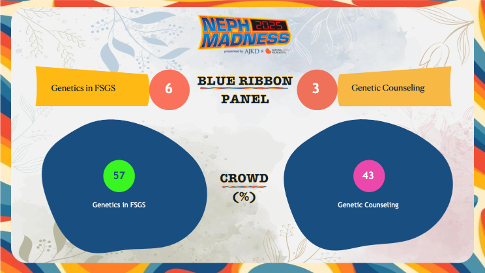

Team Genetic Counseling proved to be all talk leading to Team Genetics in FSGS’ decisive win.
Genetics in FSGS wins 6-3
Comments from the BRP:
“If genetic testing is the fastest car in the world (Koenigsegg Jesko Absolut, theoretically capable of exceeding 330 mph), genetic counseling is the seatbelt/brakes. SAFETY FIRST!”
“Genetics in FSGS because, as someone living with FSGS, I know firsthand how crucial it is to understand why this disease happens in the first place. Genetic research is opening doors to treatments that could stop FSGS at its source instead of just managing symptoms. While genetic counseling is important, it only helps guide decisions, it doesn’t change the game like discovering new treatments does. Great work both teams.”
“This is easy, you cannot counsel anyone until you make the diagnosis. FSGS has been the garbage dump of pathology for too long. Let’s get to the bottom of it once and for all. Genetics in FSGS for the win.”
“This one is easy for me. Thinking about genetic contributors to FSGS is part of my day to day work, so that’s the winner…”
CAR-T for Kidney Disease Region
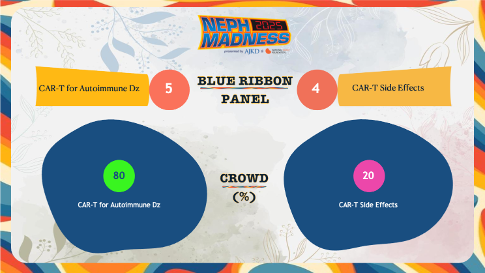
These two hotly talked about newcomers to the tournament did not disappoint! Going into overtime, Team CAR-T for Autoimmune Diseases was able to wear down Team CAR-T Side Effects and walk away with the win.
CAR-T for Autoimmune Diseases wins 5-4
Comments from the BRP:
“We must be careful not to put the CAR-T before the horse!”
“Very cool, effective mechanism re: CAR-T cells for AI diseases. Most impactful for us/our patients/practice changing in nephrology in the next 5 years ? Obviously (kidney) Side effects.”
“Autoimmune Disease because I’ve seen firsthand how devastating autoimmune conditions can be. My mother lost her battle with autoimmune liver disease in 2012, and there weren’t many options to stop it. CAR-T therapy can hopefully reset the immune system, not just manage symptoms like traditional meds. While the side effects are serious, so are the diseases it’s trying to treat. If this therapy can give people with autoimmune diseases a real shot at remission, it’s worth pushing forward. This was a person choice!”
“The potential of CAR-T reminds me of CRISPR, a 2017 NephMadness finalist (losing to Genes in ESKD Disparity – not my choice that year). Technology is the key to everything. Side effects is the Debbie Downer of NephMadness. CAR-T for the win!”
“An exciting field still in its discovery phase. Although side effects are clearly a major hurdle. They’re just that: a hurdle to be jumped, not an impassable roadblock. Therapy wins.”
Hemodialysis Region
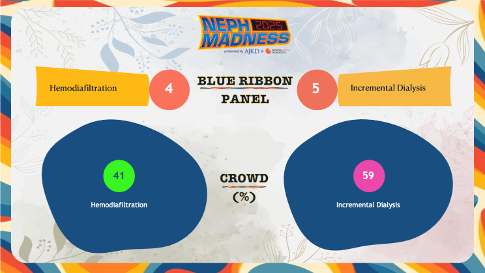
This was another close match up. Team Hemodiafiltration and Team Incremental Dialysis were so closely matched that it was hard to predict who would win the crown in the Hemodialysis Region. In the end, Team Incremental Dialysis eked out the victory.
Incremental Dialysis wins 5-4
Comments from the BRP:
“Since we don’t really know how fast to go, let’s make it incremental!”
“HDF is a cool concept and sounds great to have better clearance of FGF23, AGE etc…though how can I not vote for the patient centered approach/outcome? One size never fits all. (I see you, 2018 NephMadness Champion: Patient Reported Outcomes).”
“Incremental Dialysis because, as someone who’s been on dialysis since 2007, I know how tough it is to jump straight into full-time treatment. Starting with a gradual approach could help preserve kidney function longer and improve quality of life, which is huge for patients trying to adjust. Dialysis isn’t cookie cutter, and if we can tailor treatment to each patient’s needs instead of defaulting to tough schedules, it could change the game for a lot of people.”
“Anyone that knows me, knows I that have been putting all my chips in on hemodiafiltration for years, even before the studies suggested a benefit. There is much more than a suggestion now. I like incremental dialysis, a lot, but seems less practical for HD than PD for which it is perfectly suited. Hemodiafiltration for the win. I’m gonna take this baby far.”
“This is a good battle of two biologically plausible things that haven’t quite delivered the evidence yet. To misquote Spock ‘the dialysis needs of the many outweigh the dialysis needs of the few‘ so I think HDF shades it.”
Green House Region
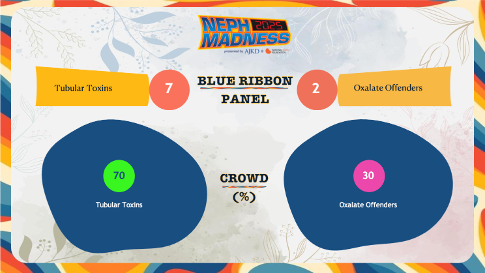
Team Oxalate Offenders proved to be no match up for Team Tubular Toxins. Team Tubular Toxins with the easy win.
Tubular Toxins Wins 7-2
Comments from the BRP:
“‘If the oxalate shall offend thee, pluck it out from thy diet!‘”
“‘Roads? Where we’re going, we don’t need roads.‘”
“Strong teams on both sides here. As much as I love oxalate (‘it must be exhausting always rooting for the [anti-nutrient]’…get it?) and every oxalate-containing food, these complementary/alternative medicines/tubular toxins need more attention and education for both patients and healthcare providers.”
“While oxalate offenders are important, especially for those at risk to kidney stones. I’d still vote for Tubular Toxins because the risk extends beyond diet and affects a larger group of kidney patients, including those with CKD, transplants, and dialysis. Many people unknowingly take herbal supplements that aren’t good, making it a hidden danger that needs more attention.”
“Few things are more fun than finding the mysterious baddie someone is consuming. There is a LOT of oxalate hidden out there, and how have I not heard about ‘oxalate toxicosis’ in livestock? I watch Dr Pol religiously. But the pandora’s box of herbal medications is as big as a shipping crate. Tubular Toxins for the win.”
“As the son of a man who grew up in the rhubarb triangle (yes, it’s real) it can only be oxalate for me.”
Obesity in Kidney Transplant Region
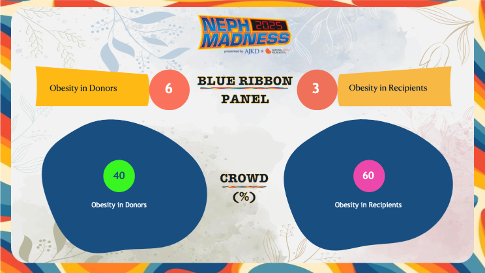
Team Obesity in Kidney Transplant Recipients‘ offense proved to be no match up for Team Obesity in Kidney Transplant Donors‘ defense. Team Obesity in Donors with the victory.
Obesity in Donors wins 6-3
Comments from the BRP:
“This is like the Chiefs vs Niners Super Bowl – can they both lose? BMI is just a number with many limitations. My vote is for obesity in donors here, especially re: weight loss clinics…though who will staff these clinics is a huge question. Agree 1000% that ‘ensuring the protection and optimization of donor care is of utmost importance.'”
“Having lived through the challenges of steroid-induced weight gain, I know firsthand how hard it is to balance medications, diet, and exercise while trying to maintain a healthy weight.”
“You have to get a patient to transplant before they can become obese after the transplant. I know -do no harm- but denying a patient a transplant is equally harmful. Obesity in Donors for the win.”
“Not even close this one.”
Minimal Change Disease Region
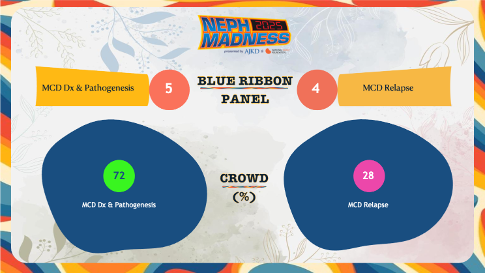
These two strong teams made for an exciting tournament game. Evenly matched, these two teams kept the score close till the very end when Team MCD Diagnosis and Pathogenesis was able to hit a buzzer beater.
MCD Diagnosis and Pathogenesis wins 5-4
Comments from the BRP:
“‘It can’t be! I just sent you back…‘”
“Anti-nephrin FTW! New biomarker > better diagnosis, potentially better/more targeted therapy…”
“Personally, managing a chronic, unpredictable disease is far harder than diagnosing it. Treatment decisions, side effects, and quality of life are bigger concerns. Great work!”
“That algorithm for ‘Initial management of a Child with nephrotic Syndrome’ is a nightmare. We need to have a more sophisticated approach. I doubt the anti-nephron story for podocytopathies will be as good as PLA2R (and other antibodies) was for MGN, but it is a start and finally something other than diffuse foot process effacement… MDC Diagnosis for the win.”
“Again, something that takes up a lot of my day to day working life. Diagnosis is important to individualize treatment and hopefully prevent relapse. Again, coin flip. Relapse as they can ruin patient’s lives.”
Current Standings | Match Results

#NephMadness | #NephMadness
Reminder:
US-based physicians can earn 1.0 CME credit and 1.0 MOC per region through NKF PERC (detailed instructions here). The CME and MOC activity will expire on June 1, 2025.
Leave a Reply