
Highlights from the January 2026 Issue
Editor’s Note: We asked authors of Original Investigations to provide short plain-language summaries that would briefly summarize what inspired their study, the basic approach taken, what was learned, and why it matters. We hope our readers will find this valuable in helping them keep up with the latest research in the field of nephrology.
Highlights from the January 2026 issue:
Contraceptive Use and Reproductive Health in Women With CKD: A Qualitative Study of Nephrologists in the United States by Nedas Semaska et al. [OPEN ACCESS]
DOI: 10.1053/j.ajkd.2025.07.007
EDITORIAL: Breaking Down Barriers to Reproductive Health Care in CKD by Ryann Sohaney and Andrea L. Oliverio et al. [FREE]

Trends in Major Cardiovascular Events and Bleeding Among Patients With Advanced CKD: A Nationwide Swedish Study by Anne-Laure Faucon et al. [FREE]
From the authors: We explored rates and trends of cardiovascular and bleeding events in Swedish patients with advanced CKD between 2011 and 2021. Cardiovascular and bleeding events were 1.5 to 11.1 times more common in patients with CKD than in the general population. However, over time there has been a significant reduction in the rates of both types of events. The decline in these events over time was larger than that observed in the general population. These findings document improvements in cardiovascular and bleeding risks for patients with advanced CKD, but their continued occurrence at a rate greater than in the general population indicates the need for additional strategies to further reduce the burden of these health conditions.
DOI: 10.1053/j.ajkd.2025.08.011

Patient and Center Factors in Home Dialysis Therapy Uptake: Analysis of a UK Renal Registry Cohort and a National Dialysis Center Survey by Jessica Potts et al. [OPEN ACCESS]
From the Authors: Some patients are less likely to use home dialysis, possibly due to both patient characteristics and how dialysis centers operate. We studied over 32,000 patients who began kidney replacement therapy between 2015 and 2019, linking national patient data with a 2022 survey of English dialysis centers. Using advanced statistical methods, we uncovered direct and indirect links between patient and center factors and home therapy use. Patients were more likely to use home dialysis if their center offered supportive practices like assisted dialysis, staff-led improvement projects, or home dialysis educational roadshows. Notably, centers serving diverse populations were more likely to implement such practices. This study highlights how center practices may contribute to improving and reducing disparities in access to home therapy.
DOI: 10.1053/j.ajkd.2025.08.012

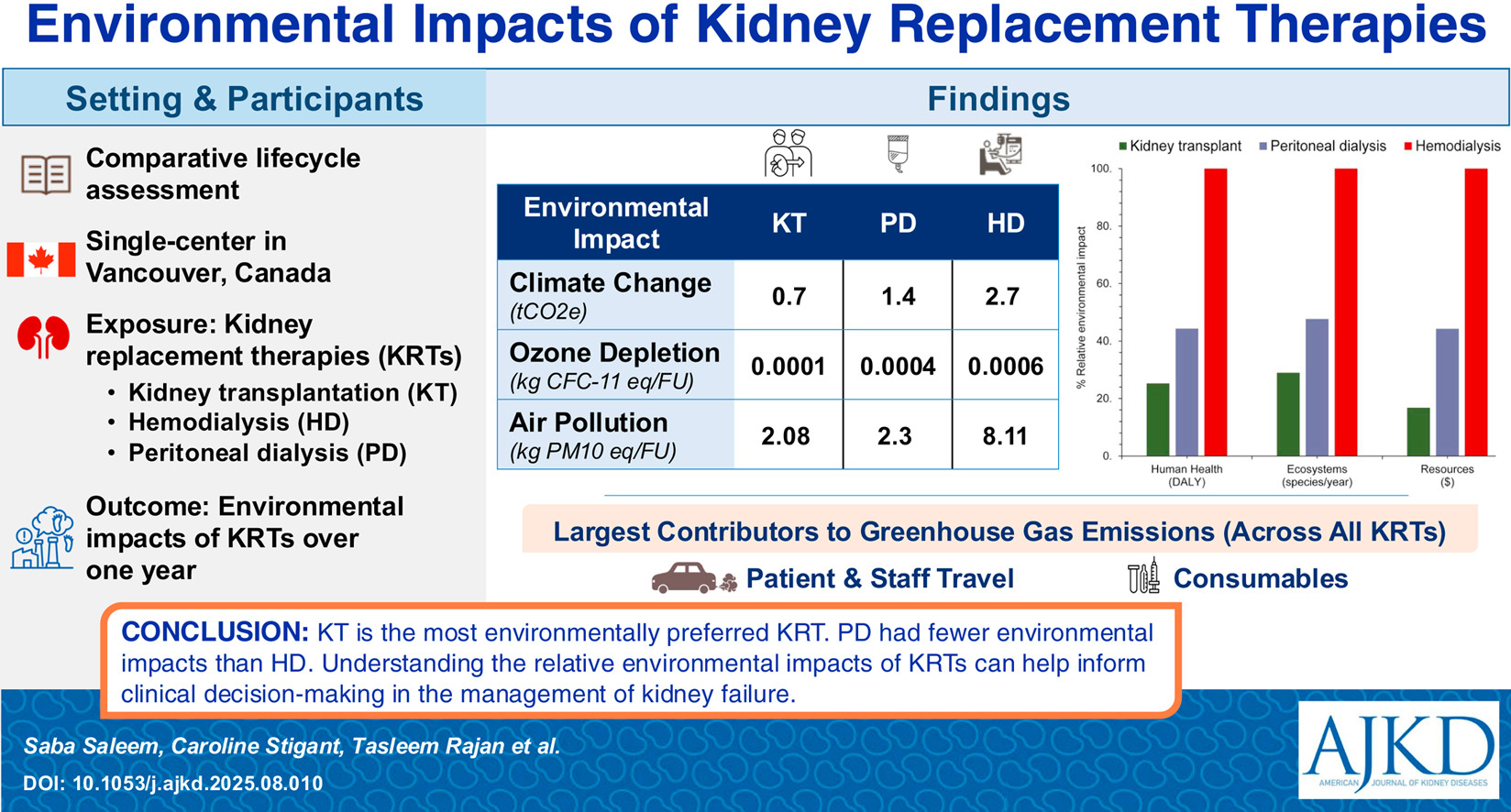
Environmental Impacts of Kidney Replacement Therapies: A Comparative Lifecycle Assessment by Saba Saleem et al. [OPEN ACCESS]
From the authors: The environmental impacts of health care are gaining attention, yet kidney care, and especially kidney replacement therapies (KRTs), have been underexamined. This study was inspired by growing concerns about the environmental consequences of KRTs like hemodialysis, peritoneal dialysis, and transplantation. We used environmental assessment tools to measure emissions and resource use across different KRTs in a clinical setting in Vancouver, Canada. We found that these therapies vary widely in their environmental impacts, with in-center hemodialysis having the greatest negative impact and kidney transplant the least impact. This study also explored the sources of these impacts and can inform health systems and health care policymakers regarding opportunities for more environmentally informed practices in kidney care.
DOI: 10.1053/j.ajkd.2025.08.010
Association of Influenza Vaccination With Acute Kidney Injury: A Prospective Target Trial Emulation Study by Lin Zhuo et al. [OPEN ACCESS]
From the authors: Influenza infection can damage multiple systems beyond the respiratory system and cause impairment of kidney function. We hypothesized that influenza vaccination may provide a more extensive protective effect beyond respiratory diseases. However, the impact of influenza vaccination on the risk of acute kidney injury (AKI) has not been sufficiently evaluated. This study investigated the association between influenza vaccination and AKI in older adults represented in the UK Biobank, a large prospective cohort. By emulating a targeted randomized clinical trial in this cohort, we found that influenza vaccination may reduce the risk of AKI by 17%. This effect was partially mediated by a reduction in influenza and pneumonia. These findings support the broader implementation of influenza vaccination to reduce both influenza and kidney-related complications in older adult populations.
DOI: 10.1053/j.ajkd.2025.09.005

Core Curriculum In Nephrology in the January 2026 issue:
Skin Disorders in Kidney Disease: Core Curriculum 2026 by Colleen M. Glennon et al [FREE]
DOI: 10.1053/j.ajkd.2025.03.031
 On the Cover:
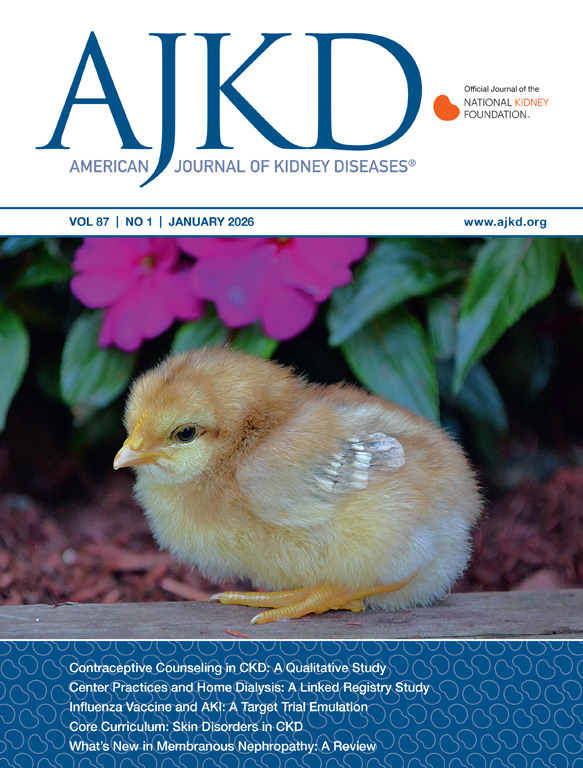
The human influenza virus was first isolated in 1933. Two years later, Sir Frank Macfarlane Burnet and Wilson Smith separately discovered that the virus could be grown on the chorio-allantoid membrane of embryonated chicken eggs. Even today, most influenza vaccines are manufactured using this process. A smaller proportion of vaccines are manufactured using cell-culture and recombinant technologies that were approved by the FDA in 2012 and 2013. In this issue of AJKD, Zhuo et al report a reduction in the risk of acute kidney injury in elderly patients who received the influenza vaccine. Their work supports the protective effect of the influenza vaccine against the disease and its kidney-related complications.
Special thanks to Editorial Intern Ifeoluwa Stowe for curating the cover image and drafting the cover blurb for this issue. The photo “A Little Chick In The Garden” by DaPuglet is released on Flickr under the CC BY-SA 2.0 license.

The editors are delighted to recognize these articles that have been selected to receive the 2025 AJKD Editors’ Choice Award (all articles are freely available until February 1, 2026).
Leave a Reply