
Dialysis Facility Closure Trends Over the Past Decade: An Interview
Between 2006 and 2016, the number of US dialysis facilities experienced steady annual growth. Recent data suggest a reversal in this trend. Varkila et al examined trends in US dialysis facility closures and associated facility- and neighborhood-level characteristics. AJKDBlog’s Interviews Editor, Timothy Yau (@Maximal_Change), recently sat down with an author of the author of the study, Meri Varkila, to discuss the implications of their research.
Meri Varkila, MD, is a Postdoctoral Fellow at Stanford University at the Division of Infectious Diseases and Geographic Medicine. Her research aims to improve infectious disease and health outcomes through advancing public health interventions and healthcare delivery for vulnerable communities.

AJKD Blog: Your paper focuses on dialysis facility trends over the past 15 years or so. When I look at the most recent USRDS data looking at incidence and prevalence of ESKD, there is an all time high in the number of people with kidney failure (831K at end of 2023) but a relatively stable prevalence of patients receiving dialysis. Can you summarize the trends in dialysis facility growth between 2006-2016, and the losses since 2022? What factors play into these trends?
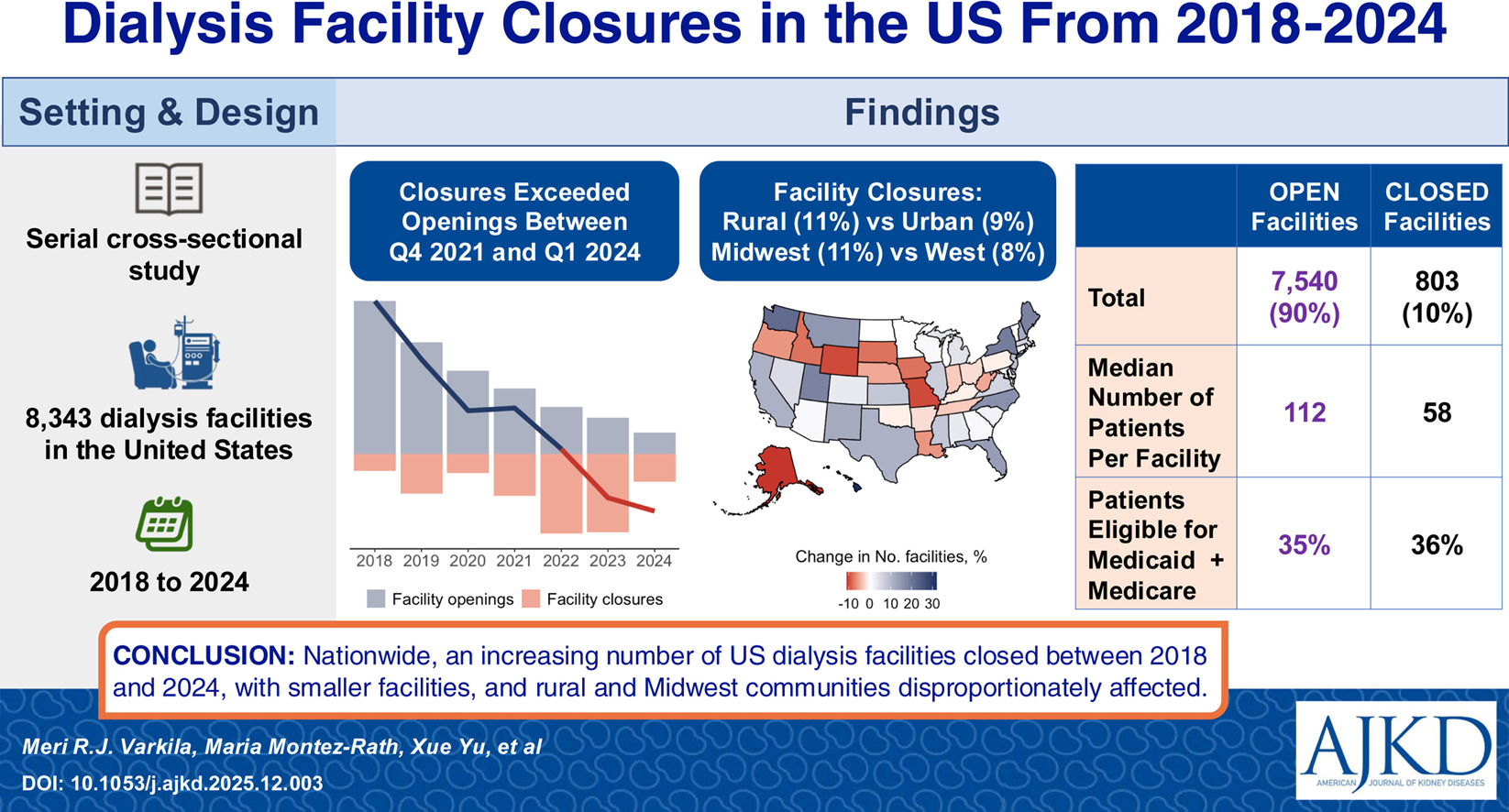
Dr. Varkila: Thank you for taking the time to read our work and the opportunity to share and discuss our findings. The period between 2006 and 2016 was a time of rapid growth in dialysis facilities where the industry was expanding to meet the needs of our aging population and rising rates of end-stage kidney disease. However, our study documents a reversal of this trend that began around 2018-2019 and accelerated after 2021. Whereas until recently, the number of dialysis facilities in the United States had been increasing, we found that since 2021, the number of closures exceeded the number of openings leading to a loss of facilities overall.
These changes are notable, because the number of Americans with kidney failure continues to grow. As you point out, however, the number of patients receiving dialysis has plateaued since 2019. The COVID-19 pandemic played a part in this, causing a substantial spike in deaths in our ESKD population in 2020 and 2021 that even in 2023 hasn’t fully reversed. However, it’s also worth noting that there has been a shift in treatment, where we’re seeing more patients on home dialysis and more preemptive kidney transplants. This changing landscape provides important context for the facility closure trends we’ve documented.
AJKD Blog: Can you explain “the bundle” to our readers? What changed in 2011 when CMS implemented the single bundled reimbursement for dialysis? What was the purpose of this change, and how did it affect the dialysis industry?
Dr. Varkila: Before 2011, Medicare paid for dialysis in a somewhat fragmented way, where there was one payment for the actual dialysis treatment and a separate payment for other dialysis-related services, such as laboratory tests and administered medications. This fee-for-service reimbursement model created incentives to increase services. The bundled payment system, which was implemented in 2011, changed this model by rolling all of these services into one single payment per dialysis treatment. The idea was to control costs, while also improving the quality of dialysis services by eliminating financial rewards related to overprescribing services and medications.
When “the bundle” was implemented, there were concerns that the bundled payment reform would cause costs that exceed reimbursement and force some facilities to close. However, the dialysis industry proved resilient and actual facility closures were quite rare. Instead, we saw many facilities change ownership.
AJKD Blog: Can you explain your methods and how you determined dialysis facility opening and closure? Most of our readers are familiar with the large organizations (DaVita and Fresenius); can you expand on the trends in these LDOs vs smaller dialysis facilities?
Dr. Varkila: Yes. We used CMS databases to track every dialysis facility from 2018 through 2024. We determined whether a facility had been operational during our study period based on the date that the provider’s CMS certification was initiated. If CMS certification was terminated during the study period, we counted that facility as closed from that date onwards. We then carefully verified that a facility truly closed and that we weren’t counting temporary closures, administrative changes, or mergers with another facility. This was important, because as mentioned before, in the years following bundled payment reform many smaller facilities were being acquired by LDOs. We wanted to distinguish between facilities that stopped operating entirely versus those that continued operating under new ownership, which was a common occurrence in the post-bundle era.
AJKD Blog: Moving now to the results, what did you find in the trends overall between 2018 and 2024?
Dr. Varkila: To us, the most striking finding is the increasing number of closures over time in relation to the number of new facilities being opened. Figure 1 in the paper illustrates this point and shows the drastic shifts in dialysis care during this period. Counting the number of facility closures over time, we found an increasing number of dialysis facilities closing annually. What makes this concerning is that the number of facility openings declined during this same period to the point where, as of late 2021, the closures exceeded openings. We’re, therefore, seeing an actual net loss of dialysis capacity in many parts of the country at a time when the number of Americans with kidney failure continues to grow.
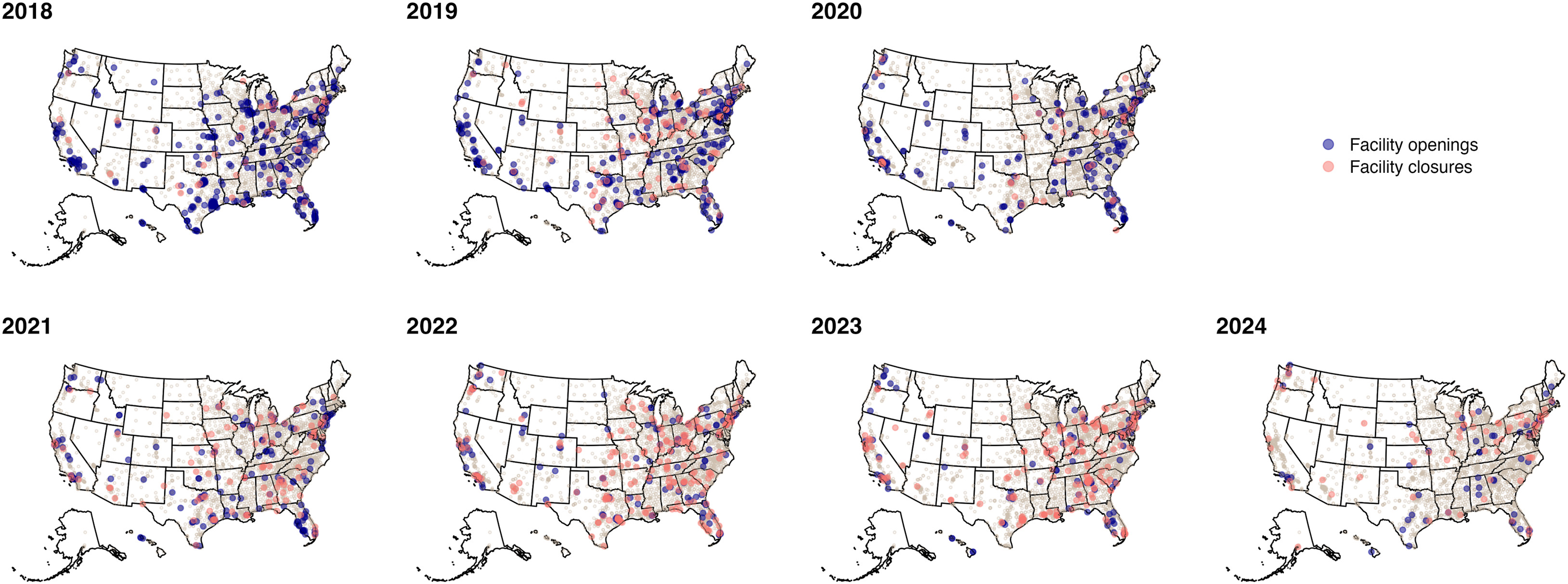
Dialysis facility openings and closures in the United States from 2018 through 2024. Blue dots indicate new facility openings, and red dots indicate closures. Beige circles indicate facilities that were operational throughout a given year. Closures exceeded openings starting in 2022, with the Midwest region experiencing the most closures: 10.8% of Midwest, 9.7% of South, 10.2% of Northeast, and 7.7% of West facilities closed during the study time period. Figure 1 from Varkila et al, © National Kidney Foundation.
AJKD Blog: Was there a geographic, ethnic, or socioeconomic trend to dialysis units that closed during this time?
Dr. Varkila: Yes, our results indicate facility closures didn’t affect all communities equally. Rural facilities closed at a higher rate than urban facilities, and closures were also happening more frequently in the Midwest compared to the West. We also found that facilities that closed were more likely to be smaller than facilities that remained open, both in terms of number of patients served and the number of dialysis stations per facility. This could point to different operational and financial pressures that smaller, rural facilities in the industry are facing.
Dialysis facilities that operated in neighborhoods where more than 60% of the patient population was Black also had higher closure rates compared to neighborhoods with other racial and ethnic majorities. We also saw that facilities that closed served a relatively higher number of patients with dual eligibility for Medicaid and Medicare compared to facilities that remained open, which could mean that patients at closing facilities had higher economic disadvantage.
AJKD Blog: You discuss not only the trends in facility closure, but also the impact on health outcomes as a result of this disruption of care. This seems like an obvious detrimental impact, but can you clarify further how these events directly affect a patient’s health?
Dr. Varkila: When we performed our study, the data to study health outcomes related to the wave of closures we describe were not yet available. Nevertheless, we wanted to highlight the impact of closures on health outcomes, because the consequences can be quite serious and go beyond simple inconvenience. These insights were based on the study team members’ first-hand experiences as practicing nephrologists and medical directors of dialysis facilities in the Bay Area, as well as data from previous studies.
When a facility closes, patients lose their established relationships with care teams who have spent months or years learning their individual needs and fine-tuning their treatment. These transitions can lead to disruptions to carefully balanced medication regimens, different cannulation techniques for vascular access that can cause complications, and psychological stress from losing the social support network that patients build with fellow dialysis patients and their care team over time. When patients have to drive a longer distance each way, three times a week, they’re also more likely to miss treatments, which increases the risk of dangerous health complications.
Previous research has shown that patients affected by dialysis facility closures experience increased rates of hospitalizations and an increased risk of death in the six months after a facility closure. For a population that already experiences higher rates of hospitalization and mortality compared to the general population, these additional disruptions can pose a serious threat to health and wellbeing.
AJKD Blog: What are some of the explanations for the trend of increasing facility closures in this country? What steps can be taken to address these issues?
Dr. Varkila: Our study was not set up to evaluate the underlying causes of facility closures, so I want to stress that the explanations we offer are based on speculation rather than actual data. The closure trend could be a sign of market adjustment to previous oversupply of facilities or a market prediction that demand for in-center dialysis stations will decline in the future. Facilities may also be facing declining profit margins and dialysis providers have reported significant increases in operating expenses and critical workforce shortages, particularly in the aftermath of the pandemic. Smaller facilities and facilities in rural areas may be particularly vulnerable to these pressures.
A first step to addressing these issues is to investigate whether small, rural facilities are continuing to face higher rates of closures and whether these trends are affecting patient outcomes. Small and rural facilities may need dedicated policy support to remain operational and deliver quality care.
To view Varkila et al [subscription required], please visit AJKD.org:
Title: Dialysis Facility Closures in the US From 2018 to 2024: A Serial Cross-Sectional Study
Authors: Meri R.J. Varkila, Maria Montez-Rath, Xue Yu, Nivetha Subramanian, Douglas K. Owens, Brian Brady, Geoffrey A. Block, Julie Parsonnet, Glenn M. Chertow, Shuchi Anand
DOI: 10.1053/j.ajkd.2025.12.003
Leave a Reply