
Highlights from the September 2026 Issue
Editor’s Note: We asked authors of Original Investigations to provide short plain-language summaries that would briefly summarize what inspired their study, the basic approach taken, what was learned, and why it matters. We hope our readers will find this valuable in helping them keep up with the latest research in the field of nephrology.
Highlights from the September 2026 issue:
Utility of Risk Scores for Predicting Stroke and Intracranial Bleeding Across Levels of Kidney Function in Two Large Community-Based Cohorts of Older Adults With Atrial Fibrillation by Nisha Bansal et al.
DOI: 10.1053/j.ajkd.2026.03.038
EDITORIAL: Weighing Ischemic Stroke and Bleeding Risks: Evaluating Discrimination and Calibration in Patients With CKD and Atrial Fibrillation by Ype de Jong et al. [FREE]
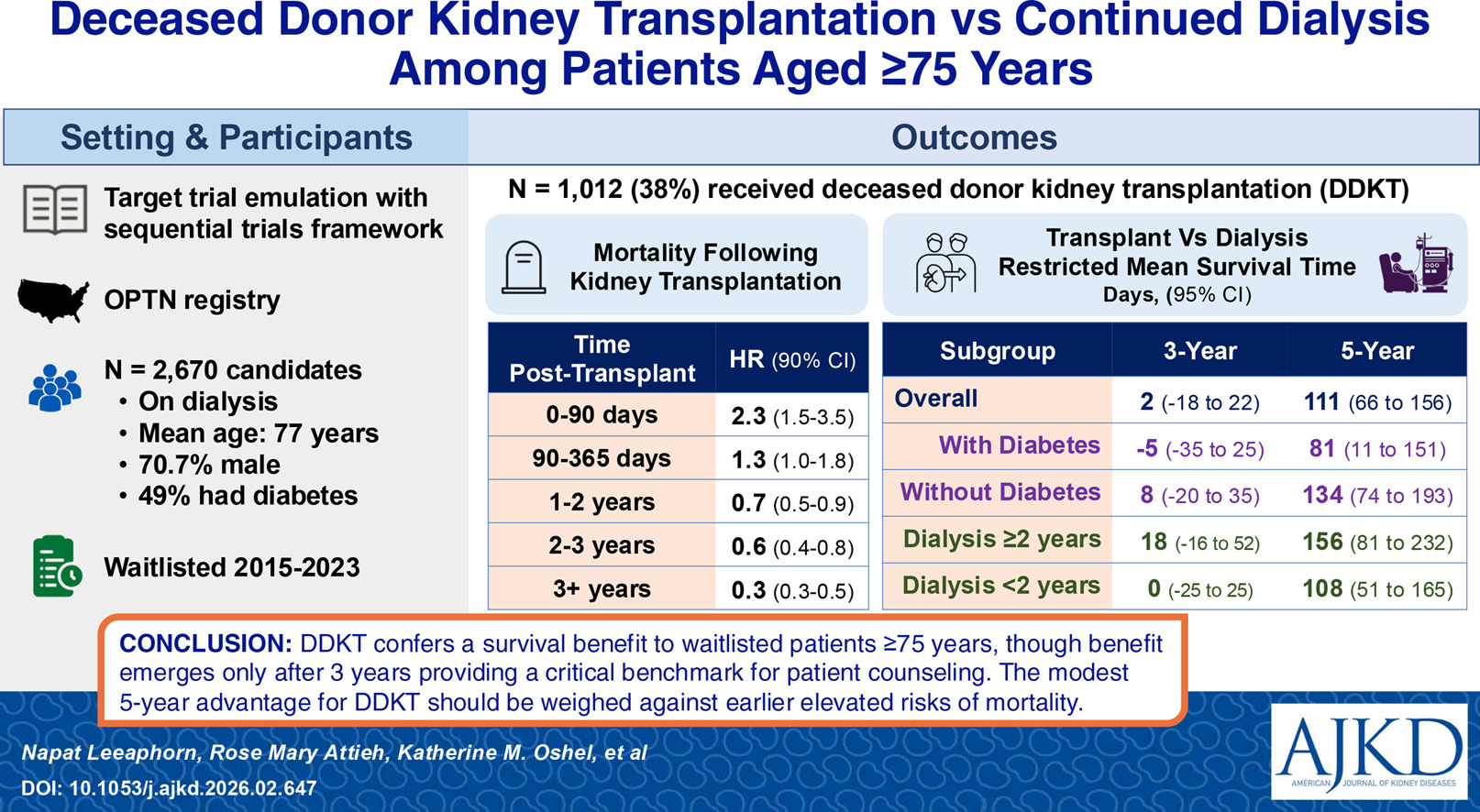
Deceased Donor Kidney Transplantation Versus Continued Dialysis Among Patients Aged 75 Years or Older: A Target Trial Emulation by Napat Leeaphorn et al.
From the authors: Kidney transplantation is the preferred treatment for kidney failure, but whether it benefits patients aged 75 and older remains unclear. Previous studies in this age group have been limited by biased methods. This study used target trial emulation to mimic a randomized trial using national registry data, allowing estimation of transplantation’s true effect on patient survival. We found that transplant recipients face a higher mortality risk in the first few months after surgery, but those who survive this early period live longer than patients continuing to receive dialysis. This survival advantage becomes clear after about 3 years of follow-up. These findings can help elderly patients and their nephrologists make more informed decisions and emphasize that age alone should not exclude patients from consideration for kidney transplantation.
DOI: 10.1053/j.ajkd.2026.02.647
EDITORIAL: Kidney Transplant Decision-Making for Candidates Over Age 75: Insights From Target Trial Emulation by Maria E. Montez Rath et al. [FREE]
Comparison of Specific Glucagon-Like Peptide-1 Receptor Agonists on Kidney Outcomes Among Patients With Type 2 Diabetes by Joshua J. Neumiller et al.
From the Authors: Chronic kidney disease (CKD) is a common complication of diabetes that increases the risk for poor health outcomes. Glucagon-like peptide-1 (GLP-1) receptor agonists were found to improve kidney outcomes in people with type 2 diabetes mellitus (T2DM) and moderate cardiovascular risk when compared with dipeptidyl peptidase-4 inhibitors and sulfonylureas. Although there has been no head-to-head comparison of individual GLP-1 receptor agonists, randomized controlled trials have suggested that there may be variation among members of this drug class on kidney disease outcomes. In this study, we tested whether there were differences in kidney outcomes when comparing individual GLP-1 receptor agonist medications. We found that semaglutide compared favorably to other drugs in the class and may represent the preferred GLP-1 receptor agonist for delaying or preventing CKD in this population.
DOI: 10.1053/j.ajkd.2026.04.007
EDITORIAL: Best in Class? The Comparative Effectiveness of Glucagon-Like Peptide 1 Receptor Agonists in Preventing Incident CKD Stage 3 or Higher by Allison Reaves and Mark Sarnak [FREE]
Kidney Outcomes After Contrast Exposure in Patients Recovering From Dialysis-Requiring Acute Kidney Injury: A Target Trial Emulation Study by Li-Chun Lin et al.
From the Authors: The effects of iodinated contrast on kidney function remain controversial and are even less well understood in patients recovering from acute kidney injury requiring dialysis (AKI-D). In this nationwide observational study using a target trial emulation framework, we evaluated adults with AKI-D whose recovery permitted discontinued dialysis. We found that patients who underwent contrast-enhanced computed tomography scans within 30 days of dialysis cessation were more likely to require dialysis again and to develop persistent kidney dysfunction compared with those who did not receive contrast. These findings suggest that kidney function may remain vulnerable after apparent recovery and support careful consideration of contrast use in this high-risk population.
DOI: 10.1053/j.ajkd.2026.03.045

Heat Stress and Kidney Injury in Taiwanese Farmers: Associations With Renal Artery Resistance and Urinary Acidification by Hsiao-Yu Yang et al.
From the authors: Outdoor workers face increasing risks to their kidney health as global temperatures continue to rise. In this study, agricultural workers were followed during a typical summer workday to examine how heat stress affected their kidneys. Before and after work, we measured their physical strain, renal artery resistance, kidney function, and several blood and urine biomarkers. We found that heat exposure was associated with impaired kidney function, urinary acidification, and inflammation. These results underscore the need for stronger protection, monitoring, and education for people working in hot environments as extreme heat events become more frequent.
DOI: 10.1053/j.ajkd.2026.04.008

Identification of Maintenance Dialysis Recipients in Administrative Health Data: A Systematic Review by Aislyn Shaw et al. [OPEN ACCESS]
From the authors: Administrative health data such as hospital records and billing information are often used to identify individuals receiving long-term dialysis. Different methods have been developed to identify these patients in the data, but it is unclear how accurate these methods are, and a critical assessment of the literature is lacking. We conducted a systematic review to compare the accuracy of these methods. We found that most methods were reasonably accurate, but many were tested using outdated data or were compared against a reference standard, which may not have accurately identified all patients. Our findings inform the development of more reliable methods for accurately identifying dialysis recipients in administrative data and for planning health care services.
DOI: 10.1053/j.ajkd.2026.04.009

Electronic Phenotype for Detection, Staging, and Subtyping of Acute Kidney Injury by Ning Shang et al. [OPEN ACCESS]
From the authors: Acute kidney injury (AKI) is a common and serious complication in hospitalized patients, but identifying and tracking it accurately in electronic health records is challenging. We developed an algorithm that uses patterns in kidney function test data to detect, classify, and distinguish AKI subtypes. After testing and validating the method, we applied it to 2 large hospital databases: one including patients hospitalized with COVID-19 and another including hospital admissions for any cause. Our approach reliably identified AKI and its association with poor outcomes. Patients with more severe or sustained AKI were more likely to die. This tool may help researchers study kidney injury more consistently across different health care settings.
DOI: 10.1053/j.ajkd.2026.04.010

Core Curriculum in Nephrology in the September 2026 issue:
Reproductive Health in CKD and Kidney Failure: Core Curriculum 2026 by Saieda A. Alleyne et al.
DOI: 10.1053/j.ajkd.2026.02.652
 On the Cover:
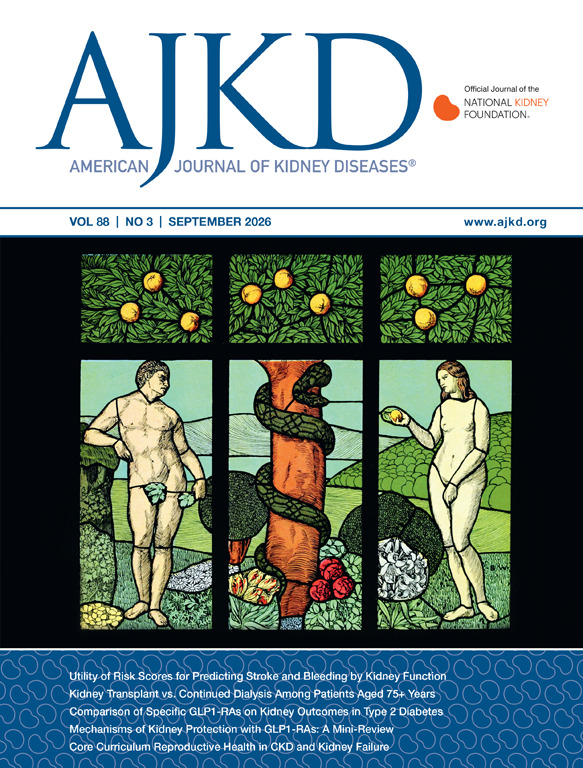
This stained-glass window design created by German artist Hans Christiansen, published in the journal Deutsche Kunst und Dekoration in 1898, depicts the biblical story of Adam and Eve. In 1987, researchers discovered that all human mitochondrial DNA types can be traced back to a single ancestral female lineage in Africa about 200,000 years ago, often referred to as the “Mitochondrial Eve,” the most recent woman whose unbroken maternal lineage persists in all living humans today. Mitochondrial DNA is passed down in an exclusively matrilineal fashion and does not undergo recombination. Mitochondrial DNA plays an important role in the pathogenesis of CKD. In this issue of AJKD, Pinzon-Cortes et al explore the various effects of mitochondrial alterations on CKD pathogenesis.
Special thanks to Editorial Intern Natasha Freeman for curating the cover image and drafting the cover blurb for this issue. The design for a stained-glass window by Hans Christiansen “Adam and Eve” was released into the public domain and is available via Wikimedia Commons
SPECIAL COLLECTION: HIGHLY CITED
The articles in this special collection highlight the top cited Original Investigations published in 2023 and 2024 that contributed to AJKD’s 2025 Impact Factor of 9.4.
Leave a Reply