
Creatinine vs Cystatin C: A Tale of Two Filtration Markers
Dr. Nicole Wyatt is a Clinical Assistant Professor in the Division of Nephrology and Hypertension at the University of North Carolina at Chapel Hill, where she specializes in the care of patients with glomerulonephritis and vasculitis. She completed her nephrology fellowship at Vanderbilt University Medical Center, followed by advanced clinical research fellowship training in glomerulonephritis and vasculitis at UNC-Chapel Hill. Dr. Wyatt’s academic interests focus on advancing the understanding and treatment of glomerular diseases through observational research and clinical trials. She is committed to providing compassionate, evidence-based care while contributing to the development of new therapies that improve outcomes for patients with glomerular diseases. Outside of work, she enjoys hiking, reading, exploring new places with her husband, and spending time with her dog and cat. Dr. Wyatt is a 2025-26 AJKD Editorial Intern.

Estimating kidney function is something clinicians do every day. Historically, nephrologists have relied on serum creatinine and its derived estimated glomerular filtration rate (eGFRcr) to assess kidney function, dose medications, and stratify patients by chronic kidney disease stage. A serum creatinine test is inexpensive, widely available, and deeply embedded in clinical workflows. However, it is well known that creatinine comes with some significant limitations. Cystatin C has emerged as an alternative filtration marker that is less dependent on muscle mass. Cystatin C based eGFR (eGFRcys) is becoming widely used across many areas of medicine in diverse settings. With this growing popularity comes questions regarding the appropriateness of using this biomarker in certain clinical situations.
One such situation involves the use of cystatin C in inflammatory states, where it is hypothesized that mechanisms involving inflammatory cells and cytokine-mediated increases in cystatin C production may elevate serum levels independently of glomerular filtration and reduce its accuracy as a marker of kidney function. A new study by Fukui et al. highlights this debacle by examining kidney function estimates in patients with active rheumatoid arthritis (RA) and offers a useful reminder of when these biomarkers can diverge. Many RA patients are sarcopenic, making eGFRcr an inaccurate representation of kidney function. On the other hand, eGFRcys may not be accurate in inflammatory conditions such as RA. This creates quite a conundrum in estimating the eGFR for this population and similar populations that are seen in nephrology clinics.
The Study
The study by Fukui et al. is a secondary observational analysis of the TARGET trial, a randomized clinical trial that was performed at multiple US institutions in active RA patients. The study evaluated different immunomodulatory treatments and followed longitudinal assessments of kidney function. Patients either received tumor necrosis factor inhibitor (TNFi) plus methotrexate or triple therapy (methotrexate, sulfasalazine, hydroxychloroquine). Participants had eGFR measured using both creatinine (eGFRcr) and cystatin C (eGFRcys) at baseline and during 24 weeks of follow-up. The authors also examined associations between kidney function estimates and inflammatory biomarkers related to RA disease activity.

Although there were several key findings in this study, for the purpose of this post it is important to focus on the comparison of eGFR measurements in this population. At baseline, eGFRcys (63 mL/min/1.73 m²) was substantially lower than eGFRcr (84 mL/min/1.73 m²), a difference of roughly 21 mL/min/1.73 m² (95% CI -24.7, -17.0) that could easily change CKD staging and influence clinical decision-making. Additionally, neither eGFRcr nor eGFRcys changed significantly over 24 weeks despite treatment and improvement in inflammatory markers, some of which were shown to be inversely associated with kidney function at baseline.
Unfortunately, measured GFR was not available, thus the study cannot determine which estimate better reflects true kidney function. Nevertheless, it highlights an important clinical reality that creatinine and cystatin C can tell very different stories and affect medical management in different ways in autoimmune conditions, including medication dosing, monitoring disease activity, and diagnosis of kidney involvement.
Why Creatinine Can Be Misleading
It is well known that creatinine is produced by skeletal muscle and eGFRcr is highly dependent on muscle mass on an individual level. When muscle mass is reduced, creatinine may give a reassuring eGFR and potentially overestimate true kidney function. On the other hand, when muscle mass is increased, such as in body builders, creatinine may underestimate the kidney function prompting possible unnecessary work up and therapy. There are certain other non-GFR factors that affect creatinine, including exogenous creatinine influence (i.e. creatine supplements, vegetarian diets), and medications that affect tubular secretion of creatinine (i.e. trimethoprim and cimetidine). Interestingly, studies have questioned whether creatinine generation is stable in certain situations such as acute illness and glomerular diseases, something that is generally assumed when using creatinine for eGFR.
Cystatin C Has Its Own Limitations
Cystatin C is a low molecular weight protein that is produced by all nucleated cells and is less influenced by muscle mass. It is filtered at the glomerulus and not reabsorbed, though it is metabolized in the tubules. Similar to creatinine, there are specific conditions that can lead to inaccurate measurements of kidney function when using eGFRcys. In inflammatory diseases like RA, chronic inflammation is thought to increase serum cystatin C independent of kidney filtration through mechanisms involving immune cells including macrophages and dendritic cells as well as cytokine-mediated upregulation of cystatin c levels.
Table 1. Non-GFR Determinants That Affect Creatinine And Cystatin C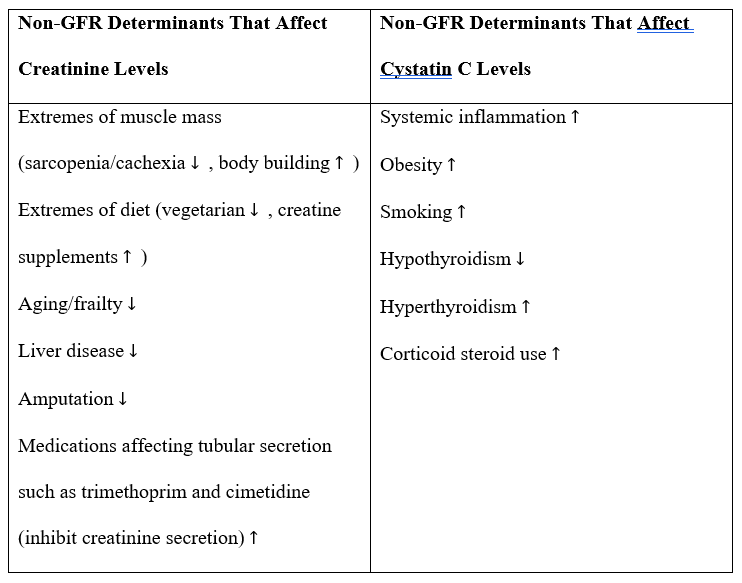
The Power of Using Both Markers
Given these limitations, certain patient populations, such as those with chronic inflammatory diseases like RA, present a clinical dilemma when determining which biomarker is more accurate, as both may be prone to inaccuracy. There is increasing evidence that suggests the combined creatinine–cystatin C equation provides the most accurate estimate of kidney function across diverse populations. In practice, large discrepancies between eGFRcr and eGFRcys should prompt clinicians to pause and consider the patient’s physiology:
- Is muscle mass unusually low or high?
- Is systemic inflammation or another condition that could affect accuracy present (Table 1)?
- Would the combined equation change clinical decisions?
Rather than competing biomarkers, creatinine and cystatin C may be best viewed as complementary.
When Should Clinicians Order Cystatin C?
Like with many biomarkers in medicine, the cystatin C wave has caught on across all specialties and care settings. Whether it is being checked in clinic or in acutely ill patients in the hospital, it is increasingly important to understand the clinical scenarios when it may be helpful to check a cystatin C and perhaps when it is not.
When eGFRcr is <60 mL/min/1.73 m² without albuminuria, cystatin C can help confirm or refute a CKD diagnosis.
2. Suspected creatinine bias
Consider cystatin C when there are factors present that may affect endogenous and exogenous sources of creatinine as noted in Table 1.
3. Drug dosing uncertainty
It may be important to consider checking cystatin C in the setting of a renally-cleared therapy with the potential for significant toxicities. Though clinical and pharmacokinetic data regarding drug dosing and cystatin C are lacking, there is evidence suggesting that cystatin C-based eGFR may be more predictive of drug levels/clearance than creatinine-based eGFR in certain situations. This needs to be further evaluated prior to widespread change of clinical practice to eGFRcys for drug dosing.
What This Study Teaches Us
The RA population provides an ideal example of why kidney function estimation can be challenging. Two opposing biological forces are present: Sarcopenia lowers creatinine. Inflammation may raise cystatin C.
Importantly, neither estimate changes meaningfully during RA treatment, despite improvements in inflammatory biomarkers. This suggests either that kidney filtration remained stable or that current estimation methods are insensitive to short-term inflammatory changes. As important as it is to recognize when creatinine is an inaccurate estimation of kidney function, it is just as important to understand how certain common non-GFR factors such as inflammation or obesity may inappropriately estimate cystatin C.
-Post prepared by Nicole Wyatt
To view Fukui et al [subscription required], please visit AJKD.org:
Title: Cystatin C and Creatinine–Based Estimated GFR and Disease Activity Biomarkers in Rheumatoid Arthritis
Authors: Sho Fukui, Lesley A. Inker, Leah M. Santacroce, Jon T. Giles, Katherine P. Liao, Joan M. Bathon, Daniel H. Solomon
DOI: 10.1053/j.ajkd.2026.01.014
Leave a Reply