
A Call for Better Cancer Screening Guidelines for Patients with Glomerular Disease
Dr. Natasha Freeman is an Assistant Professor in Nephrology, specializing in glomerular diseases, at Columbia University Irving Medical Center. She received her MD from the Columbia University Vagelos College of Physicians and Surgeons and a MS in Narrative Medicine from Columbia University. She completed her residency in internal medicine at Yale-New Haven Hospital, followed by her fellowship in general nephrology and advanced fellowship in glomerular disease at Columbia University Irving Medical Center. Dr. Freeman’s clinical and research interests focus on glomerular diseases and narrative medicine, with a particular focus on how chronic kidney disease affects patient identity. She is also passionate about nephrology education—she enjoys teaching trainees on the wards and in the classroom, served on the American Society of Nephrology Workforce and Training Committee, and helped to plan the Kidney Stars program for medical students and residents at ASN Kidney Week. In her free time, she can be found at the beach with a novel, on the tennis court, haunting NYC’s Broadway theaters, and wandering in Central Park. Dr. Freeman is a 2025-26 AJKD Editorial Intern.

Cancer screening is an often-overlooked topic in the nephrology clinic. In 2025, a systematic review including 5.5 million patients with chronic kidney disease (CKD) found a 35% higher risk of malignancy in those with an estimated glomerular filtration rate (eGFR) < 60 ml/min/1.73m2 compared to ≥ 60 ml/min/1.73m2. Another meta analysis found that it is albuminuria that may be the true driver of this increased cancer risk rather than reduced GFR. Currently, there are no CKD-specific cancer screening guidelines beyond what is routine for the general population. Our field does a little better for patients with kidney transplants, as the 2009 KDIGO guidelines supplement routine age-appropriate cancer screening with annual skin checks, more frequent pap smears, native kidney ultrasounds, and hepatic ultrasounds for at-risk groups.
There is some evidence that patients with glomerulonephritis (GN) have up to a two-to-three-fold increased incidence of malignancy compared to the general population and yet, due to a lack of high-quality data surrounding incidence, outcomes, and effectiveness of screening strategies, the 2021 KDIGO GN guidelines do not include recommendations regarding cancer screening needs specific to this population. Over the last 30 years, the end-stage kidney disease (ESKD)-free survival of patients with GN has increased considerably, by 46% from 1985 to 2014 in one Danish study . With more recent therapeutic advancements for glomerular diseases, we can expect that this trend will continue, making high quality data and effective screening guidelines more necessary than ever.
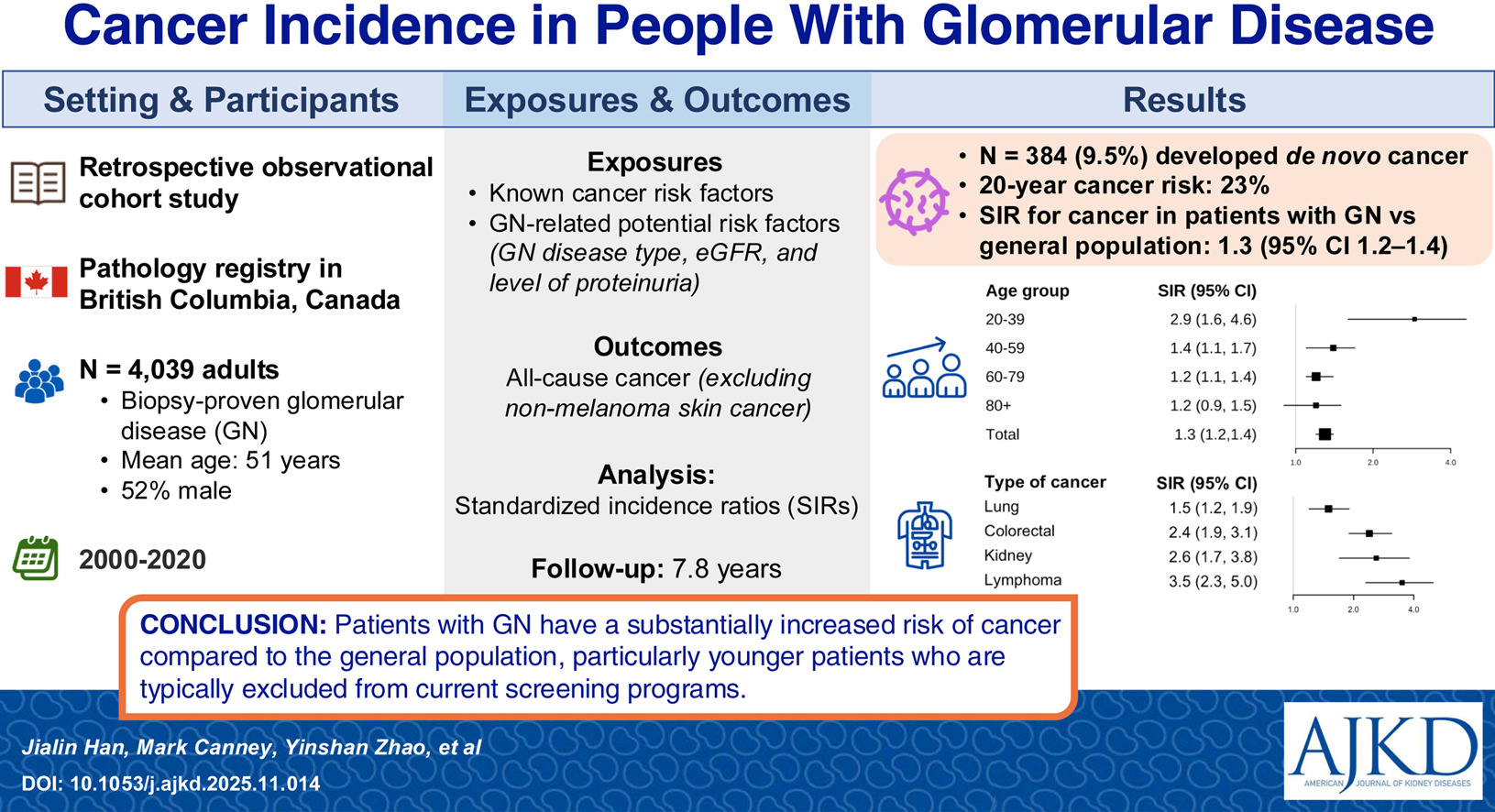
In a recent study published in the American Journal of Kidney Diseases, Han et al conducted a population-level cohort study to quantify the absolute cancer risk of patients with certain GNs compared to the general population and identify traditional and GN-specific risk factors for incident cancer in this population. They included 4039 patients with up to 21 years of follow up, drawn from comprehensive registry data in British Columbia. Patients had IgA nephropathy, focal segmental glomerulosclerosis, ANCA-associated glomerulonephritis, membranous nephropathy, lupus nephritis, and minimal change disease. Importantly, they were careful to exclude any patients with a prior history of malignancy to avoid capturing pre-existing or recurrent cancers, effectively screening out malignancy-associated secondary membranous nephropathy or other malignancy-associated glomerulonephritis.
In this cohort, they report a 20-year incidence of de novo malignancy of 22.9%, which is 30% higher than the age- and sex-matched general population. This risk was most pronounced in patients under 40 years old, who were nearly three times as likely to develop a malignancy than their age-matched counterparts. Lymphoma, kidney, colorectal, and lung (predominantly nonsmoking-associated) cancer were disproportionately represented compared to other types of malignancy (Figure 1).

Standardized incidence ratios by type of cancer. Figure 2 from Han et al, © National Kidney Foundation.
Risk factors that were associated with higher cancer incidence included: older age, male sex, non-white ethnicity (particularly East and South Asian ethnicity), smoking, hypertension, diabetes, dyslipidemia, previous cardiovascular disease, lower baseline eGFR (< 90 ml/min/1,73m2, proportional increase with decreasing GFR), focal segmental glomerulosclerosis, and lupus nephritis. Unfortunately, as they did not have access to individual-level data or treatment data, they were not able to assess the effect of immunosuppression on cancer risk.
The authors point out several discrepancies between the epidemiology of their findings and routine cancer screening guidelines for the general population, which exclude patients under 40 years old for most cancers, and do not routinely recommend screening for kidney cancer or lung cancer in non-smokers. This could leave a significant gap in screening of high-risk patients with GN. However, there are many factors that play into the benefits, harms, and costs of cancer screening tests and programs (Figure 2), and the authors appropriately call for future research surrounding the utility, cost-effectiveness, and appropriate strategies for cancer screening in the GN population.

Benefits and Risks of Screening Programs © Natasha Freeman.
Finally, cancer screening guidelines for patients with GN can only be effective if implemented systematically in nephrology clinics. In a 2009 survey in Australia and New Zealand of 131 nephrologists, 86% reported recommending cervical cancer screening, 75% breast cancer screening, and only 48% colon cancer screening for patients with CKD. Borrowing from the ESKD literature, a U.S. cohort study showed that only 11.6% of nearly half a million Medicare beneficiaries on dialysis were up to date with colon cancer screening. Some cited factors that negatively impact screening include competing clinical priorities, perceived reduced life expectancy of patients, and lack of definitive evidence showing benefit.
Han et al provide valuable insights into de novo cancer incidence in patients with GN. As our pharmacological toolbox grows with newer and more effective therapies, leading to longer ESKD-free survival for our patients with GN, understanding the epidemiology of cancer incidence in this specific population and developing screening programs that are both beneficial and not harmful will be a consequential factor in improving patient outcomes.
-Post prepared by Natasha Freeman
To view Han et al (Open Access), please visit AJKD.org:
Title: Cancer Incidence in People With Glomerular Disease: A Population-Level Study
Authors: Jialin Han, Mark Canney, Yinshan Zhao, Mohammad Atiquzzaman, Adeera Levin, Sean J. Barbour
DOI: 10.1053/j.ajkd.2025.11.014
Leave a Reply