
Chronic Kidney Disease Prevalence in Africa: An Interview
Chronic kidney disease (CKD) is a global public health concern, but its burden in Africa is poorly defined. George et al recently combined individual-level and summary data from multiple African countries to provide a more accurate and precise estimate of CKD prevalence. AJKDBlog’s Interviews Editor, Timothy Yau (@Maximal_Change), recently sat down with an author of the study, Ikechi G. Okpechi (@Ikokpechi), to discuss the implications of their research.
Dr. Ikechi Okpechi, PhD, is a researcher at the University of Alberta, Edmonton, Canada. He is a steering committee member of the International Society of Nephrology-Global Kidney Health Atlas (ISN-GKHA). He is founding member of the Chronic Kidney Disease in Africa Collaboration (CKD-Africa). He was former Chair of the ISN Fellowship Program.

AJKD Blog: Your paper focuses on chronic kidney disease (CKD) prevalence in the African adults. Can we start with a big picture snapshot of what we knew prior to your paper about these numbers and how they compared to the adult population worldwide?
Dr Okpechi: There have been varying reports on CKD prevalence in Africa. Some of these studies reported CKD prevalence as low as 2% and others as high as 41% in some countries. The main reason for this has been the differences in ways in which CKD has been defined and measured. Most of the studies have relied on a single measurement of serum creatinine and GFR estimation and very few had assessed GFR and urine albumin-to-creatinine ratio (UACR).
Our study analyzed data by pooling individual participant data (IPD) across African studies. This approach has major advantages over conventional meta-analysis given the latter’s reliance solely on aggregated summary data. Our study showed that the pooled prevalence of CKD in Africa (stages 1-5) was 13.7% (95% CI, 11.0-16.4), with the prevalence of advanced stages (stages 3-5) found to be 5.1% (95% CI, 4.3-5.8). Our findings are similar to global estimates and CKD prevalence estimates reported from other regions. For instance, the Global Burden of Disease CKD Collaborators recently reported global CKD prevalence to be 14.2%. Similarly, the United States Renal Data System (USRDS) also recently reported CKD prevalence in adults to be 14.0%. This, therefore, means that when assessed adequately, 14% is about the best current prevalence of CKD in many parts of the world.
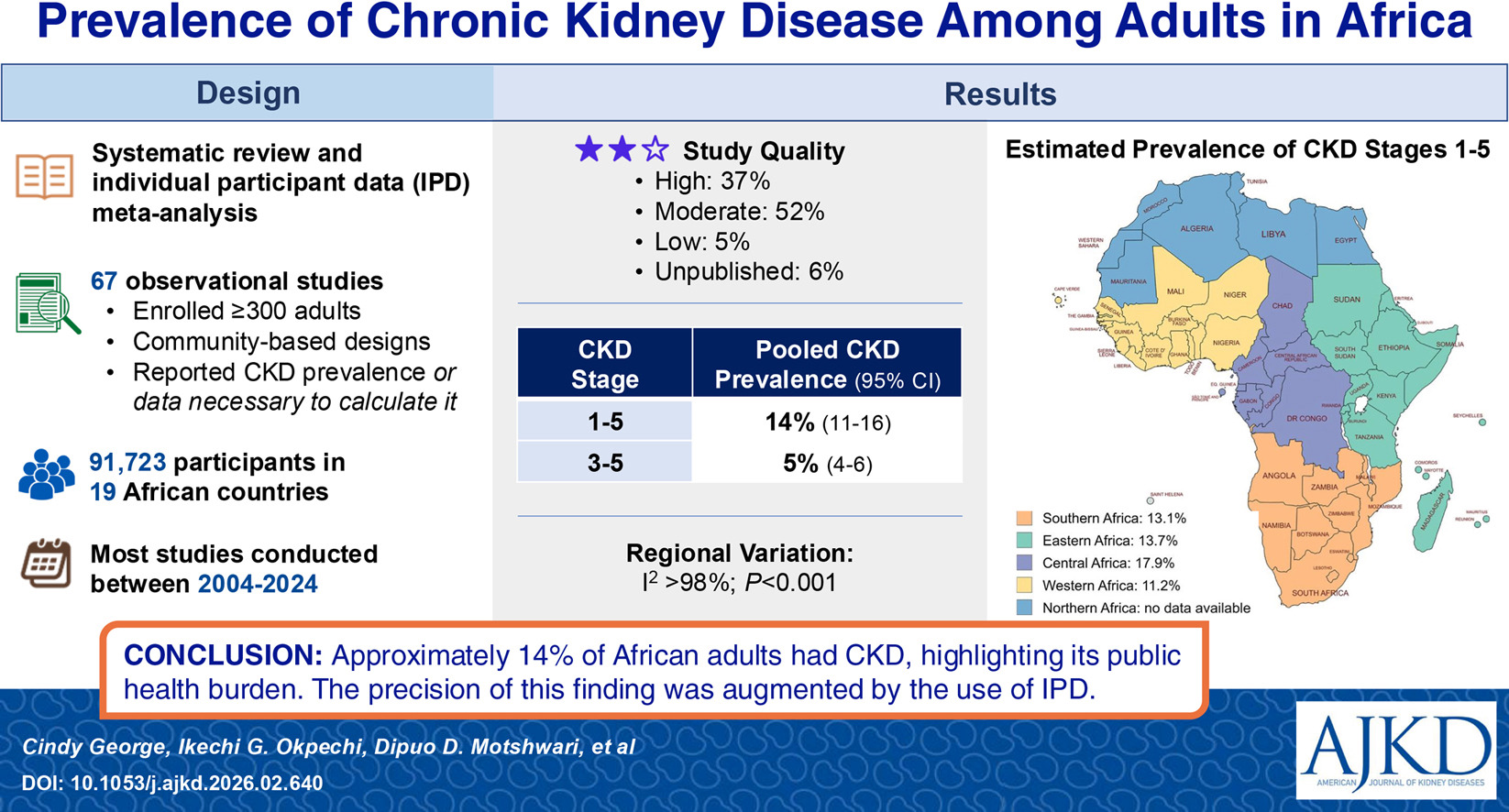
AJKD Blog: There also seem to be large regional differences in CKD prevalence (e.g. lower rates in Northern Africa, higher rates in Western and sub-Saharan Africa). What are some of the reasons for these variances?
Dr Okpechi: The observed inter-regional differences in CKD prevalence could be related to several factors including differences in burden of CKD risk factors, availability of early detection programs, cultural differences (e.g., use of traditional and herbal medications is very common in West Africa), access to affordable medicines to treat non-communicable diseases such as diabetes mellitus and hypertension, and healthcare coverage and delivery of services.
While diabetes mellitus and hypertension are common causes of CKD, many countries in sub-Saharan Africa also struggle with a high burden of communicable diseases such as HIV which can contribute to an increased incidence of kidney disease. Also, data from the International Society of Nephrology Global Kidney Health Atlas (ISN-GKHA) project have shown that access to affordable kidney care across the African continent is more readily available in North African countries. Other differences such as higher prevalence of APOL-1 genetic alleles among people of sub-Saharan Africa may also contribute to regional differences in CKD prevalence across the continent.
AJKD Blog: In the United States, much of what we know comes from the USRDS database, with an annual report summarizing trends and numbers. You mention the SAMRC (South African Medical Research Council) and CKD-Africa Collaboration, which aggregates data across the continent: can you tell us a bit more about these endeavors?
Dr Okpechi: The SAMRC is a South African National organization that conducts research on South Africa’s quadruple burden of disease: maternal, newborn, and child health; HIV/AIDS and TB; and non-communicable diseases and interpersonal violence to inform health policy and practice and improve the quality and health status of people in South Africa. Although similar organizations exist in other countries in Africa, there is not a lot of emphasis on CKD research in the region.
The CKD-Africa Collaboration (CKD-Africa) is an initiative of the Non-Communicable Diseases Research Unit of the SAMRC, tasked with compiling and meta-analyzing the best available data on kidney measures and clinical outcomes in the region (https://ckd-africa.samrc.ac.za/index.html). The goal of the CKD-Africa Collaboration is to pool IPD from existing African studies, to clearly determine the burden of CKD in the continent, provide reliable estimates to aid the development of policy solutions, and to aid the understanding of the mechanisms driving CKD across the African continent. CKD-Africa also aims to provide evidence that could inform health services planning and shape policy and guidelines in Africa, drive the agenda for expanding CKD research in Africa, and allow for discussions centred on standardization of approaches related to study design and kidney function measurements.
AJKD Blog: Moving on now to your study: how did you gather data, and how does this differ from the CKD-Africa Collaboration? How did you standardize the definitions of CKD across the meta-analysis?
Dr Okpechi: We gathered data via a comprehensive, systematic electronic search of major databases, including MEDLINE (via PubMed), EBSCOhost, Scopus, and Web of Science. After selection of studies, we matched the studies selected through the systematic search process to studies already available within the CKD-Africa database to identify those for which data were not yet available. For such studies, a request was sent via email inviting potential collaborators to contribute primary data for inclusion into the network and thus inclusion into this review. We ensured standard definitions for all included studies by following the Preferred Reporting Items for Systematic Reviews and Meta-Analyses (PRISMA) guideline to conduct this study. Hence, we had to ensure that selected studies used a similar definition of CKD based on Kidney Disease Improving Global Outcomes (KDIGO) guidelines as CKD being defined as either an eGFR of <60 mL/min/1.73m2 and/or urinary albumin-creatinine ratio (UACR) ≥ 3 mg/mmol or urinary protein-creatinine ratio (UPCR) ≥0.3 mg/mg. CKD staging 1-5 was also based on the same KDIGO guidelines.
AJKD Blog: Let’s talk a bit about the results. First off, how many studies and patients did you have in your final analysis after filtering an excluding for various reasons?
Dr Okpechi: After our search of the databases, we initially identified 6,620 articles whose titles and abstracts were screened for inclusion. From that number we screened the full text of 107 articles and further excluded another 43 and thus included 64 articles in our review. This represented a total of 91,723 participants who were included in the review, ranging from 307 to 10,524 participants per study overall, with 307 to 5,748 across IPD studies and 326 to 10,524 across aggregated data studies.
AJKD Blog: Let’s look at the prevalence of CKD by stage. Can you summarize the major findings here?
Dr Okpechi: The figure summarizes the estimated prevalence of CKD (stages 1-5), by geographic regions in Africa. The figure shows that CKD prevalence was highest in Central Africa (17.9%; data from Cameroon and Democratic Republic of Congo), with Eastern Africa (13.7%; data from Seychelles, Tanzania, Kenya, and Ethiopia), Southern Africa (13.1%; data from South Africa) and Western Africa (11.2%; data from Ghana, Cote d’Ivoire, and Burkina Faso) having lower prevalence rates.
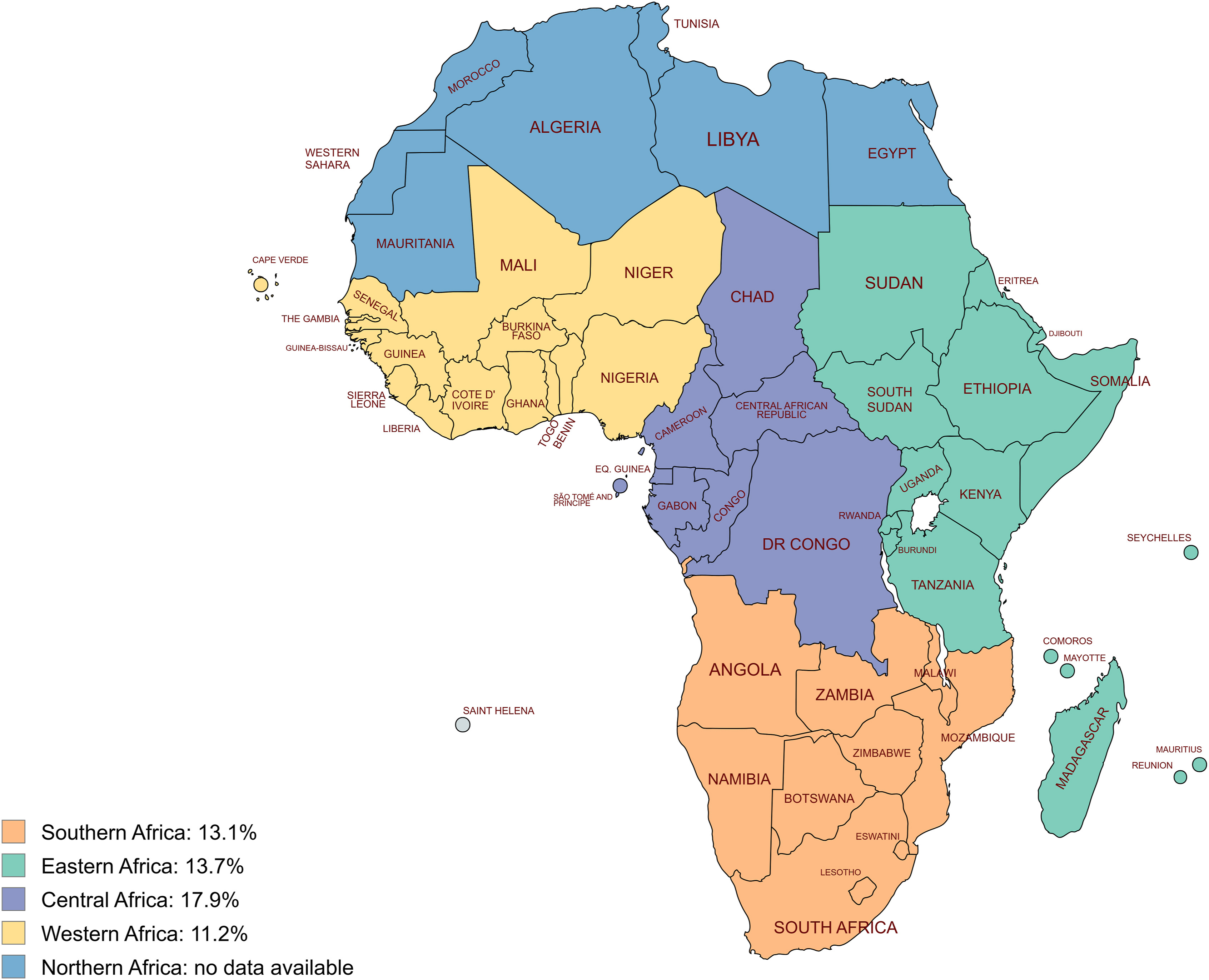
Estimated prevalence of chronic kidney disease (stages 1-5), by African Union geographical regions. The reported estimates for each region is presented by the following countries: Southern Africa (South Africa [n = 9]); Eastern Africa (Seychelles [n = 1], Tanzania [n = 1], Kenya [n = 2], Ethiopia [n = 1]); Central Africa (Cameroon [n = 3], Democratic Republic of Congo [n = 1]); Western Africa (Ghana [n = 2], Côte d’Ivoire [n = 1], Burkina Faso [n = 1]). Only studies reporting chronic kidney disease prevalence based on the CKD-EPI equation were included; studies reporting estimated glomerular filtration rate using other equations (eg, Modification of Diet in Renal Disease equation) were excluded if individual participant data were unavailable. Figure 2 from George et al, © National Kidney Foundation.
Dr Okpechi: As would be expected, fewer people in any population are likely to have more advanced CKD (stage 3 to 5) given varying rates of CKD progression, loss to follow up, and even death with early CKD stage. Our results are therefore similar to those from other parts of the world. The rate of advanced stage CKD (stages 3 to 5) from USRDS data is 5.6%. The difference in prevalence based on CKD-EPI and MDRD is well known. The MDRD equation is known to underestimate kidney function and is less validated and not very reliable in some population groups like the very elderly. The CKD-EPI equation is now utilized by the medical community for assessing eGFR to provide more equitable assessments for all patients. Using a reliable equation is also important for policy and planning as it provides a more accurate estimate of the population requiring intervention and care.
AJKD Blog: Your paper emphasizes that a national kidney registry would be beneficial to capture more data, and to allow for more targeted early intervention. Are there ongoing efforts or initiatives to turn this into reality?
Dr Okpechi: There have always been efforts from the kidney community in Africa to develop a kidney registry. As noted in our paper, some African countries such as Egypt, Tunisia, South Africa, Nigeria, Ghana, Libya, Algeria, and Morocco have previously initiated kidney registries, but in many cases, they have struggled to sustain them over time, primarily due to resource constraints. Only South Africa has had a sustained effort at keeping a kidney registry. There are ongoing efforts by the African Association of Nephrology (AFRAN) to sustain a continental registry which was initiated in 2015 to collect, analyze, and publish information on patients treated with chronic dialysis and transplantation. There has been a slow start with seven countries (Botswana, Burundi, Ghana, Kenya, Nigeria, South Africa and Zambia) currently participating in this initiative. It is hoped that the initiative will continue to grow and be sustained over time.
AJKD Blog: Final question: there are many barriers to effectively addressing CKD care, but what can be done from an individual, policy, or public health perspective to advance care for kidney health in Africa?
Dr Okpechi: Form an individual perspective, there is need to improve patient education and improve awareness of CKD risk factors and treatment. This will improve patients’ health seeking behavior and participation in their healthcare. It will also enable patients to understand the risk associated with use of herbal remedies which can often be nephrotoxic and to avoid such.
From a policy and public health perspective, it is important that CKD is recognized as a health priority in Africa, that each country develops CKD-specific policy or at least that CKD should be included in each country’s non-communicable disease (NCD) health framework. This will increase early detection programs for implementation of early interventions to prevent or retard progression of CKD. It will also compel governments to prioritize the availability of essential medications for the treatment of communicable and non-communicable diseases associated with CKD
To view George et al [Open Access], please visit AJKD.org:
Title: Prevalence of CKD Among Adults in Africa: A Systematic Review and Meta-Analysis
Authors: Cindy George, Ikechi G. Okpechi, Dipuo D. Motshwari, Suzaan Stoker, Min Jun, Sradha Kotwal, Segun Fatumo, Charles Agyemang, June Fabian, Tandi E. Matsha, Pascal Bovet, Mark Woodward, Andre P. Kengne on behalf of the CKD-Africa Collaboration
DOI: 10.1053/j.ajkd.2026.02.640
Leave a Reply