
After Remission, What Next? Rethinking Rituximab Strategy in Idiopathic Nephrotic Syndrome
Zohreh Gholizadeh Ghozloujeh, MD, is a research postdoctoral fellow in the Division of Nephrology at Loma Linda University School of Medicine. Her work focuses on rare kidney diseases, clinical research, and patient-centered outcomes, with a particular interest in improving care for patients with complex kidney conditions.

Sayna Norouzi, MD, is an Associate Professor of Medicine in the Division of Nephrology at Loma Linda University School of Medicine, where she directs the Glomerular Disease Clinic and Polycystic Kidney Disease Clinic. Her clinical and research interests include glomerular and other rare kidney diseases, with a focus on advancing evidence-based, patient-centered care through research and education.

For patients with idiopathic nephrotic syndrome (INS), reaching remission is often only part of the treatment challenge. The harder question comes next: once proteinuria improves and glucocorticoids are being tapered, should rituximab be reserved for relapse, or used more proactively to help keep remission in place? That question sits at the center of the multicenter cohort study by Laslandes et al.
Rather than revisiting the now familiar observation that rituximab can be effective in adult INS, the study takes on a more practical and clinically relevant issue: how best to use rituximab over time. That distinction matters because the field has already moved beyond asking whether rituximab has a role at all. In adults with frequently relapsing or glucocorticoid-dependent disease, rituximab is now widely regarded as a legitimate steroid-sparing option rather than a marginal or experimental one. The more relevant question is no longer simply whether rituximab is effective, but how it should be used: as rescue therapy at relapse, as a way to reduce cumulative steroid exposure, or as part of a more deliberate relapse-prevention strategy. Given nephrologists’ familiarity with it and its established place in current practice, rituximab will likely remain part of the therapeutic armamentarium for INS even as newer therapies emerge.
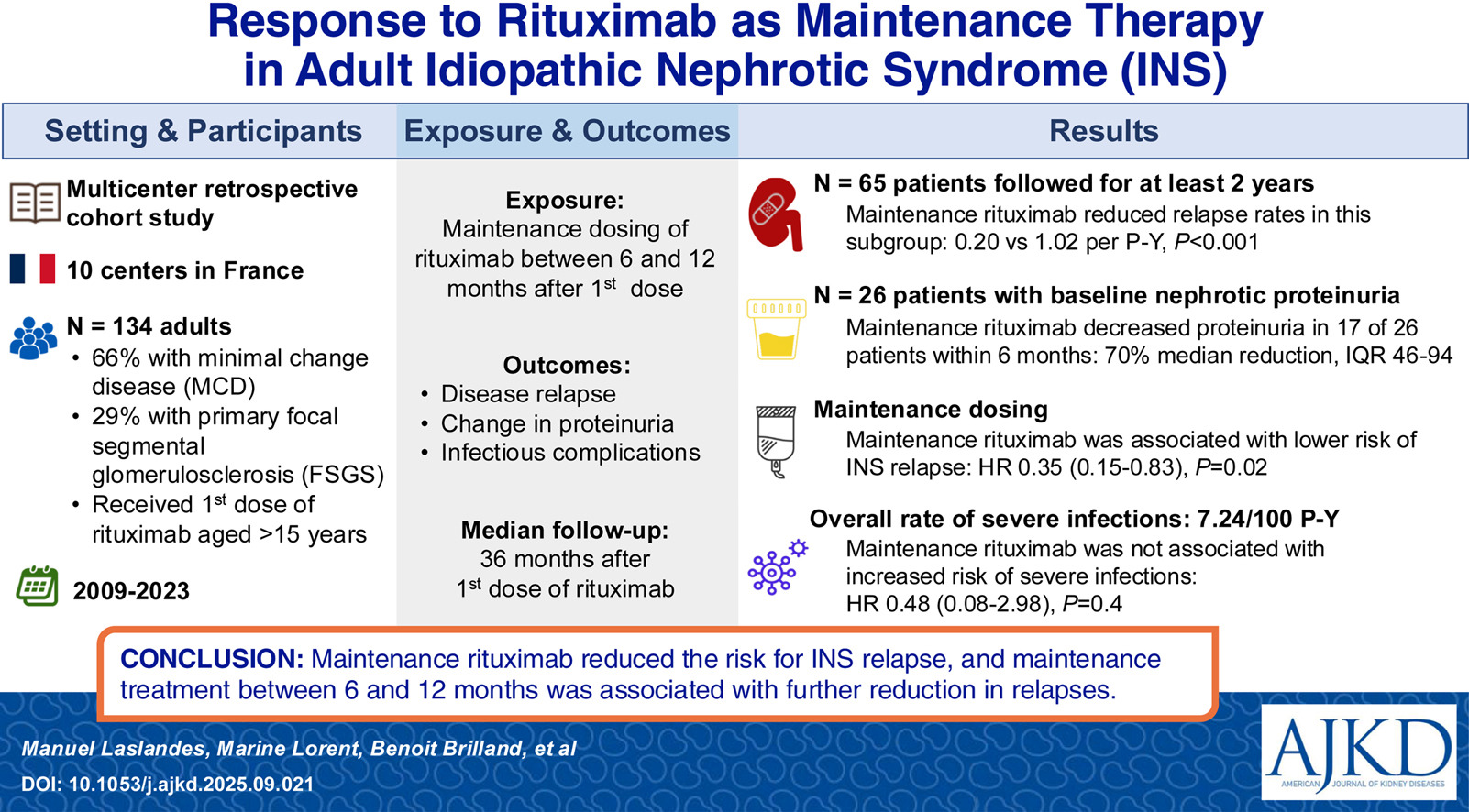
Laslandes et al. add meaningfully to that discussion. In a cohort of 134 adults with minimal change disease (MCD) and primary focal segmental glomerulosclerosis (FSGS), rituximab use was associated with fewer relapses and reduced exposure to corticosteroids and other immunosuppressive agents. Among patients who achieved remission, maintenance dosing between 6 and 12 months after the initial course was associated with a substantially lower subsequent relapse risk, with an adjusted hazard ratio of approximately 0.35 (95% CI 0.15–0.83; p = 0.02). Severe infection was similar between groups, although the study was not powered to exclude more modest safety differences.
These findings matter. They shift the conversation away from rituximab as episodic rescue therapy for INS toward a longer-term strategy of disease control. The analytic approach used by the authors makes their findings more convincing. The authors used marginal structural models to account for time-varying treatment and confounding, incorporating longitudinal changes in proteinuria, glucocorticoid exposure, and concomitant therapies. In a real-world setting, where retreatment decisions are inevitably shaped by perceived relapse risk, that is an important strength. It does not eliminate bias, but it goes beyond a simple observational comparison and gives greater weight to the association between maintenance dosing and reduced relapse risk.
Still, this is where the interpretation needs discipline. The study supports consideration of a maintenance-oriented strategy; it does not establish a universal maintenance standard. Rituximab retreatment was not protocolized, and decisions were left to treating physicians, creating substantial potential for confounding by indication. Patients selected for maintenance therapy may have differed in clinically important ways, including ongoing steroid exposure at the time of re-dosing, suggesting higher perceived relapse risk. Treatment timing, dosing regimens, and cumulative exposure were also heterogeneous, and key biologic markers such as B-cell reconstitution were not systematically incorporated. The statistical approach helps, but it cannot remove those limitations. What emerges is a strong signal, not definitive proof, that maintenance therapy itself is driving the improved outcomes.
The study also brings into focus a broader problem in INS research: biological heterogeneity. Grouping MCD and primary FSGS within a single INS framework is clinically practical, but biologically imprecise. MCD is typically highly glucocorticoid-responsive, whereas FSGS represents a more heterogeneous clinicopathologic entity in which steroid responsiveness has historically shaped therapeutic thinking and prognostic expectations. As the field evolves and nephrology moves toward greater precision and more individualized therapy, it will become increasingly difficult to justify uniform retreatment algorithms across podocytopathies.
For practicing nephrologists, the implications are therefore nuanced (Figure 1). These data challenge a purely reactive strategy in which rituximab is reserved only for relapse, particularly in patients with frequent relapses or high cumulative steroid exposure. At the same time, they do not justify routine fixed-interval maintenance dosing for all patients. A more reasonable reading is that retreatment decisions should be individualized, informed by clinical phenotype, relapse history, treatment burden, tolerance of prior therapies, and patient preferences, rather than determined by calendar time alone.
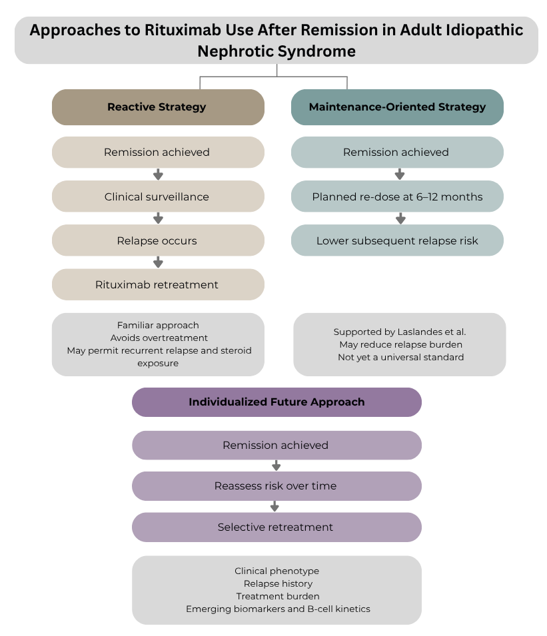
Figure 1. Conceptual approaches to rituximab retreatment after remission in adult idiopathic nephrotic syndrome. The figure contrasts a reactive strategy, a maintenance-oriented strategy, and a future individualized approach based on clinical risk and emerging biologic markers. © Ghozloujeh and Norouzi .
Looking ahead, the field is unlikely to settle on a one-size-fits-all maintenance strategy. A more plausible direction is risk-adapted or biomarker-informed retreatment. B-cell kinetics already influence practice in some settings, and emerging biologic markers may eventually allow a more precise assessment of disease activity and relapse risk. These tools are not yet ready to define routine care, but they point toward a future in which retreatment decisions are guided less by arbitrary timing and more by underlying disease biology.
The safety signal in this study also deserves careful interpretation. The absence of a detectable increase in severe infection is reassuring, but it should not be mistaken for proof of equivalence. Patients with nephrotic syndrome accumulate infection risk from multiple sources, including the disease itself, glucocorticoid exposure, and other immunosuppressive therapies. A strategy that reduces relapse frequency and cumulative glucocorticoid and other immunosuppressive exposure may ultimately improve overall safety, but that hypothesis still requires prospective validation. For now, relapse prevention and safety monitoring should be viewed as complementary goals rather than competing priorities.
Ultimately, this study is best understood as direction-setting rather than practice-changing. It does not resolve the question of whether maintenance rituximab should become standard in adult INS, but it reframes the problem in a more clinically meaningful way. The field is no longer focused simply on whether rituximab is effective, but on how it should be used once remission is achieved: specifically, in whom, when, and on what basis retreatment should occur. That is the question that will define the next phase of adult nephrotic syndrome management.
To view Laslandes et al [Subscription required], please visit AJKD.org:
Title: Response to Rituximab as a Maintenance Therapy in Adult Idiopathic Nephrotic Syndrome: A French Multicenter Cohort Study
Authors: Manuel Laslandes, Marine Lorent, Benoit Brilland, Hugoline Boulay, Léonard Golbin, Christelle Barbet, Jimmy Grellier, Amaury Dujardin, David Larmet, Angelo Testa, Pierre Pfirmann, Antoine Thierry, Simon Ville, Jacques Dantal, Christophe Masset
DOI: 10.1053/j.ajkd.2025.09.021
Leave a Reply