
Contrast Administration in Kidneys Recovering from AKI: Are They Safe?
Dr. Catalina Morales-Alvarez is an Assistant Professor in the Division of Nephrology at the University of Alabama at Birmingham. Her academic and clinical interests include home dialysis, nephrolithiasis, palliative care and conservative management in advanced kidney disease, and improving kidney care access and outcomes in underserved communities, particularly Latino populations. She is actively involved in medical education and fellowship mentorship.

Dr. Gabrielle Barthel is a recent graduate of internal medicine residency at the University of Alabama at Birmingham (UAB) now continuing training as a nephrology fellow at UAB. Her interests include home dialysis modalities, resistant hypertension, and the palliative care within the scope of nephrology.

Contrast-induced nephropathy (CIN) is a controversial and poorly understood phenomenon, but one of ongoing relevance as contrast media use and chronic kidney disease (CKD) populations continue to grow. Effective studies to date have been limited by the existence of numerous confounding factors that may precipitate acute kidney injury (AKI) among hospitalized patients as well as inconsistent definitions of CIN. Classically associated risk factors for CIN are repeat contrast administration within 72 hours, higher volume of contrast, and underlying CKD, especially with estimated glomerular filtration rate (eGFR) < 30 mL/min/1.73 m² as noted in radiology guidelines.
Ethical concerns also arise when designing placebo-controlled studies that would require withholding contrast administration otherwise required for standard of care. There have been limited investigations to date of contrast exposure, especially in some of the highest risk populations, such as patients recovering from AKI-requiring dialysis (AKI-D). AKI-D has been associated with higher mortality within four months relative to AKI not requiring dialysis, and this association persists even when compared to non-AKI causes of kidney failure. Similarly, AKI-D patients who progress to end stage kidney disease (ESKD) also have increased mortality. In the context of such a vulnerable population, minimizing risk of additional kidney injury will have a direct impact on patient outcomes (Fig 1).
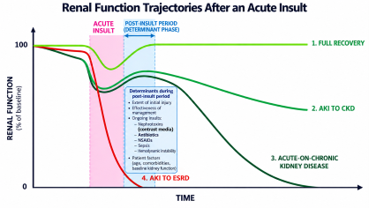
Nature history of AKI. Highlighting the important of the post-recovery period as an additional determinant of long-term outcomes. Adapted from Cerda et al, © Morales Alvarez and Barthel.
Lin et al. sought to address this gap in the literature by understanding the risk of contrast exposure in patients with AKI-D who have recovered kidney function. This was a target trial emulation (TTE) study using data from Taiwan’s National Health Insurance Research Database (NHIRD). Although the TTE design cannot overcome the observational and retrospective nature of the data, the NHIRD is overall well-equipped for such a study type, capturing more than 99% of all patient encounters for the country’s residents and linking laboratory, procedure, and diagnosis claims data together.
The study included adults in whom dialysis was discontinued after AKI-D and who successfully remained off dialysis for 30 days. Exposed patients underwent a contrast-enhanced computed tomography (CT) scan within these 30 days. Nadir SCr in the preceding year prior to hospitalization and 7-30 days post dialysis cessation defined the baseline and post AKI-D baseline, respectively. Lab data were followed for up to one year. Other baseline characteristics noted included demographics, comorbidities, and concurrent medications (angiotensin-converting enzyme inhibitors [ACEIs], angiotensin II receptor blockers [ARBs], diuretics, etc.). Progression to ESKD or resumption of dialysis defined the primary outcome. The secondary outcome was persistent kidney dysfunction, defined as an increase in SCr of at least 0.3 mg/dL or a 50% rise compared to post AKI-D nadir SCr. Statistical analysis relied on inverse probability of treatment weighting (IPTW) because the likelihood of receiving a contrast-enhanced CT is influenced by factors such as disease severity and comorbidities.
Of the 23,263 adult patients eligible for this study, 1,551 (6.7%) received contrast within 30 days. Patients with contrast exposure tended to be younger, have fewer comorbidities, present with sepsis, and require ICU admission or major surgery. In the follow-up period, contrast exposure was associated with a higher risk of resumption of dialysis (sHR 1.37, 95% CI 1.20–1.57) and persistent kidney dysfunction (sHR 1.11, 95% CI 1.01–1.23). Adverse kidney outcomes occurred at an eGFR below 36 mL/min/1.73 m² in the contrast-exposed group versus 22.8 mL/min/1.73 m² in the control group. Subgroup analysis revealed that patients with pre-existing CKD or not receiving ACEIs or ARBs were at increased risk of persistent kidney dysfunction. The researchers applied the same analysis structure in a separate multicenter hospital-based cohort of 1,496 adults with competing-risk regression, again showing similar, statistically significant associations for both outcomes. This second analyzed population was older and had a lower baseline eGFR than the cohort of the original analysis.
The strength of the authors’ work lies in a large population database with analysis and outcomes based on laboratory values rather than diagnostic codes alone, differentiating it from other retrospective observational studies. These data were collected in an exclusively Taiwanese population, but the overall robust dataset and replicated findings in a second inpatient cohort are encouraging for the generalizability of the data.

In addition, a TTE framework and applying IPTW in analysis certainly strengthen the causal inference of this study, but these are not replacements for true randomization and placebo-controlled trials. The built-in negative outcome controls of UTI and gastrointestinal bleeding were not associated with increased contrast exposure, but other more global assessments of frailty, functional status, or illness severity were not incorporated. These are unaccounted confounders of plausible strength significant enough to nullify the association of contrast exposure with worsened long-term kidney outcomes. Conversely, the authors note that even in a critically ill population likely most affected by muscle wasting, a lower SCr and overestimated eGFR would have favored a null hypothesis in a likewise vulnerable population of AKI-D patients, making the statistically worsened kidney outcomes with contrast exposure all the more notable.
CIN controversy aside, this study is an important call for thoughtful consideration of risks and benefits of any therapy or exposure that can precipitate further kidney injury, especially in patients already prone to nephropathy like patients with AKI-D. Given the anticipated barriers to a prospective placebo-controlled study, further research to better understand contrast’s relation to AKI and AKI-D recovery may be supplemented by assessments of cystatin C based eGFR as more reliable predictors of kidney function reserve, especially in ICU patients. Biomarkers of AKI are still not widely available in clinical practice, and there is no consensus on which set of biomarkers are most specific for AKI, let alone CIN; however, they may provide another avenue to better explore and understand contrast exposure’s association with AKI and kidney outcomes in AKI-D. Until then, this study should prompt clinicians to remain judicious in contrast use in AKI-D patients, perhaps even at a higher-than-traditional eGFR threshold. It remains to be seen if these associations with recovered AKI-D, contrast exposure, and worsened long-term kidney outcomes fade at a specified time interval, or if the route of contrast administration makes an impact.
To view Lin et al [Subscription required], please visit AJKD.org:
Title: Kidney Outcomes After Contrast Exposure in Patients Recovering From Dialysis-Requiring Acute Kidney Injury: A Target Trial Emulation Study
Authors: Li-Chun Lin, Thomas Tao-Min Huang, Yi-Ting Wu, Sufeng Chiang, Nai-Chi Teng, Likwang Chen, Vin-Cent Wu
DOI: 10.1053/j.ajkd.2026.03.045
Leave a Reply