
It Is Time to Accept Preeclampsia as a Risk Factor for Kidney Disease
Dr. Line Malha is a nephrologist and hypertension specialist in the Division of Nephrology and Hypertension at Weill Cornell Medicine, where she is also an Assistant Professor of Medicine in Obstetrics and Gynecology. She cares for women with hypertension and kidney disease before, during, and after pregnancy. Her research focuses on preeclampsia, with the goal of improving women’s kidney and cardiovascular health across the entire lifespan.

Preeclampsia is a complication of pregnancy, associated with long-term cardiovascular-kidney-metabolic (CKM) disease, but data on shorter-term kidney health are limited. The American College of Obstetricians and Gynecologists defines preeclampsia as new-onset hypertension (blood pressure ≥140/90mmHg on two different checks ≥4 hours apart) after 20 weeks of gestation with evidence of organ involvement such as proteinuria (≥300 mg/24h or protein-to-creatinine ratio ≥0.3), thrombocytopenia, renal insufficiency (serum creatinine >1.1 mg/dL or doubling), transaminitis, pulmonary edema, headache, or visual disturbances. Preeclampsia is further classified as having severe features when blood pressure reaches ≥160/110mmHg or there is organ involvement other than proteinuria, a distinction associated with worse pregnancy outcomes and higher long-term CKM risk. Preeclampsia is thought to be a mechanistically different process from gestational hypertension, which manifests as new-onset hypertension after 20 weeks without evidence of organ involvement. The pathophysiology of preeclampsia involves endothelial injury with downstream consequences for later CKM health, with no existing established biomarkers or dedicated preventive strategies [Figure 1]. From a nephrocentric perspective, podocytopathy and glomerular endotheliosis are well-documented features of preeclampsia, with proteinuria as a hallmark and, in severe cases, decreased glomerular filtration. Kidney involvement during preeclampsia has often been described as an inciting event that may explain the increased long-term risk of kidney disease and even end-stage kidney disease found in preeclampsia survivors.
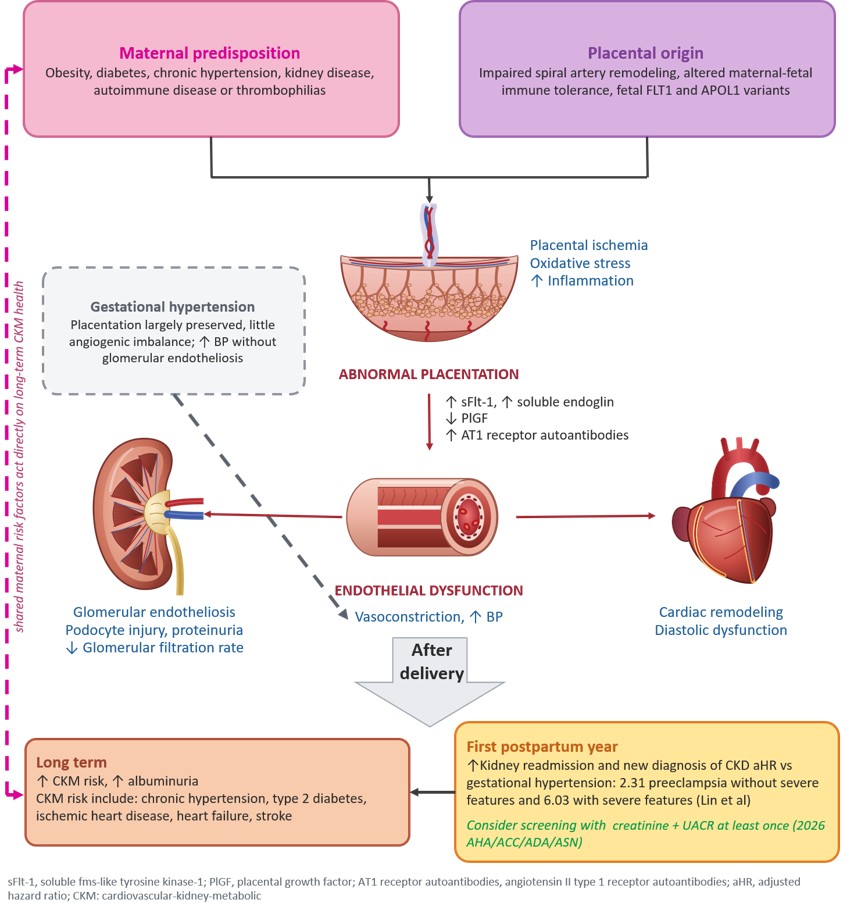
Figure 1. Preeclampsia as a window into maternal kidney and cardiovascular-kidney-metabolic (CKM) risk. Preeclampsia can arise from pre-existing maternal predisposition, from a primarily placental origin, or from both. Abnormal placentation releases antiangiogenic factors (high sFlt-1 and soluble endoglin, low PlGF) and AT1 receptor autoantibodies that cause systemic endothelial dysfunction, with glomerular endotheliosis, podocyte injury, with proteinuria and cardiac remodeling. Gestational hypertension raises blood pressure with little angiogenic imbalance and without identified organ involvement. Preeclampsia is associated with increased cardiovascular-kidney-metabolic risk in the first postpartum year and long term; many of these conditions are also risk factors for preeclampsia. Abbreviations: aHR, adjusted hazard ratio; AKI, acute kidney injury; AT1, angiotensin II type 1; BP, blood pressure; CKD, chronic kidney disease; eGFR, estimated glomerular filtration rate; GFR, glomerular filtration rate; GH, gestational hypertension; PE, preeclampsia; PlGF, placental growth factor; sFlt-1, soluble fms-like tyrosine kinase 1; UACR, urine albumin-creatinine ratio. © Malha.
A recent large database study by Lin et al shows that preeclampsia is associated with kidney disease leading to hospitalization even within the first year postpartum. Using the Nationwide Readmissions Database, the authors identified 3,425,221 deliveries complicated by a hypertensive disorder of pregnancy (gestational hypertension or preeclampsia) in females 15-54 years old between 2010 and 2020. The study included singleton pregnancies in patients without known kidney disease or hypertension. The outcome was non-fatal kidney disease hospitalization occurring in the calendar year after the index pregnancy, with subgroups of acute kidney injury and chronic kidney disease. The models were adjusted for maternal age, insurance status, income quartile, and hospital characteristics. The median follow-up was similar across groups at 6 months (interquartile range, 3 to 9 months). Readmission for any kidney disease was 246 per 100,000 delivery hospitalizations for those with recent gestational hypertension versus 407 for those with preeclampsia without severe features and 648 for those with preeclampsia with severe features. Compared with the gestational hypertension group, the preeclampsia group without severe features had an adjusted hazard ratio of 1.55 (95% CI, 1.41-1.71), and the preeclampsia group with severe features had an adjusted hazard ratio of 2.44 (95% CI, 2.23-2.68) [Figure 2]. The E-values (2.47 and 4.31; lower confidence-limit E-values, 2.17 and 3.89) suggest that only a relatively strong unmeasured confounder could fully explain the observed associations. The signal was strongest for chronic kidney disease (CKD) (22, 50, and 142 per 100,000 delivery hospitalizations across the three groups), with adjusted hazard ratios of 2.31 (95% CI, 1.70-3.13) and 6.03 (95% CI, 4.54-8.01) for preeclampsia without and with severe features, respectively. The comparator in the Lin et al study is gestational hypertension, not normotensive pregnancies. In the same database, the kidney disease readmission rate among deliveries without a hypertensive disorder of pregnancy or placental abruption was even lower, at 197 per 100,000. Because the study relied on ICD codes, which have low sensitivity for CKD, and captured only admissions, the true incidence and prevalence of kidney disease are likely higher. Diabetes, another major CKM risk factor, was neither excluded nor adjusted for, and may independently raise postpartum kidney readmission risk.
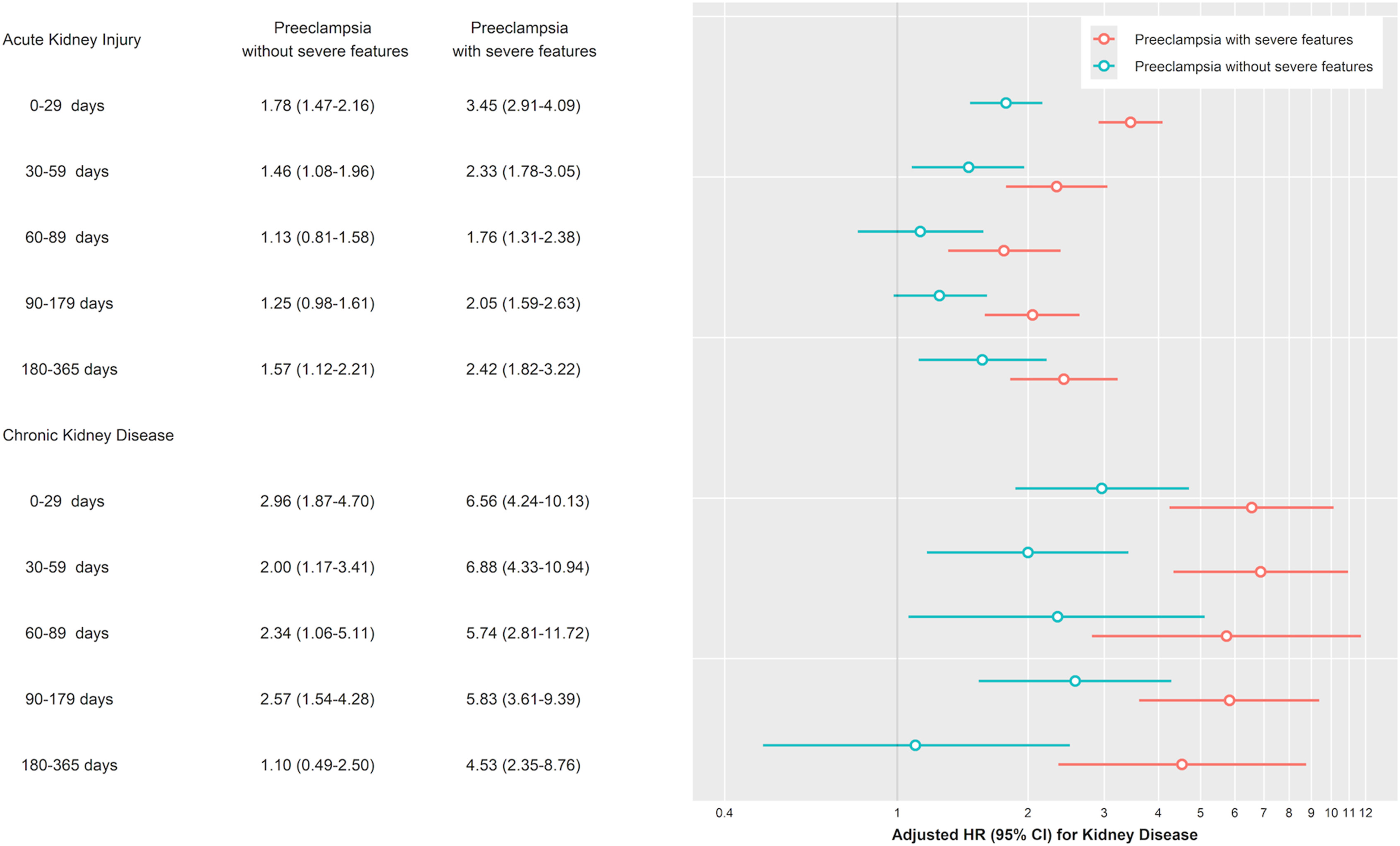
Association of preeclampsia with and without severe features compared with gestational hypertension 0-29, 30-59, 60-89, 90-179, 180-365 days after delivery for any acute kidney injury and chronic kidney disease (confounder-adjusted hazard ratio with 95% CI), Nationwide Readmissions Database, 2010 to 2020. Figure 2 from Lin et al. © National Kidney Foundation.
Despite repeated documentation of long-term vascular disease and altered endothelial function in preeclampsia survivors, especially those with severe or preterm preeclampsia, there is no established kidney-specific follow-up or preventive strategy. This is especially important for nephrologists, since preeclamptic pregnancies can serve as an opportunity to identify at-risk individuals who should be screened for kidney disease.Currently, no major US primary care organization endorses proteinuria screening in asymptomatic adults without risk factors (which do not include preeclampsia). Kidney Disease: Improving Global Outcomes (KDIGO) also targets screening to risk groups that exclude preeclampsia. In the United Kingdom, the National Institute for Health and Care Excellence recommends a urine dipstick 6-8 weeks after preeclampsia, with a kidney function review at 3 months only if proteinuria persists. The 2026 AHA/ACC/ADA/ASN CKM guideline recommends documenting estimated glomerular filtration rate (eGFR) at least every 5 years in all adults, but recommends annual UACR (urine albumin-to-creatinine ratio) only once metabolic risk factors or CKD are present, and lists adverse pregnancy outcomes as risk enhancers. The 2026 ASN Kidney Health Guidance on CKM advises postpartum reassessment of kidney function and albuminuria without a set schedule, and the AHA/ACC/ADA/ASN guideline recommends screening with serum creatinine and UACR at least once in the first postpartum year after any adverse pregnancy outcome. Beyond that, a patient with normal results returns to CKM stage 0 or 1, with eGFR checked every 2-5 years and no UACR. Lin et al data support the first year screening window and the authors advocate a 3-month urinalysis for all patients with preeclampsia. Most patients with preeclampsia are seen by a clinician in the first postpartum year: 79% attend an obstetric visit and 62% attend a primary care visit, with known racial disparities. Yet in one health system, only 26% had urine protein testing within 6 months of delivery.
The data presented by Lin et al. support advocating for closer follow-up and dedicated albuminuria and creatinine screening within the first year (preferably within 6 months) after delivery for preeclampsia survivors, especially those with severe features. Screening may not prevent hospitalizations, but it could enable earlier diagnosis of CKM disease and prompt the initiation of disease-modifying management. If pregnancy is viewed as a physiologic stress test, preeclampsia may either reveal previously unrecognized CKD or underlying CKD risk factors, such as hypertension, or directly injure the kidney. In either case, it is a marker of risk, and a reasonable case can be made for extending to these patients the annual eGFR and UACR testing recommended for CKM stage 2.
-Post prepared by Line Malha, MD
To view Lin et al [Open Access], please visit AJKD.org:
Title: Risks of Postpartum Kidney Disease Following Pre-eclampsia and Gestational Hypertension
Authors: Ruby Lin, Rachel Lee, Emily E. Daggett, Morgan C. Dunn, Emily B. Rosenfeld, Ruchira Sharma, Cande V. Ananth
DOI: 10.1053/j.ajkd.2026.04.016
Leave a Reply