
Why Physical Function Matters More Than We Think in CKD
Dr. Kashvi Gupta is a Clinical Research Fellow in the Division of Nephrology at the University of California, San Francisco. She completed her internal medicine residency at the University of Missouri–Kansas City and earned a Master of Public Health in Epidemiology from the University of Michigan. Her research focuses on reducing complications of high blood pressure and improving health outcomes in patients with end-stage kidney disease. Outside of work, she enjoys distance running and discovering new restaurants around the Bay Area. Follow her @kashvilunawat.bsky.social. Dr Gupta is a 2025-26 AJKD Editorial Intern.

Our ability to carry out daily activities is fundamental to our independence, quality of life, and disease self-management. Across many populations, poor functional status is an established predictor of healthcare utilization and mortality. However, its association with cardiorenal outcomes is less well defined. This gap is important to address as chronic kidney disease (CKD) care is increasingly focusing on patient-centered outcomes alongside traditional clinical measures. In a new study published in the American Journal of Kidney Diseases, Peschard et al. found that how patients with CKD feel and function physically are important predictors of outcomes.
Using data from the Chronic Renal Insufficiency Cohort (CRIC), the authors explored how baseline functional status and changes in functional status over time are associated with cardiorenal outcomes, including incident heart failure (HF), incident end-stage kidney disease (ESKD), and all-cause mortality. The authors used the Physical Component Summary (PCS) score from the Short Form-12 survey, which is a validated patient-reported outcome measure in patients with CKD. The PCS scores range from 0 to 100, with higher scores indicating better function.
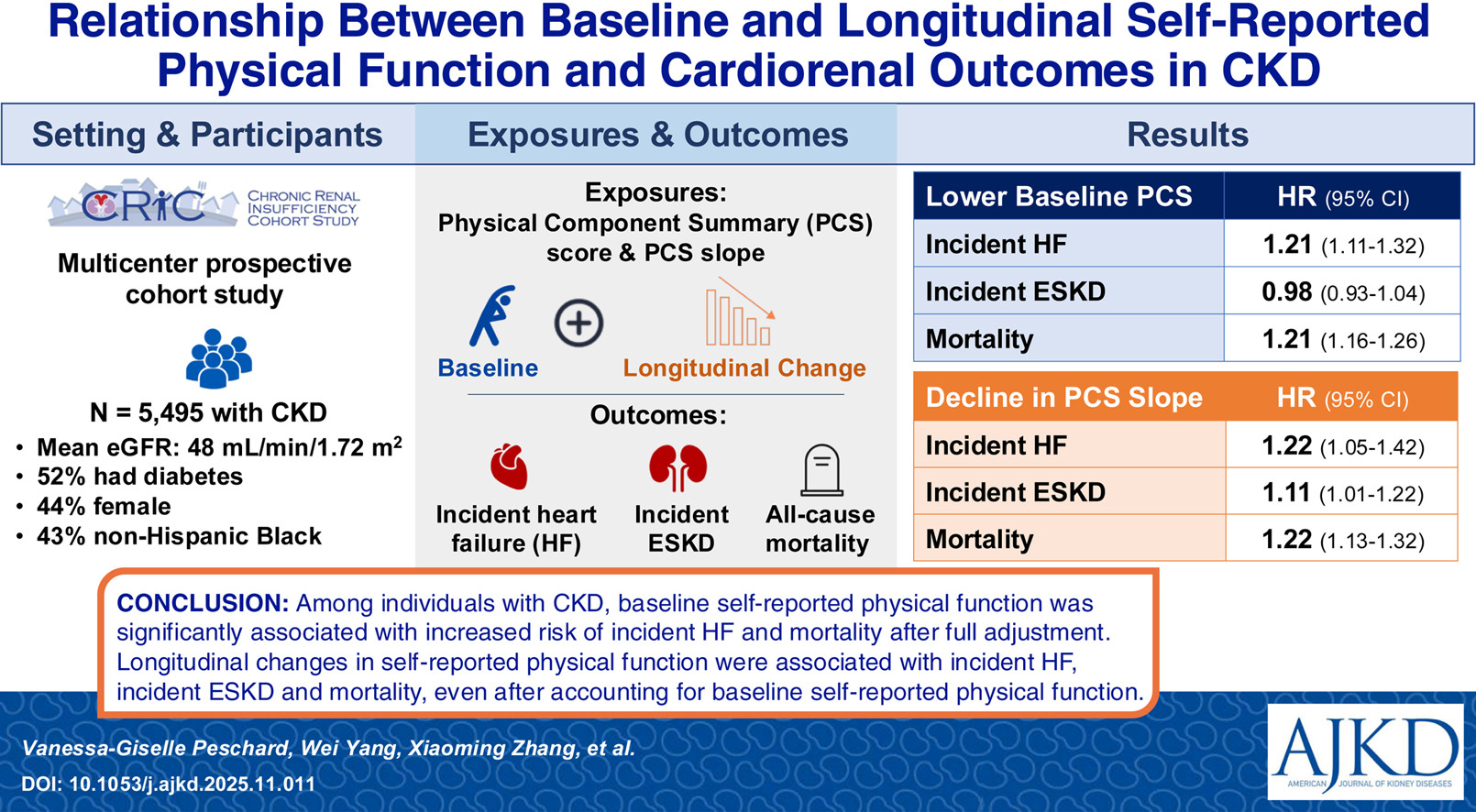
In a cohort of 5,495 CRIC participants with moderate to severe CKD (mean [SD] eGFR 48.1 [16.7] ml/min/1.73 m2), the average PCS score was 41, which is below the general population norm of 50, highlighting the burden of functional impairment in CKD. Patients with worse baseline physical function had significantly higher risks of incident HF (21% higher risk per 10-point lower PCS, after adjusting for baseline covariates), all-cause mortality (21% higher risk per 10-point lower PCS, after adjusting for baseline covariates), and incident ESKD; however, for ESKD, the association attenuated after full adjustment (see Figure).

Association of Physical Functional Status with Cardiorenal Outcomes in Chronic Kidney Disease Abbreviations: PCS, Physical Component Summary; CRIC, Chronic Renal Insufficiency Cohort; CKD, chronic kidney disease; HF, heart failure. © Gupta.
The most striking finding of their paper was that the trajectory of functional status matters. The authors found that a decline in physical function (by 4 points/year) was associated with a 22% higher risk of incident HF, a 22% higher risk of all-cause mortality, and an 11% higher risk of incident ESKD. Importantly, these associations were seen independent of the baseline function of the participants, which means that even patients with average functional status who declined over time were at higher risk.
Furthermore, even modest declines (2 to 4 points/year) carried prognostic significance. This suggests that subtle deterioration in functional status, which may be overlooked in the clinic, is an early warning signal.
Amidst all of this, one hopeful finding of the authors was that patients whose physical function improved over time had a ~20% lower risk of death. This raises an important question: Is functional status only a predictor of disease progression, or a modifiable risk factor?
Assessing functional status in routine CKD management can be easily implemented. For example, the questionnaire can be shared with patients before the visit electronically via their health portal or in the waiting room. As the study suggests that improving function can reduce incident HF and mortality risk, interventions such as exercise programs, physical therapy, nutritional optimization, and multidisciplinary care may not only improve the quality of life of our patients with CKD but also improve long-term outcomes.
As with any observational study, this study has limitations, which include residual confounding, biases in self-reported measures, and underlying diseases contributing to declines in functional status. Nonetheless, the consistency of their findings across the different outcomes strengthens the results.
In summary, since prior studies on functional status in CKD were focused on dialysis populations or single-time-point measurements, this study added an important dimension to CKD management. Functional status is a predictor of incident HF and all-cause mortality in patients with CKD, and importantly, a decline in functional status itself carries prognostic weight, beyond where patients start.
-Post prepared by Kashvi Gupta
To view Peschard et al (subscription required), please visit AJKD.org:
Title: Relationship Between Baseline and Longitudinal Self-Reported Physical Function and Cardiorenal Outcomes in CKD: Findings From the CRIC Study
Authors: Vanessa-Giselle Peschard, Wei Yang, Xiaoming Zhang, Michael G. Shlipak, Rebecca T. Brown, Navdeep Tangri, Alfonso Cabrera Lagunes, Mark L. Unruh, Jonathan J. Taliercio, Matthew R. Weir, Hernan Rincon-Choles, Jiang He, Jing Chen, Manjula Kurella Tamura, James P. Lash, Sarah J. Schrauben
DOI: 10.1053/j.ajkd.2025.11.011
Leave a Reply